

Planning the photograph before leaving home
I woke at 2:49 a.m. on August 28, 2026. Reaching the area around Quéribus required about two hours. The intended composition, however, had begun before the drive.
I used Stellarium Mobile Plus, Stellarium Web, and PhotoPills to study the eclipse timing, the Moon’s azimuth and elevation, its path, and its likely relationship with Quéribus Castle and the surrounding landscape. Those simulations helped me consider viewpoints and compositions before darkness made every decision slower.
The software could predict astronomical geometry. It could not predict the local clouds, substantial wind, incoming marine layer, visibility at a particular minute, or the practical condition of the terrain.
For the full preparation workflow, starting settings, focusing steps, and U.S. viewing times, see Senkōra’s guide to photographing the August 27–28, 2026 partial lunar eclipse. This Field Note begins where that planning guide ends: with what the light and terrain actually allowed.
Quéribus before dawn
Quéribus Castle stands on a rocky ridge in Aude, Occitanie, southern France. The fortress gave the Moon a clear landscape reference without requiring the frame to become a historical study. It was simply a strong, recognizable structure against a sky changing from night to dawn.
The first two selected photographs were made from a ridge east-northeast of the castle. Illumination was extremely low because it was still night and the Moon remained partly inside Earth’s shadow. Clouds crossed the view, the wind complicated the work, and dawn was approaching. A marine layer moved in around sunrise.
The ridge viewpoint required careful movement in darkness and was not a location to discover for the first time at night. Difficult ground should be scouted in daylight, approached only through authorized access, and abandoned if the composition asks for more risk than the photograph justifies.
NASA classifies the event as the August 27–28, 2026 deep partial lunar eclipse. It was seen on the evening of August 27 in much of the United States, while my session took place on the morning of August 28 in France. Greatest eclipse occurred at about 6:13 a.m. CEST (4:13 UTC). NASA reports that 96.3% of the Moon’s disk was inside Earth’s umbra at that moment. All four frames below were made after maximum, as the Moon was moving out of the shadow.
Four frames as daylight returned
The four photographs cover roughly 36 minutes. They do not form a fixed sequence from one tripod position. I changed viewpoints, focal length, camera, metering, and photographic intent while the sky and atmosphere also changed.
6:28 a.m.: Honor Magic V2 in very low light
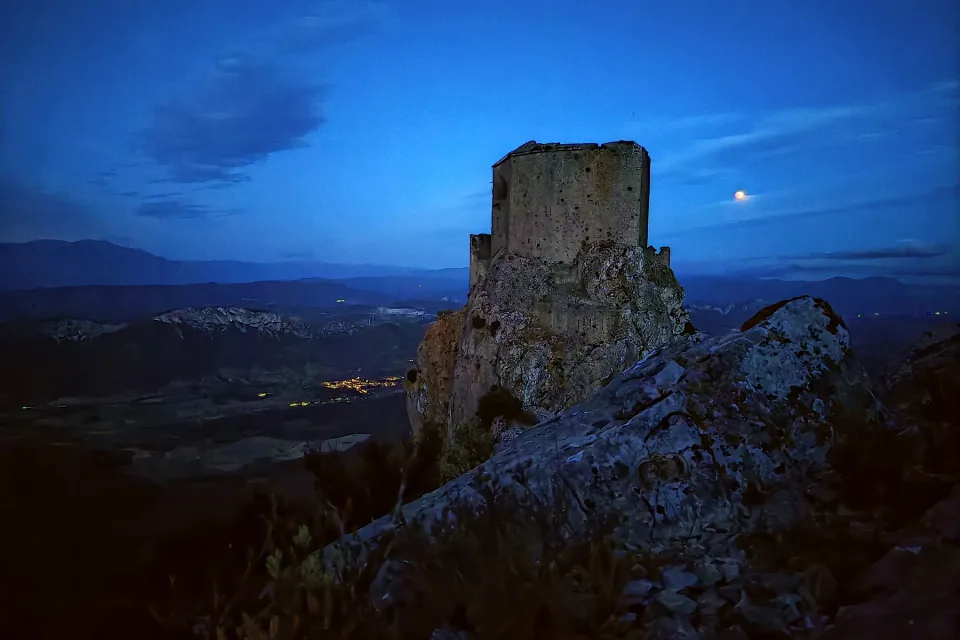
At 6:28:14 a.m. CEST, the Honor Magic V2 selected 1/6 second, f/1.9, and ISO 6400 with spot metering. Its 25mm-equivalent view placed the castle, Moon, rock, and broader landscape in one frame.
ISO 6400 is not a recommendation here. It records how demanding the light was for this phone and its automated exposure at that moment. The file also shows why the phone was useful as a secondary field camera: it was quickly available and offered a wider account of the place.
6:31 a.m.: Nikon D800, 30 seconds
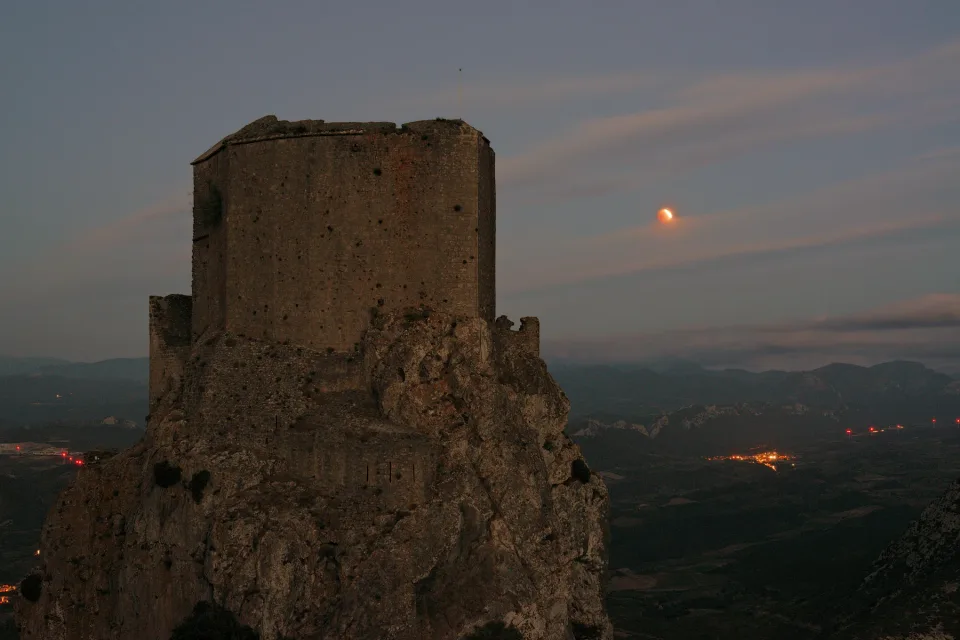
Three minutes later, the Nikon D800 recorded the main photograph with an AF-S Nikkor 50mm f/1.4G. The camera clock read 6:38:36 a.m., but it was seven minutes fast. The corrected actual time is 6:31:36 a.m. CEST.
The exposure was 30 seconds at f/16 and ISO 100, set manually with matrix metering. Those values belong to this landscape photograph, not to a standard lunar-eclipse recipe. The composition had to hold several different elements together: the fortress and rock, the Moon, distant lights, the last darkness, and the first signs of dawn. The 50mm view made the relationship between castle and Moon more explicit than the phone’s wider frame.
7:02 a.m.: the fortress becomes the subject
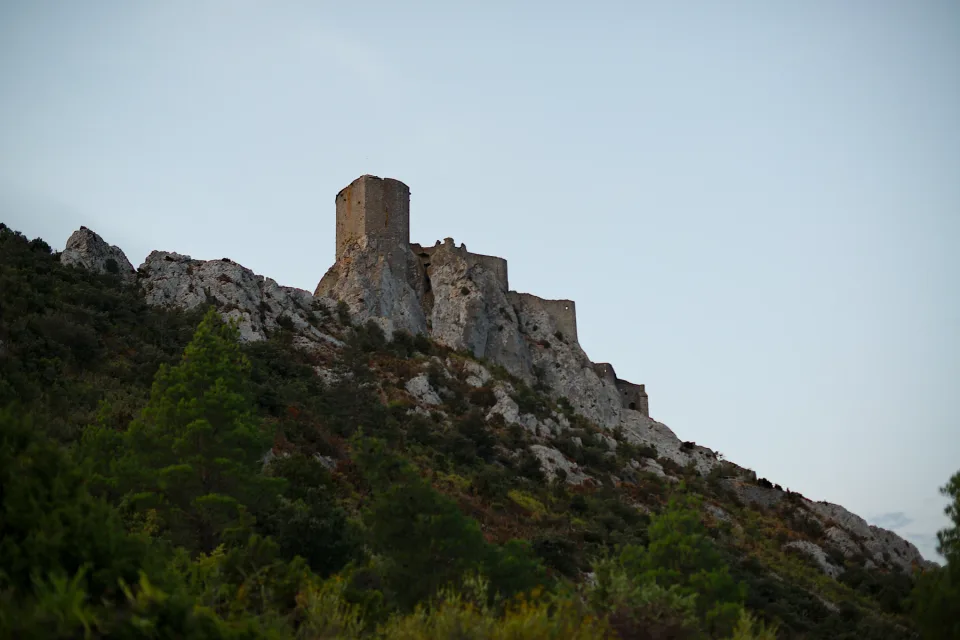
By the corrected time of 7:02:42 a.m. CEST, I had moved to the castle access path. The Nikon recorded 1/20 second at f/2.2 and ISO 100 in program exposure mode with matrix metering.
The Moon is absent, and that is part of the evidence rather than a failed eclipse photograph. As daylight increased and the viewpoint changed, the fortress and its setting became the subject. A field story about an eclipse does not require the Moon in every frame. The changing landscape can document how the event and the photographer’s attention developed.
7:04 a.m.: the phone after dawn gained ground
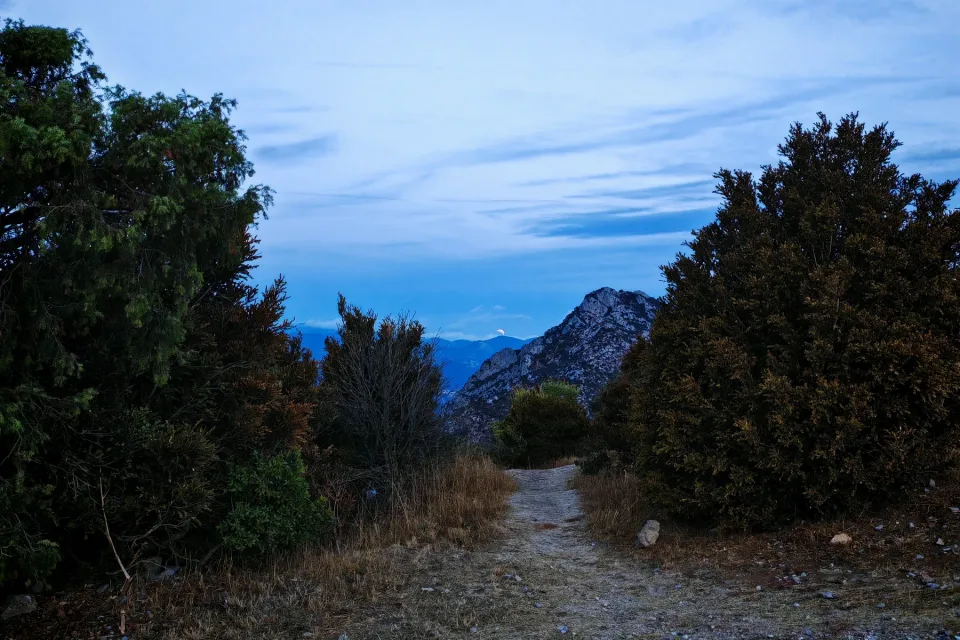
At 7:04:01 a.m. CEST, the Honor Magic V2 used 1/100 second, f/1.9, and ISO 320 with center-weighted metering. A path and vegetation frame the distant mountains, with the Moon very low above the horizon. Quéribus Castle is outside this composition.
The contrast with the 6:28 phone file is instructive: the shutter changed from 1/6 to 1/100 second while ISO fell from 6400 to 320. That illustrates rapidly changing exposure demands, but it does not measure a precise increase in scene brightness. Framing, metering, atmosphere, phone automation, and potentially computational processing all changed or may have changed between the files.
What the Nikon and phone each contributed
This was not a Nikon D800 versus Honor Magic V2 test. The images were not made at identical times, and the compositions, focal lengths, exposure modes, metering, viewpoints, and field conditions differ.
The Nikon supported deliberate 50mm framing, manual exposure for the main landscape, and an explicit long-exposure decision. The Honor offered a wider 25mm-equivalent view, fast access, automated exposure, and a practical way to document the session while moving between viewpoints.
Neither role establishes comparative image quality. The useful camera was the one that supported the frame I was attempting at that moment.
What an eclipse at Termes in 2015 had already taught me
I had photographed a lunar eclipse at Termes in southern France in 2015. That earlier experience exposed several problems that carried into the Quéribus planning: the Moon and landscape impose competing exposure demands, stability matters, and focal length changes the story. A wider frame establishes place; a longer focal length makes the lunar disk more prominent.
The 2015 session also showed that there is no universal eclipse exposure. Quéribus added different constraints: a deep partial eclipse, a low Moon, dawn arriving during the sequence, wind, clouds, a marine layer, a phone alongside the Nikon, several viewpoints, and light changing quickly enough to redirect the subject.
The value of the earlier attempt was not nostalgia. It reduced the number of assumptions I brought to the 2026 shoot.
Processing without manufacturing the event
The selected photographs were developed using Corel AfterShot Pro 3, Piccure+, and Corel PaintShop Pro. Documented adjustments included color temperature, lighting, sharpness with Piccure+, and detail enhancement. The main Nikon TIFF is a cropped and/or processed derivative of 800_9571.NEF; it is not a camera-original RAW file.
Processing should clarify what the camera recorded, not manufacture an eclipse that was not present. No Moon was moved or enlarged for this article, no sky was replaced, and no separate photographs were merged. The publication files are resized and, for the OpenGraph image, non-destructively cropped derivatives of the approved TIFF sources.
The transferable exposure lesson
Planning software put the Moon where I expected it. It could not hold the light still. Over 36 minutes, the Moon continued out of Earth’s shadow, dawn brightened the landscape, clouds and a marine layer altered visibility, the wind affected the work, and I changed both viewpoint and camera.
The settings therefore describe decisions, not prescriptions. Plan the geometry before the shoot, then expose for the light that actually exists when you get there.
Transparent evidence
Method and limitations
This Field Note is based on Philippe Contal's first-hand outing at Quéribus Castle on August 28, 2026, photographer-supplied field observations, recorded EXIF from four selected TIFF files, visual inspection of those files, and published astronomical and planning-tool sources. The Nikon camera clock was seven minutes fast, so its two capture times were corrected editorially. Publication images are resized derivatives of the supplied processed TIFFs; the source files were not altered.
- This was one photographer at one location, not a controlled camera, exposure, or image-quality comparison.
- Wind, clouds, and the marine layer were observed but not measured instrumentally; no temperature, wind speed, humidity, or cloud percentage was recorded.
- The selected files contain no GPS coordinates, and this article does not provide route instructions to the ridge viewpoint.
- The Nikon camera clock was seven minutes fast; 6:31:36 a.m. and 7:02:42 a.m. CEST are corrected actual times.
- All four selected photographs were made after greatest eclipse, not at maximum.
- Phone exposure includes automation and potentially computational processing; the four EXIF records are not universal recommended eclipse settings.
Five key takeaways
- Stellarium and PhotoPills established the Moon's expected position, but wind, clouds, and a marine layer still forced decisions in the field.
- All four selected photographs were made after maximum eclipse as the Moon left Earth's shadow and the ambient landscape became brighter.
- Nikon D800 and Honor Magic V2 exposure data changed substantially during the session, but the images were not made under controlled comparison conditions.
- The strongest frame came from balancing the Moon, fortress, landscape, and available light at that moment, not from copying a standard eclipse exposure.
- For a future eclipse, scout difficult terrain in daylight, plan more than one composition, and keep adjusting exposure as the sky changes.
Frequently asked questions
When was the August 2026 partial lunar eclipse at maximum?
NASA places greatest eclipse at about 4:13 UTC on August 28, 2026, which was about 6:13 a.m. CEST at Quéribus Castle. The event occurred on the evening of August 27 in much of the United States. All four photographs in this Field Note were made after maximum.
How much of the Moon was eclipsed in August 2026?
NASA reports that 96.3% of the Moon's disk was inside Earth's umbra at greatest eclipse. This obscuration figure describes area. It is different from the roughly 0.93 umbral magnitude, which describes the fraction of the Moon's diameter immersed in the umbra. The eclipse was partial, not total.
What settings were used for the Quéribus lunar eclipse photographs?
The four exposures ranged from 1/6 second at f/1.9 and ISO 6400 on the Honor Magic V2 to 30 seconds at f/16 and ISO 100 on the Nikon D800, followed later by 1/20 second at f/2.2 and ISO 100 on the Nikon and 1/100 second at f/1.9 and ISO 320 on the Honor. None is a universal eclipse setting because the light, framing, metering, and intended photograph changed.
Can you photograph a lunar eclipse with a smartphone?
Yes. The Honor Magic V2 recorded both the low-light eclipse landscape and the brighter conditions near the end of the session. Its automated exposure and potential computational processing mean the EXIF should be read as evidence of what the phone did for those frames, not as a repeatable recipe for every phone.
Is Stellarium or PhotoPills useful for lunar eclipse photography?
Both are useful for planning timing, direction, elevation, trajectory, and the intended relationship between the Moon and a foreground. They cannot guarantee local visibility, cloud behavior, wind, marine-layer conditions, safe terrain access, or whether the planned composition will still work in the available light.
Should you scout an eclipse photography location in daylight?
Yes, particularly when terrain is uneven, exposed, or unfamiliar. The ridge near Quéribus required careful movement in darkness and was not a location to discover for the first time at night. Use authorized access, understand local rules, and prioritize safety over a planned composition.
Was the Nikon D800 better than the Honor Magic V2?
This outing cannot answer that question. The cameras were used at different times, with different framing and metering, while conditions were changing. The Nikon provided deliberate exposure control and 50mm framing; the phone provided wider, quickly accessible documentation. They offered complementary evidence, not a controlled image-quality comparison.
Primary sources
- svs.gsfc.nasa.gov · Verified 2026-08-28
- science.nasa.gov · Verified 2026-08-28
- promenade.imcce.fr · Verified 2026-08-28
- stellarium.org · Verified 2026-08-28
- photopills.com · Verified 2026-08-28
- forteressesroyalesdulanguedoc.fr · Verified 2026-08-28