

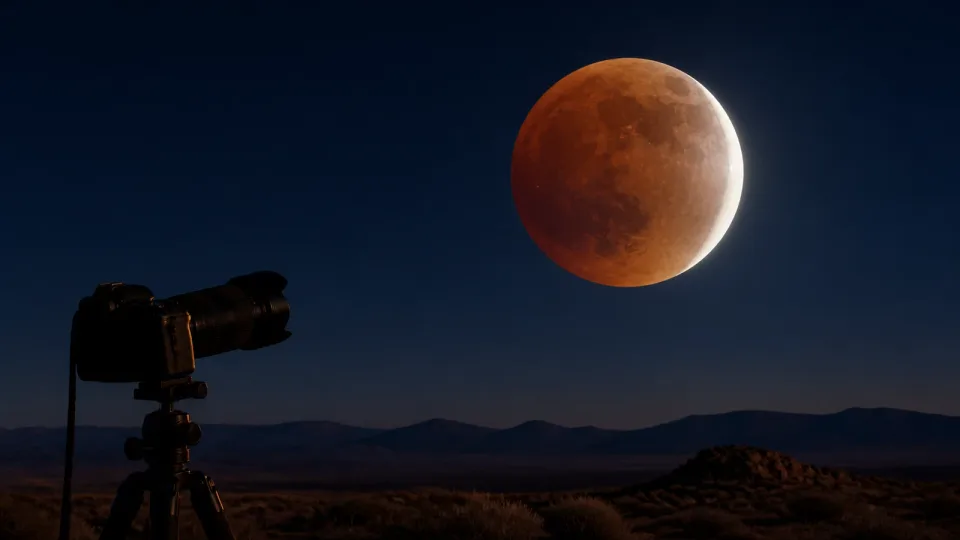
Interactive eclipse timeline
Preview the shadow before you set up
Drag the timeline or press play to see the partial phase. Times are rounded planning times for August 28, 2026 in UTC.
This is a planning visualization, not a simulation of lunar color or local sky position. Check the Moon’s altitude and weather for your exact location.
United States visibility map
Where the eclipse will be visible
The eclipse happens simultaneously nationwide. The clock time and the Moon’s height above the horizon are what change from place to place.
When the eclipse happens in U.S. time zones
NASA lists the eclipse as partial and visible from the Americas. Its catalog gives an umbral magnitude of 0.930 and places greatest eclipse near 04:14 UTC on August 28. The partial phase lasts about 3 hours 18 minutes.
The following rounded times are planning references. Dates are shown where the clock crosses midnight.
| Phase | Eastern (EDT) | Central (CDT) | Mountain (MDT) | Pacific (PDT) | Alaska (AKDT) | Hawaii (HST) |
|---|---|---|---|---|---|---|
| Penumbral begins | Aug. 27, 9:24 p.m. | 8:24 p.m. | 7:24 p.m. | 6:24 p.m. | 5:24 p.m. | 3:24 p.m. |
| Partial begins | Aug. 27, 10:34 p.m. | 9:34 p.m. | 8:34 p.m. | 7:34 p.m. | 6:34 p.m. | 4:34 p.m. |
| Maximum | Aug. 28, 12:14 a.m. | Aug. 27, 11:14 p.m. | 10:14 p.m. | 9:14 p.m. | 8:14 p.m. | 6:14 p.m. |
| Partial ends | Aug. 28, 1:52 a.m. | Aug. 28, 12:52 a.m. | Aug. 27, 11:52 p.m. | 10:52 p.m. | 9:52 p.m. | 7:52 p.m. |
| Penumbral ends | Aug. 28, 3:02 a.m. | 2:02 a.m. | 1:02 a.m. | Aug. 28, 12:02 a.m. | Aug. 27, 11:02 p.m. | 9:02 p.m. |
These clock conversions do not guarantee that every phase is visible from every location. Check the Moon’s rise, set, altitude, and direction for your exact observing site.
What 0.930 magnitude will look like
Umbral magnitude measures the fraction of the Moon’s diameter immersed in Earth’s dark inner shadow at greatest eclipse. A value of 0.930 therefore means nearly 93 percent of the diameter, not 93 percent of the apparent disk area.
At maximum, expect most of the lunar disk to look much darker, potentially with muted copper or red tones, while a narrow uneclipsed portion remains intensely bright. That brightness range is the main photographic challenge: an exposure that reveals color in the shadow can easily clip the bright edge.
Choose the composition before choosing the lens
A longer focal length is not automatically better. Choose among three practical approaches:
- Moon in the landscape: use a wider or moderate telephoto view to include terrain, buildings, or a foreground subject. Confirm the Moon’s direction and altitude in advance.
- Large lunar disk: use a stable telephoto setup, commonly in the 300–600mm full-frame-equivalent range, and leave room for drift and later cropping.
- Telescope or binocular projection: use only a secure camera or smartphone adapter designed for the instrument. Test alignment, balance, and focus before the event.
Binoculars are excellent for observing the changing shadow but do not automatically make phone photography easier. Handholding a phone against an eyepiece usually causes alignment, focus, and vibration problems.
Starting camera settings
There is no single correct exposure because the Moon’s brightness changes dramatically through the event and equipment varies. Start with a controlled workflow:
- Select manual exposure and RAW capture.
- Set a fixed white balance so the sequence remains visually consistent.
- Begin near your lens’s sharp working aperture rather than stopping down excessively.
- Use a low-to-moderate ISO for the bright phases, then raise it only when the shadowed Moon requires a faster shutter speed.
- Make a bracketed series and check the RGB histogram for clipping on the bright uneclipsed edge.
As a test point before the deep phase, try ISO 100–400, around f/5.6–f/8, and roughly 1/125 to 1/500 second, then adjust from the histogram. During the deepest partial phase, the shadowed surface may require substantially more exposure. Prioritize a shutter speed that controls lunar motion, wind, tripod vibration, and atmospheric softness.
Focus and stabilize the camera
Autofocus may work on the bright Moon before the eclipse deepens, but manual focus is easier to keep consistent across a sequence. Magnify the lunar limb on the rear screen or electronic viewfinder, focus carefully, and recheck after temperature changes or any contact with the lens.
Turn off long-exposure noise reduction if it would create gaps in a timed sequence. Stabilization behavior varies by camera and lens, so follow the manufacturer’s tripod guidance. Use an electronic or mechanical remote release, an intervalometer, or the camera’s self-timer to avoid touching the setup.
Protect the highlights during maximum eclipse
The narrow bright portion of the Moon can be several stops brighter than the surface inside the umbra. Do not judge exposure only from the rear-screen preview. Watch the highlight side of the histogram and make brackets that include:
- one exposure protecting the bright lunar edge;
- one or more longer exposures revealing the copper-toned shadow;
- a middle exposure for a natural-looking transition.
If you later blend exposures, disclose the composite treatment in the caption. A single frame with some shadow noise is preferable to an image whose bright edge has lost all texture.
Smartphone, binocular, and telescope options
For a phone-only landscape image, use the main camera rather than extreme digital zoom, lock focus and exposure if available, and support the phone on a small tripod. The Moon will remain relatively small without optical magnification.
For an eyepiece setup, use a rigid adapter that keeps the phone centered and square to the exit pupil. A small telescope can provide a larger image, but accurate tracking, balance, and focusing become more demanding as magnification increases. Practice on the ordinary Moon several nights before the eclipse.
Night-of checklist
- Confirm local weather, cloud cover, and the Moon’s altitude.
- Arrive with a clear view toward the Moon’s path.
- Level and secure the tripod before darkness.
- Charge batteries and clear memory cards.
- Synchronize the camera clock and set a fixed white balance.
- Focus before the deep partial phase and tape the focus ring only if it can be done safely.
- Run a short bracket and interval test.
- Leave framing margin for lunar drift.
- Keep a dim red light available without shining it toward other observers.
- Pause occasionally to observe the eclipse directly.
Unlike a solar eclipse, this event presents no direct solar-viewing hazard. You can look at the Moon normally and use ordinary binoculars, telescopes, and camera lenses without a solar filter.
After the eclipse: what changed in the field
For a first-hand account made after maximum eclipse, see the Quéribus Field Note. Four real Nikon D800 and Honor Magic V2 exposures show how dawn, clouds, wind, a marine layer, and changing viewpoints turned the planned settings into continuous field decisions.
Recommended gear
Find your next piece of gear
Find the setup that fits your plans, then explore prices and buying options on Amazon.
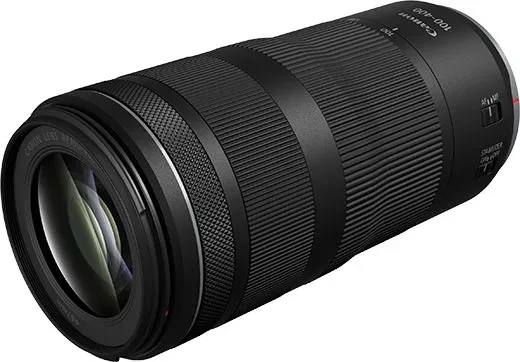
Canon
Canon RF100-400mm F5.6-8 IS USM
The Canon RF100-400mm provides long wildlife reach in a 635 g RF-mount lens. It fits both full-frame and APS-C EOS R cameras and uses optical stabilization for steadier framing.
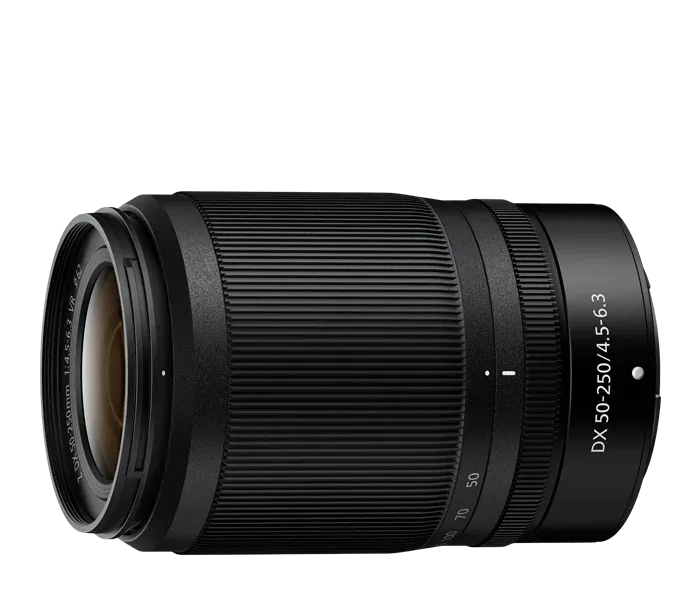
Nikon
Nikon NIKKOR Z DX 50-250mm f/4.5-6.3 VR
The NIKKOR Z DX 50-250mm adds a retractable, optically stabilized telephoto to a Nikon DX travel kit. It complements the shorter DX 16-50mm without the bulk of a large wildlife lens.
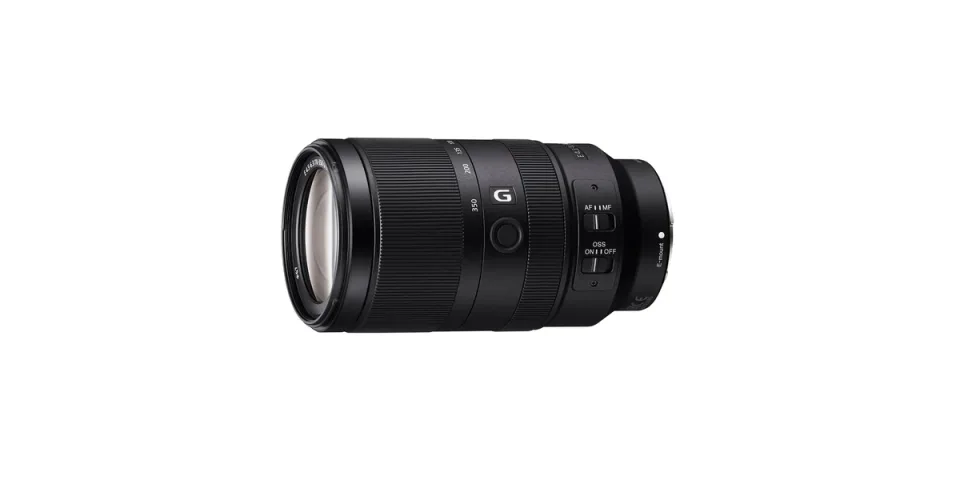
Sony
Sony E 70-350mm F4.5-6.3 G OSS
The Sony E 70-350mm G OSS offers long reach for Sony APS-C wildlife trips with optical stabilization. Its 625 g weight keeps it within reach of a practical hiking kit.
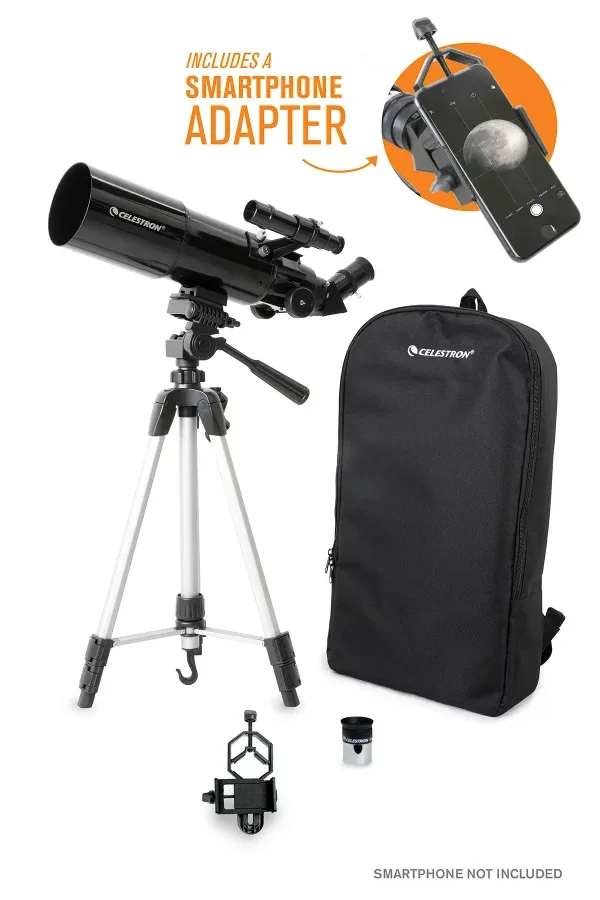
Celestron
Celestron Travel Scope 80
The Celestron Travel Scope 80 is a portable refractor for casual camping views and simple astronomy. Its role is a compact observing setup rather than a high-magnification planetary specialist.
Transparent evidence
Method and limitations
Eclipse type, visibility region, magnitude, and greatest-eclipse time were checked against NASA eclipse pages and the NASA/GSFC catalog. Contact times are rounded to the nearest minute for planning, then converted using August daylight-saving offsets for the contiguous U.S. time zones. Camera guidance is presented as a starting workflow rather than a claim of hands-on testing of this future event.
- The timeline illustrates eclipse progress but does not calculate the Moon’s altitude or azimuth for a specific location.
- NASA catalog values and newer numerical models can differ by roughly a minute; use the rounded times as planning guidance.
- Cloud cover, haze, terrain, buildings, and the local horizon determine real-world visibility.
Five key takeaways
- Maximum eclipse occurs near 04:14 UTC on August 28, or late August 27 in most U.S. time zones.
- The umbral magnitude is 0.930: about 93 percent of the Moon’s diameter enters Earth’s umbra, not 93 percent of its visible area.
- Expose for the bright uneclipsed edge first, then bracket because the shadowed surface is much dimmer.
- A tripod and remote release help more than adding unfamiliar equipment on eclipse night.
- No solar filter or eclipse glasses are required for viewing or photographing a lunar eclipse.
Frequently asked questions
Do I need eclipse glasses or a solar filter for a lunar eclipse?
No. A lunar eclipse is safe to view directly and through ordinary cameras, binoculars, and telescopes. Solar filters are for observing the Sun, not the eclipsed Moon.
What focal length is best for the August 2026 lunar eclipse?
A moderate telephoto can include landscape context, while roughly 300–600mm on full frame makes the Moon more prominent. Sensor size, final crop, tracking accuracy, and the composition you want matter more than one universal focal length.
What camera settings should I use?
Begin in manual mode with RAW, manual focus, a moderate aperture, and a shutter speed fast enough to limit lunar motion and vibration. Make a bracket around the bright edge and adjust from the histogram rather than relying on one fixed recipe.
Can I photograph the eclipse with a smartphone?
Yes, especially through a securely aligned binocular or telescope adapter, but test the adapter in daylight. Lock focus and exposure when the camera app allows it, use a timer, and avoid excessive digital zoom.
Will the entire eclipse be visible everywhere in the United States?
No. Visibility depends on the Moon being above the local horizon, and the penumbral phases may be subtle. Verify altitude, obstructions, and local weather for your exact location.
Primary sources
- science.nasa.gov · Verified 2026-08-16
- science.nasa.gov · Verified 2026-08-16
- eclipse.gsfc.nasa.gov · Verified 2026-08-16
- eclipse.gsfc.nasa.gov · Verified 2026-08-16