

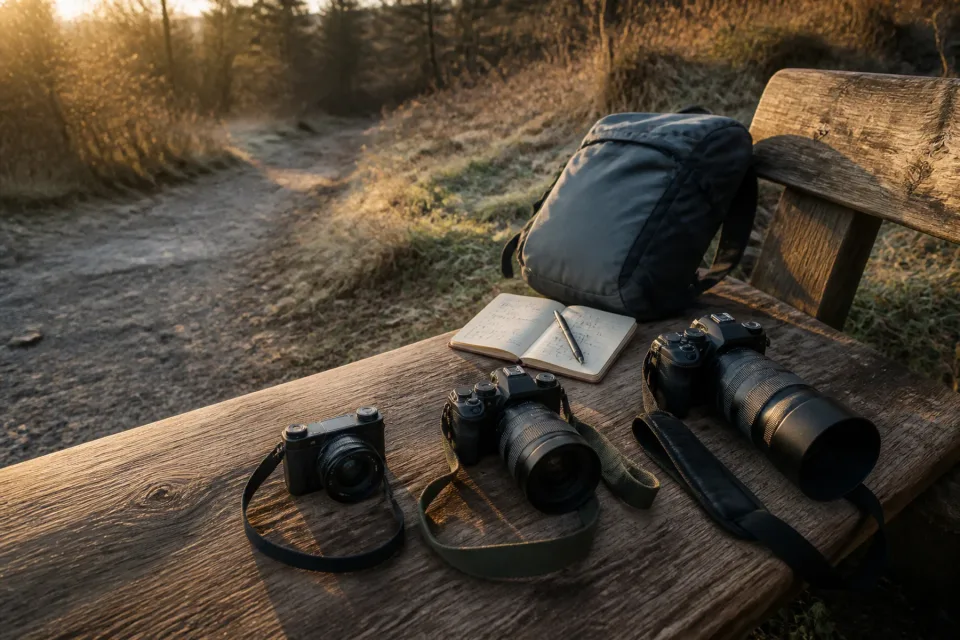
One photograph, 33 pounds of options
On August 1, 2026, I set out to make a night photograph of Château de Peyrepertuse in Aude, Occitanie, France. The outing covered about 5 km (3.1 miles). My camera load weighed approximately 15 kg (33 lb).
The bag contained a Nikon D800, 50mm and 24mm primes, a 10-24mm zoom, a Sigma 150-500mm telephoto zoom, and a Manfrotto 190 tripod. It offered an enormous range of possible framing. Most of that range never became useful.
The equipment that left the bag was much simpler:
| Carried | Used in the field | Role |
|---|---|---|
| Nikon D800 | Yes | Camera body |
| 24mm prime | Yes | Final wide night composition |
| 50mm prime | Yes | Alternative framing |
| 10-24mm zoom | No | Extra wide-angle option |
| Sigma 150-500mm | No | Long-distance option |
| Manfrotto 190 tripod | Yes | Support for the 30-second exposure |
The sharpest lesson was not that the unused lenses were poor choices in general. It was that they did not support the photograph I had gone there to make.
The photograph
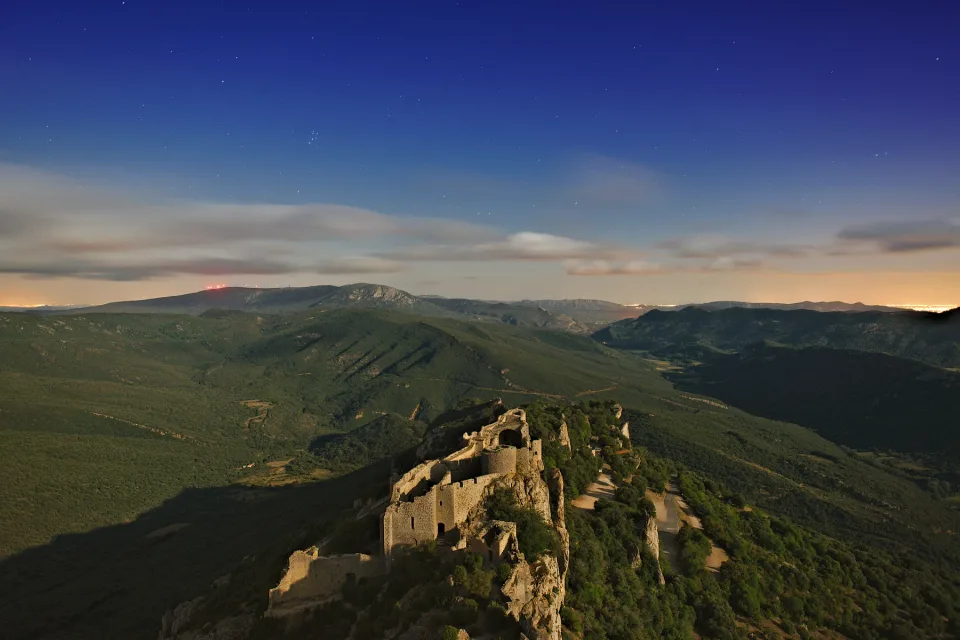
The exposure metadata records:
| Setting | Recorded value |
|---|---|
| Camera | Nikon D800 |
| Focal length | 24 mm |
| Aperture | f/2.5 |
| Shutter speed | 30 seconds |
| Sensitivity | ISO 100 |
| Exposure compensation | 0 EV |
| Flash | Did not fire |
The photograph was planned rather than reactive. A stable tripod and direct access to the selected lens mattered. Rapid autofocus, burst speed, and immediate lens reach did not.
What the weight changed
Fifteen kilograms was very tiring even over five kilometers. The distance looked modest on paper, but the load remained present during every step, pause, and setup.
The bag itself worked: access was straightforward, lens changes were easy, and no photograph was missed. That distinction matters. A system can be operationally efficient and still be physically excessive.
Changing lenses was not difficult, but it was constraining. Each additional option added another decision and another object to manage in the dark. The unused 10-24mm and 150-500mm lenses created carrying cost without contributing to the final result.
What I would change next time
For the same objective at the same location, I would start with the photograph rather than the catalog of possibilities:
- Nikon D800.
- The 24mm lens for the intended composition.
- The 50mm only if a tighter alternative remains part of the shot plan.
- The tripod required by the long exposure.
- Batteries, cards, light, weather protection, and safety equipment appropriate to the outing.
The 10-24mm and 150-500mm would need a specific planned frame to justify their place. “I might need it” was not enough on this walk.
The transferable rule
The first Senkōra Decision Lab showed how quickly body-and-lens weight changes across 20 camera combinations. This outing adds the field consequence: the relevant number is not only what a kit weighs, but how much of the carried system contributes to the photographs actually attempted.
For a deliberate night photograph, pack against a shot list:
Every heavy item should answer a specific frame, not a hypothetical possibility.
This does not mean always traveling light. The Manfrotto tripod was heavy, but it enabled the 30-second exposure. Useful weight earns its place. Unused range does not.
Transparent evidence
Method and limitations
This Field Note is based on Philippe Contal's first-hand outing at Château de Peyrepertuse on August 1, 2026. Distance, total carried load, equipment used, handling observations, and fatigue are field notes supplied by the photographer. Exposure data comes from the metadata displayed for the original image file. No individual item weights, timed access tests, fatigue scale, or controlled comparison were recorded.
- The 15 kg figure is the total reported load; individual components were not weighed for this article.
- This was one photographer, one route, one objective, and one night, not a controlled comparison of camera systems.
- Weather, elevation gain, temperature, bag model, and exact walking time were not recorded.
- The generated cover is an editorial illustration; the castle photograph within the article is the original field image.
Five key takeaways
- A 15 kg (33 lb) load was exhausting even across a relatively short 5 km outing.
- Only two of the four carried lenses were used: the 24mm and 50mm primes.
- The final photograph used the Nikon D800 at 24mm, f/2.5, 30 seconds, and ISO 100.
- Good access prevented missed photographs, but it did not remove the physical cost of carrying excess options.
- For a planned static night composition, focal-length intent matters more than carrying every possible lens.
Frequently asked questions
How much camera gear was carried to Peyrepertuse?
The complete load was approximately 15 kg, or 33 lb, including the Nikon D800, four lenses, a Manfrotto 190 tripod, and the rest of the carrying setup. Individual item weights were not recorded on this outing.
Which lenses were actually used?
The 24mm and 50mm primes were used. The 10-24mm zoom and Sigma 150-500mm remained in the bag.
What settings were used for the final photograph?
The supplied file metadata records a Nikon D800, 24mm focal length, f/2.5 aperture, 30-second exposure, ISO 100, zero exposure compensation, and no flash.
Did the heavy bag cause a missed photograph?
No. Equipment access was straightforward and the planned night photograph was made. The penalty was fatigue and the constraint of carrying and managing equipment that was not ultimately needed.
Primary sources
- nikonusa.com · Verified 2026-08-15
- peyrepertuse.com · Verified 2026-08-15