

One lens for a trip, if changing lenses costs you pictures
On a family trip or a dusty trail, moving from a wide landscape to a distant animal can mean an awkward lens change. Sigma’s Nikon Z 16-300 mm offers a straightforward answer: keep one lens attached and change the framing instead. It is also a choice with weight and aperture trade-offs.
Sigma’s October 8 announcement schedules the Nikon Z version for November 5, 2026. This is a new mount option for an existing superzoom, not a newly tested optical design. We have not used the Nikon Z lens, measured its sharpness or tested tracking.
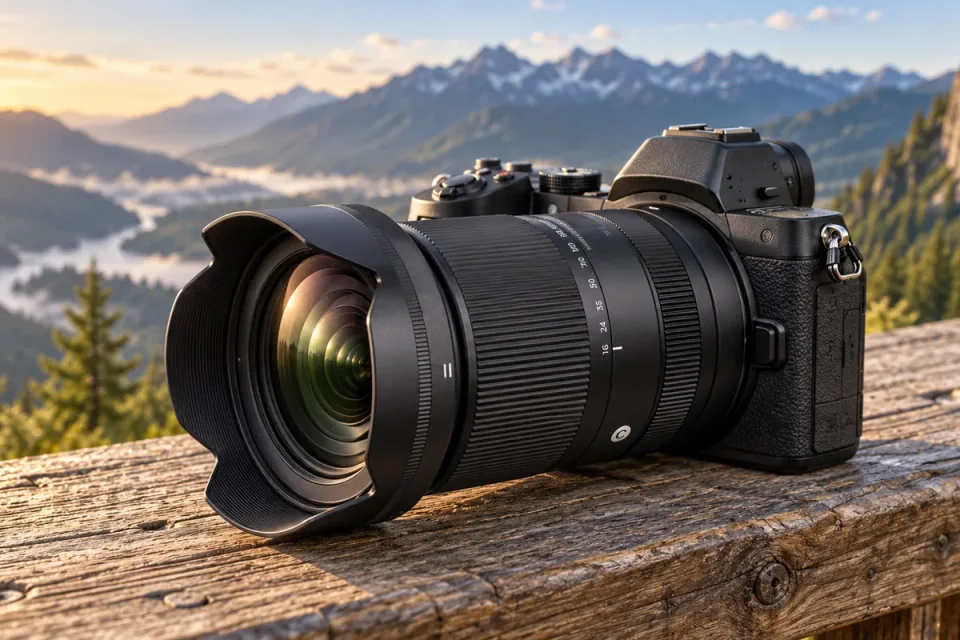
The cover and product images are AI-generated hyperrealistic illustrations with approximate equipment appearance. They are not manufacturer photos or pictures captured with the lenses.
What Nikon DX photographers get
The lens covers APS-C, which Nikon calls DX. Its 16-300 mm focal range gives approximately 24-450 mm full-frame-equivalent framing, calculated with a 1.5 x crop factor. Extra video cropping can narrow the view further. It does not become a full-frame 450 mm lens, and its aperture designation remains f/3.5-6.7.
This makes it relevant to Nikon DX owners considering a travel lens, including Z50, Z50 II, Z fc and Z30 users. That is an intended-use assessment, not certification of every body, firmware version or correction setting. Sigma confirms Nikon Z AF-C support and aberration correction on supported cameras only. Check current compatibility documentation for your exact body before ordering.
The Nikon Z model weighs 630 g /22.2 oz and measures 73.8×125.4 mm /2.9×4.9 in. Do not use the 615 g figure printed elsewhere for other mounts. It has a 67 mm filter thread. Sigma lists a hood, pouch and caps; they do not need to become extra purchases by default.
Sigma 16-300 mm versus Nikon 18-140 mm and the two-lens kit
For travel, compare what you carry and what you can frame. These are manufacturer specifications and calculated equivalent ranges, not matched optical tests.
| Setup | Equivalent framing on Nikon DX | Published lens weight | Practical trade-off |
|---|---|---|---|
| Sigma 16-300 mmF3.5-6.7, Nikon Z | 24-450 mm | 630 g /22.2 oz | One lens; the longest telephoto endpoint here |
| Nikon Z DX 18-140 mmf/3.5-6.3 VR | 27-210 mm | 315 g /11.2 oz | Half the Sigma’s weight; less wide and much shorter at the long end |
| Nikon Z DX 16-50 mmf/3.5-6.3 VR plus 50-250 mmf/4.5-6.3 VR | 24-75 mm plus 75-375 mm | 135 g +405 g =540 g /19.0 oz | Lens changes; very small camera setup with just the standard zoom mounted |
Sources: Sigma US, Nikon 18-140 mm, Nikon 16-50 mm and Nikon 50-250 mm. The total excludes camera bodies, bags and extra accessories.
The Sigma is 90 g heavier than the two Nikon lenses combined. Its main benefit is avoiding a swap, with 300 mm rather than 250 mm at the telephoto end. Those endpoints represent 20% more focal length, not 20% more image detail guaranteed. Optical performance, focus accuracy, atmosphere and shutter speed also matter.
The 18-140 mm makes a different promise. If most travel pictures fall within its range, carrying an extra 315 g to reach 300 mm may not be worthwhile. Its 18 mm wide end is also tighter than 16 mm, which can matter inside buildings or on a narrow overlook. Check the focal lengths of your favorite trip photos before deciding.
An 18.8 x zoom buys flexibility, not a free optical upgrade
Dividing 300 by 16 gives 18.75, rounded to 18.8 x. A wide zoom range combines many framing options, but the ratio says nothing by itself about corner sharpness, distortion after correction or tracking reliability. Sigma’s claims about optical quality, reduced breathing and its HLA motor need to remain claims until measured on the Nikon Z version.
At the wide end the maximum aperture is f/3.5; at 300 mm it is f/6.7. Compared with f/2.8, f/6.7 admits about 2.5 stops less light at the same exposure settings, calculated from the squared aperture ratio. That can mean a higher ISO or slower shutter. The Nikon kit zooms are also relatively slow, so switching to them does not automatically solve dim indoor sports.
For wildlife and daylight sport, reach can help fill the frame, but a stabilized lens cannot stop an animal or player moving. Sigma rates OS at six stops at 16 mm and 4.5 stops at 300 mm under CIPA guidelines. These are camera-shake ratings, not permission to use very slow shutter speeds for moving subjects. We have not measured keeper rates.
Close-ups: useful half-life-size magnification
Sigma specifies a maximum reproduction ratio of 1:2 at 70 mm, or 0.5 x. That describes how large a subject is projected on the sensor; it is not 1:1 macro. It can be useful for flowers, food and details during a trip without packing a dedicated macro lens.
Maximum magnification changes across the zoom range. Do not assume the 1:2 figure applies at 300 mm. Minimum focus distance is measured from the camera’s sensor plane, not the front of the lens, and a hood can reduce the space available around a close subject. Lighting, stability and focus placement still determine whether that detail picture works.
Price, launch and the exact version to order
On October 9, Sigma America’s page displays $769 regular pricing and a generic starting price of$694 with instant savings. Its mount selector did not expose a usable Nikon Z choice during our check. We therefore do not claim that the discounted price applies to Nikon Z, or that the lens is already in stock. Confirm the exact Z offer and delivery date with a US seller.
DC means APS-C coverage; Nikon Z identifies the mount. Do not order an older DSLR 16-300 mm or a Sony E, Fujifilm X, Canon RF or L-mount version because the focal range looks right. Sigma’s listed USB Dock compatibility is for L-mount, so it is not an accessory recommendation for this Nikon Z purchase.
Buy, wait, or keep your Nikon kit?
- Consider the Sigma if frequent lens changes are causing missed moments and you regularly need both 16 mm and a long telephoto view on the same outing.
- Choose or keep the 18-140 mm if lighter everyday travel matters more than distant wildlife and its range already covers your pictures.
- Keep the 16-50 mm plus 50-250 mm kit if swapping lenses is manageable. It is lighter in total, and carrying just the small standard zoom can make sightseeing easier.
- Wait for Nikon Z tests if edge sharpness, action tracking or handheld telephoto performance are essential to paid work.
The two product guides below separate the all-in-one and lighter single-lens choices. Their Amazon.com buttons open clearly labeled searches because exact US ASINs are unconfirmed. Search results do not establish stock, mount correctness or an exact product offer.
Recommended gear
Find your next piece of gear
Find the setup that fits your plans, then explore prices and buying options on Amazon.
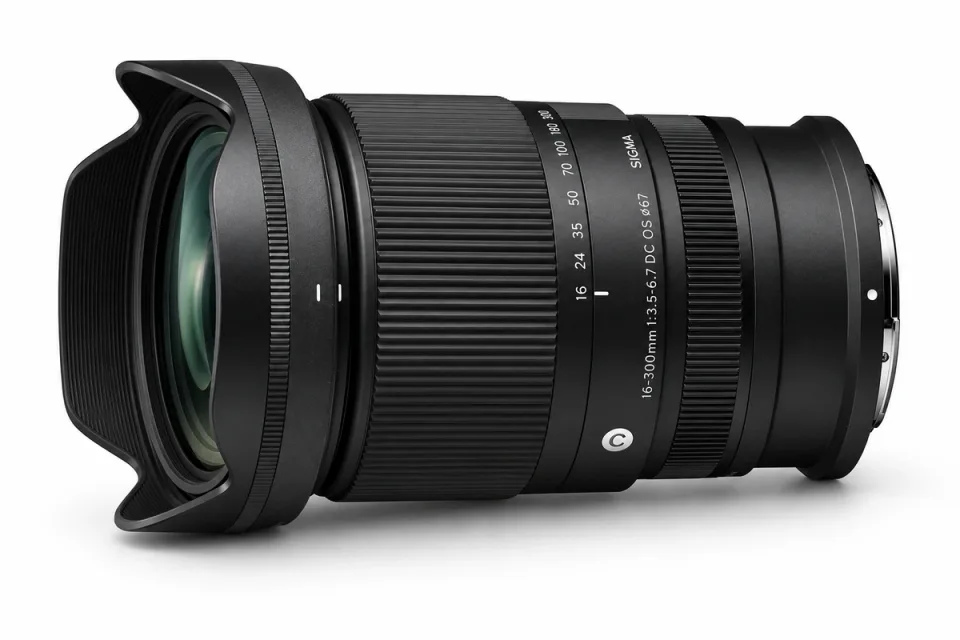
AI-generated product illustration
Based on a reference by Senkōra / AI-generated. Original hyperrealistic conceptual studio illustration with approximate appearance; not a manufacturer photograph or optical test.
Sigma
Sigma 16-300mm F3.5-6.7 DC OS Contemporary Nikon Z
Best for: Travel without swapping lenses
24-450mm equivalent framing; 630g. Consider if missed moments from lens changes matter more than the weight or a brighter telephoto aperture.
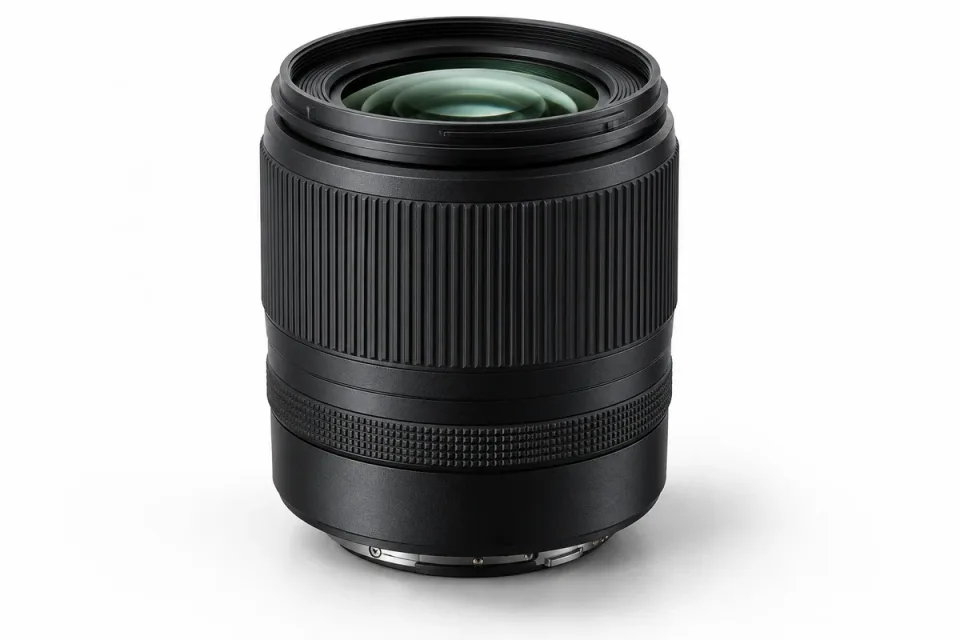
AI-generated product illustration
Based on a reference by Senkōra / AI-generated. Original hyperrealistic conceptual studio illustration with approximate appearance; not a manufacturer photograph or optical test.
Nikon
Nikon NIKKOR Z DX 18-140mm f/3.5-6.3 VR
Best for: A lighter everyday Nikon DX travel kit
Half the Sigma’s published weight at 315g, with 27-210mm equivalent framing. Keep it if this range already covers your trips.
Transparent evidence
Method and limitations
Source-based first look checked October 9, 2026, using Sigma’s launch notice and specifications and Nikon USA product pages. Equivalent framing, weight totals and aperture comparisons are calculations. No independent optical, tracking or stabilization test. Images are AI-generated hyperrealistic editorial illustrations, not photographs captured with these lenses.
- Nikon Z-specific discount and US retailer stock are unconfirmed.
- Correction support depends on the camera; no body-by-body firmware certification here.
- No tested sharpness, tracking hit rate, breathing or stabilization measurements.
Five key takeaways
- Nikon Z launch is scheduled for November 5, 2026; no current US stock confirmed.
- 16-300 mm gives 24-450 mm equivalent framing on Nikon DX; zoom ratio is 18.75 x, rounded to 18.8 x.
- The 630 g Sigma is 90 g heavier than Nikon’s 16-50 mm and 50-250 mm pair combined.
- Nikon’s 315 g 18-140 mm is lighter, with a shorter 27-210 mm equivalent range.
- HLA, stabilization and optical quality claims do not establish measured Nikon Z performance.
Frequently asked questions
When does the Sigma 16-300mm Nikon Z launch?
Sigma schedules November 5, 2026. A scheduled release is not proof of retailer inventory or a guaranteed delivery date.
Is it a full-frame Nikon Z lens?
No. DC denotes APS-C coverage. On Nikon DX, 16-300mm frames approximately like 24-450mm on full frame. Z mount alone does not imply full-frame coverage.
Is the Sigma lighter than the Nikon DX two-lens kit?
No. The Nikon 16-50mm weighs 135g and the 50-250mm weighs 405g, totaling 540g. The Nikon Z Sigma weighs 630g, 90g more. The Sigma primarily saves lens changes.
Does its stabilization freeze wildlife or sports?
No. Stabilization reduces camera shake. Subject movement still needs a suitable shutter speed; autofocus and flash-free exposure performance require real testing.
Primary sources
- sigma-global.com · Verified 2026-10-09
- sigmaphoto.com · Verified 2026-10-09
- sigma-global.com · Verified 2026-10-09
- nikonusa.com · Verified 2026-10-09
- nikonusa.com · Verified 2026-10-09
- nikonusa.com · Verified 2026-10-09