

iPhone 18 Pro variable aperture: what Apple announced
Apple announced iPhone 18 Pro and iPhone 18 Pro Max on September 9, 2026, introducing a physical variable aperture to an iPhone for the first time. The 48MP Fusion Main camera uses six blades, with automatic adjustment or a choice of four manual settings in the Camera app, according to Apple’s US launch announcement.
For photographers and video creators, the useful question is how that mechanical control changes a shot. It adds another way to manage light and focus at capture, but does not by itself establish better low-light results or make a phone equivalent to a dedicated camera. This is an announcement-based first look, not a performance review.
Physical aperture, computational imaging, and simulated blur
These three processes can contribute to the same photograph, but they do different jobs.
| Process | What changes | What it means for a creator |
|---|---|---|
| Physical aperture | The opening through which light reaches the sensor | Alters light transmission and optical depth of field at capture |
| Computational imaging | How captured information is combined and rendered | Can influence noise, tone, detail, and the final appearance |
| Simulated depth of field | Software applies selective blur using an estimate of scene depth or subject separation | Changes the appearance of focus without changing the original lens opening |
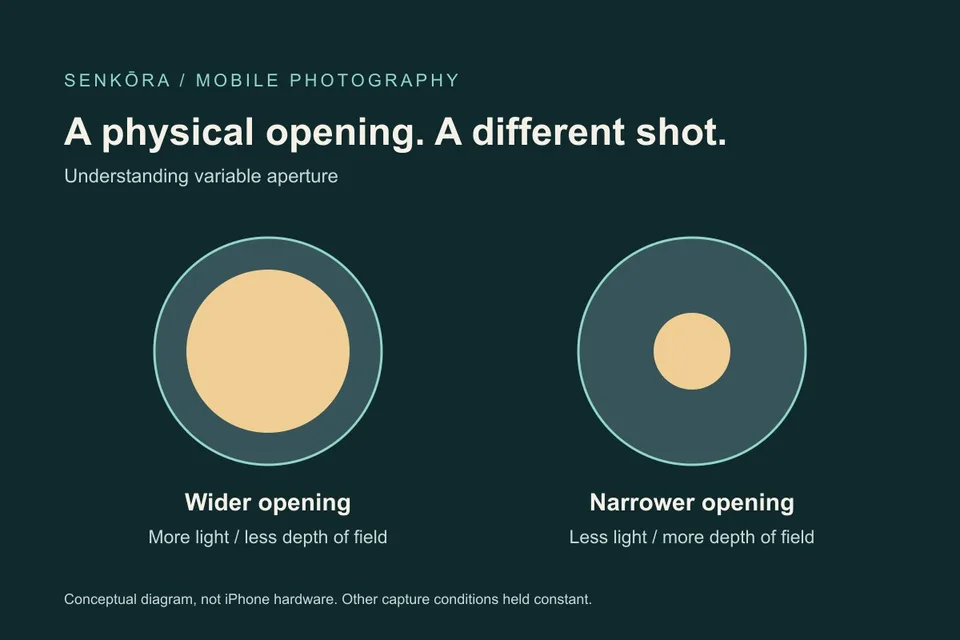
A wider opening admits more light for the same shutter speed and scene illumination. With focal length and focus distance held constant, it also reduces optical depth of field. A narrower opening increases depth of field but admits less light, requiring a change in exposure settings or capture strategy to maintain brightness.
For a group portrait, stopping down may help keep people at different distances acceptably sharp. For a close subject, opening up may increase optical background blur. The size of either effect depends on the lens, sensor format, subject distance, and background distance. Matching an f-number across different camera formats does not guarantee matching background blur.
Nor does a smaller opening guarantee a sharper picture. Reduced light can force a slower shutter speed that blurs a moving subject, and diffraction can soften fine detail at smaller apertures. The practical balance needs testing on the finished camera.
Computational processing remains a separate part of the result. A physically adjustable iris does not mean the output is free of processing. Likewise, adding a blur effect later cannot change how much light originally reached the sensor.
What the new iPhone 18 Pro camera controls offer
Apple’s new Pro controls expose shutter speed and white balance, alongside aperture, and provide a histogram in Camera. These controls are documented in the camera section of the announcement.
Each control answers a different creative question. Shutter speed influences whether movement looks crisp or blurred. White balance helps manage the color cast of a scene. The histogram summarizes tonal distribution, making it useful for checking exposure, although it does not by itself guarantee that every highlight is recoverable.
For video, aperture offers another exposure adjustment when a creator wants to hold a chosen shutter speed. Changing it can also change the look of focus. Before relying on aperture changes during a take, inspect footage for visible exposure steps, focus shifts, or distracting transitions. The announcement alone does not establish how smooth those adjustments will look in a particular workflow.
Video: Cinematic effects after capture and HDR time-lapse
Apple says Cinematic effects can be applied after capture to video recorded at up to 60 fps, and adds 4K Dolby Vision HDR time-lapse. These are separate additions to the announced video feature set.
Post-capture depth effects deserve particular attention around hair, transparent objects, and subjects that cross one another. Those are useful evaluation scenes, not reported faults with these phones. Creators should also check the complete recording, editing, and export path they intend to use before building a paid production around a newly announced feature.
Apple Reference Image: a newsroom verification aid
For photojournalists and picture editors
Apple Reference Image is an opt-in feature. Apple says Reference mode captures signed sensor data, which Private Cloud Compute develops into a reference image that can be viewed beside the main image in Photos. That comparison can help examine later edits. See Apple’s description and footnote 5.
A reference image cannot establish whether a scene was staged, whether a caption names the right place or person, or whether important events happened outside the frame. Treat it as one piece of evidence within a verification process, not a universal authenticity guarantee.
For a newsroom, the useful next step is to evaluate the entire handoff: capture, preservation of the reference, transfer to an editor, comparison, and archiving. Check what remains available after the actual export and publishing tools used by the organization. A feature description is not evidence that every downstream workflow preserves the same verification information.
The distinction matters for readers too. An image can accurately record a staged scene, and an untouched image can accompany a misleading caption. Cryptographic information about capture and editorial verification of an event answer different questions.
US preorder date, availability, and starting prices
Apple’s US pricing and availability announcement gives the following schedule:
| Model | Starting storage | Announced US starting price |
|---|---|---|
| iPhone 18 Pro | 256GB | $1,199 |
| iPhone 18 Pro Max | 256GB | $1,299 |
Preorders begin September 12, 2026 at 5 a.m. Pacific, or 8 a.m. Eastern. Availability begins September 18. These are Apple’s announced dates and starting prices; an individual order’s delivery estimate must be checked at checkout.
What to evaluate before upgrading a creator kit
The most useful comparison would hold the scene, framing, lighting, and output size consistent across the new phone, a previous iPhone, and competing smartphones. Separate the effect of aperture from changes in processing wherever the available controls permit it.
Look for optical depth-of-field differences in close portraits and staggered group shots; motion rendering and noise in dim interiors; and detail near the frame edges. For video, examine exposure transitions and the reliability of post-capture subject separation. These are proposed evaluation criteria, not Senkōra test results.
For now, improved image quality and low-light performance remain Apple’s claims pending independent comparisons. Variable aperture is a meaningful capture control, but the announcement does not establish that either phone replaces an interchangeable-lens camera for a particular assignment.
Budget around the job as well as the phone. Microphones, supports, lighting, and storage can matter to production, but compatibility should be checked for the exact device and workflow before purchasing. No accessory selection or Amazon US ASIN is asserted here.
For broader kit planning, read our travel vlogging camera guide and APS-C versus full-frame travel comparison. Neither is a performance comparison with the new iPhone.
Transparent evidence
Method and limitations
First look based on Apple's September 9, 2026 US Newsroom release, checked September 11. Optical explanations and suggested evaluation criteria are editorial analysis. Senkōra has not handled either phone.
- Image-quality and low-light improvements are manufacturer claims pending independent comparisons.
- Announced availability does not establish delivery dates or stock for an individual order.
- The cover is a conceptual aperture diagram, not a photograph or technical drawing of the iPhone camera.
Five key takeaways
- Physical aperture changes the light entering the lens and optical depth of field.
- Camera controls add shutter speed, white balance, and a histogram.
- Cinematic effects after capture and optical background blur are separate processes.
- Signed reference data can support verification, but cannot establish the truth of a caption or scene.
- US preorders start September 12 at 5 a.m. PT; availability is announced for September 18.
Frequently asked questions
Does iPhone 18 Pro have a physical variable aperture?
Yes. Apple describes a six-blade variable aperture on the 48MP Fusion Main camera of both Pro models, with automatic operation or four manual settings in Camera. This changes the lens opening, rather than simply adding background blur in software.
What do the new iPhone 18 Pro camera controls do?
Apple lists aperture, shutter speed, and white balance adjustments, plus an exposure histogram. Aperture affects light and optical depth of field; shutter speed affects motion rendering; white balance controls color interpretation.
Does Apple Reference Image guarantee a photograph is true?
No. A signed reference can help compare a captured image with an edited version, but it cannot establish whether a scene was staged or a caption is accurate. Newsroom verification still requires context and source checks.
When can US buyers preorder iPhone 18 Pro, and what does it cost?
Apple announced September 12, 2026 at 5 a.m. Pacific, or 8 a.m. Eastern, for preorders and September 18 for availability. Announced starting prices are $1,199 for Pro and $1,299 for Pro Max, each with 256GB. These are launch prices, not verified retailer inventory.
Primary sources
- apple.com · Verified 2026-09-11