
Quick answer
For most travelers, APS-C is the practical default. It can deliver excellent stills and video while leaving more room in a carry-on for a second lens, a small tripod, or simply less weight. Full frame becomes the better tool when its specific strengths solve a recurring problem: dim interiors, night scenes, very shallow depth of field, or access to a lens that does not have a useful APS-C equivalent.
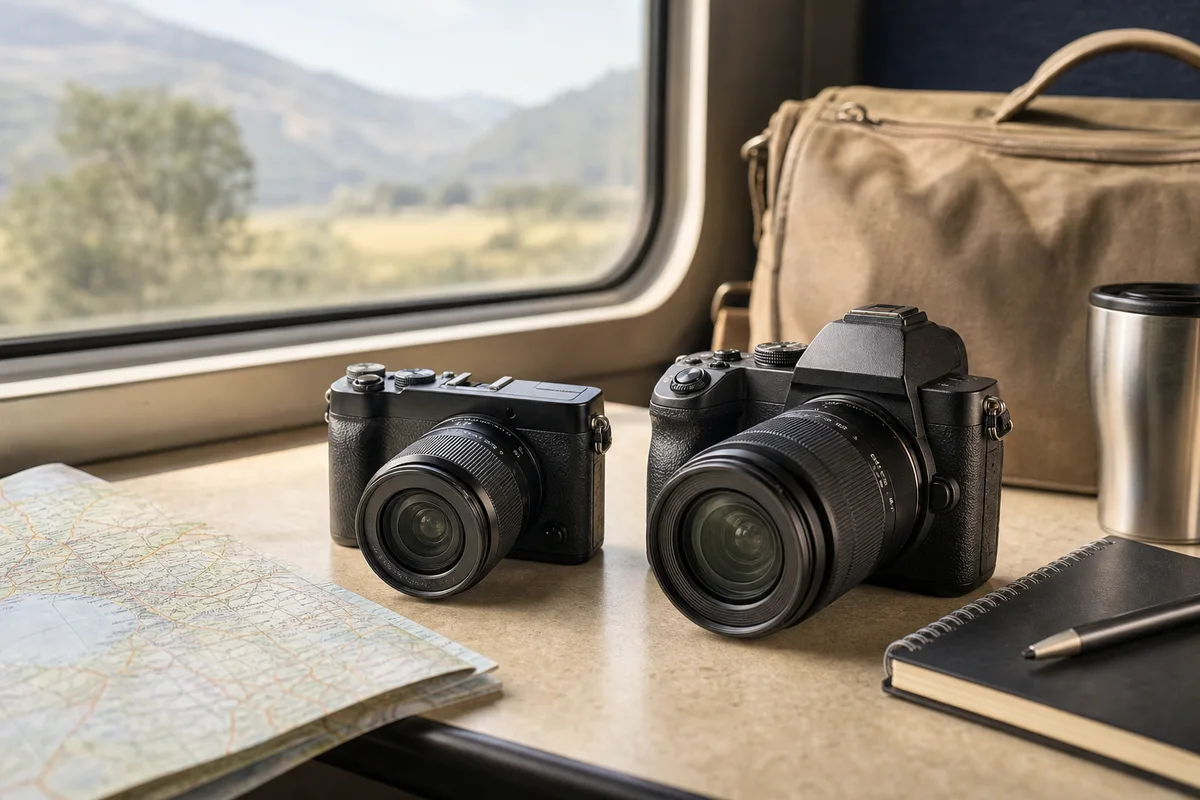
The meaningful comparison is not “small sensor versus large sensor.” It is complete APS-C kit versus complete full-frame kit for the same photographs.
What sensor size changes
An APS-C sensor is smaller than a 35mm full-frame sensor. With lenses framed to produce the same picture, a comparable full-frame system can collect more total light and can produce shallower depth of field. That advantage is real, but it is conditional. A faster APS-C lens, better stabilization, a tripod, or a newer sensor may matter more in a particular photograph.
Crop factor changes angle of view, not the physical focal length of a lens. A 35mm lens remains a 35mm lens; on APS-C it frames more tightly than it does on full frame. This can be useful, but it is not free optical magnification.
Compare matched travel kits
Start with the pictures you expect to make, then match fields of view. A compact APS-C standard zoom may cover everyday streets, landscapes, and family scenes in one small package. A compact full-frame zoom may also travel well, but check its aperture range and whether you will add a second lens to recover low-light or depth-of-field capability.
| Travel question | APS-C tendency | Full-frame tendency |
|---|---|---|
| Smallest complete kit | Often favored | Possible with compact lenses |
| Dim interiors and night scenes | Capable with good technique or a fast lens | More latitude in comparable conditions |
| Shallow depth of field | Requires a wider aperture for a matched frame | Easier to achieve |
| Body and lens budget | Often lower | Often higher |
| Lens choice | Depends on mount | Depends on mount |
Weight and packing
Do not stop at the body specification. Add the exact lens, battery, charger or USB adapter, hood, filters, and any second lens. A small full-frame body with a large fast zoom is not a lightweight system. Conversely, a compact full-frame prime can make a very restrained kit.
Low light
Full frame generally offers more high-ISO flexibility when sensor generation, exposure, and output size are comparable. Travelers should still ask whether the subject moves. Stabilization and a tripod help architecture and landscapes, but cannot freeze a walking person. A brighter lens may be the more useful upgrade.
Depth of field
Full frame makes a blurred background easier at the same framing and equivalent aperture. That is helpful for portraits, but not automatically helpful for travel landscapes or group photographs where greater depth of field is desirable.
System growth
Look at the lenses you may add over the next three years. Check compact wide angles, telephotos, weather-sealed options, and used-market availability in the United States. A format advantage is less valuable if the mount does not offer the lens you need at a size you will carry.
Choose by traveler profile
- One-body, one-zoom traveler: favor the smallest complete kit that covers your field of view.
- Night and indoor traveler: compare a full-frame kit against APS-C with a genuinely faster lens.
- Hiker or airline minimalist: prioritize packed weight, charging, and weather protection over sensor prestige.
- Portrait-led traveler: full frame may justify itself if shallow depth of field is central to your style.
- First interchangeable-lens buyer: APS-C is usually the lower-risk entry point, provided the mount has the lenses you expect to add.
Methodology and limits
This is an editorial comparison of format behavior and current US manufacturer specifications. Senkōra did not field-test every possible body-and-lens combination, and this article does not claim that one format is universally superior. Verify the exact kit contents and current specifications on the manufacturer page before buying.
Five key takeaways
- Sensor size does not determine whether a camera is professional or capable of large prints.
- The lens often changes the travel-weight comparison more than the body.
- Full frame has an optical advantage in low light when technology and framing are broadly comparable, but technique and lens aperture still matter.
- APS-C can make a smaller, less expensive system without preventing later creative growth.
Frequently asked questions
Is full frame always sharper than APS-C?
No. Final detail also depends on the lens, pixel count, focus, shutter speed, processing, and viewing size.
Is APS-C good enough for large prints?
Yes. A well-exposed, sharply focused APS-C file can support substantial prints; required resolution depends on print size and viewing distance.
Which format is lighter for travel?
APS-C often produces the lighter complete kit, but compare the exact body, lens, charger, and spare batteries you will carry.
Primary sources
- usa.canon.com · Verified 2026-07-22
- usa.canon.com · Verified 2026-07-22
- electronics.sony.com · Verified 2026-07-22
- electronics.sony.com · Verified 2026-07-22