
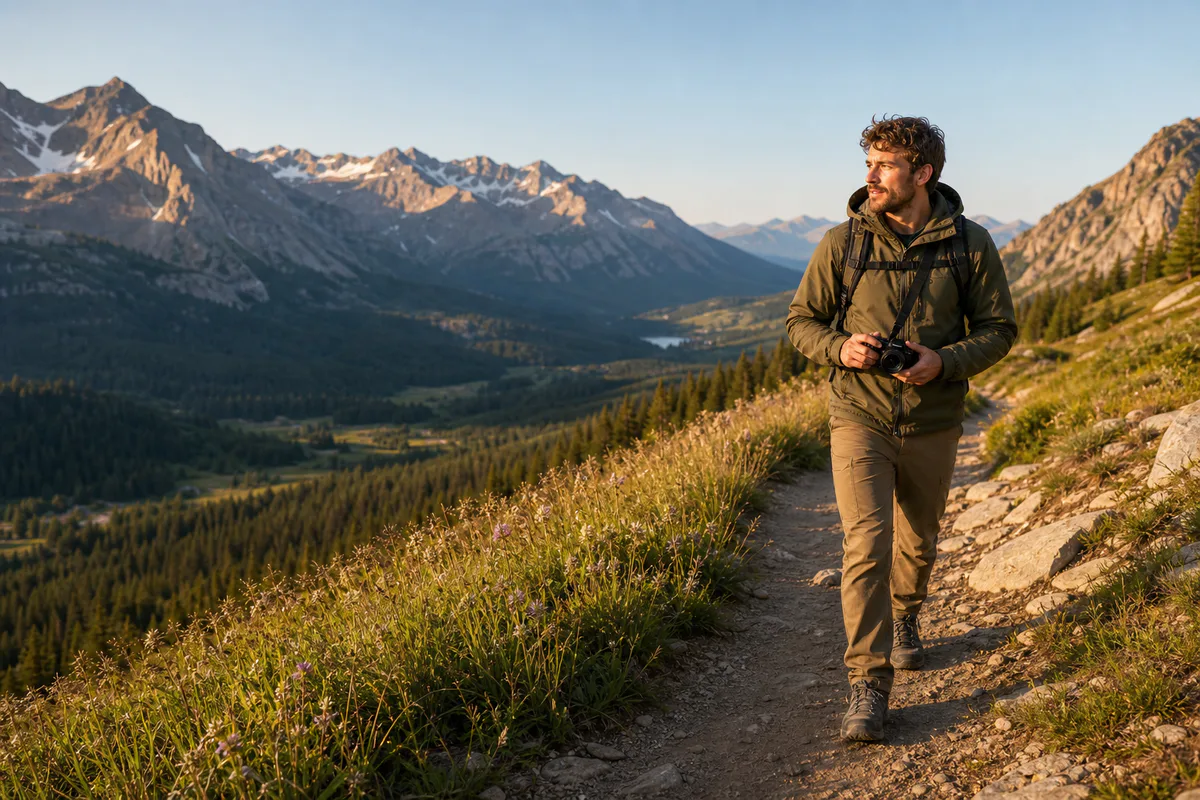
What makes a camera good for hiking
Start with the measured planning ranges in our Decision Lab: How Much Does a Complete Travel Camera Kit Really Weigh?
A hiking camera must survive the decision to carry it. Image quality matters, but so do retrieval time, lens bulk, battery planning, grip, and protection. A technically excellent camera stored under food and rain layers is less useful than a modest camera that is secure and immediately accessible.
Choose a hiking camera around trail distance, pack weight, access, and the subjects you expect to encounter. For wildlife opportunities, road access, permits, and rules at a particular park, use the US national parks camera guide and its modular park checklist.
We separate day hikes from longer trips. A day hiker can accept a slightly heavier body or second lens. An overnight backpacker must account for every accessory alongside shelter, water, insulation, navigation, and safety equipment. Camera weight never displaces essential trail gear.
Quick selection
| Best fit | Camera and lens | Ready-to-shoot weight | Why it fits | Main caution |
|---|---|---|---|---|
| Best light day-hike kit | Canon EOS R50 + RF-S 18-45mm | 17.8 oz | Viewfinder, grip, autofocus, compact zoom | No weather sealing claim |
| Smallest fair-weather option | Fujifilm X-M5 + XC 15-45mm | 17.3 oz | Very compact standard-zoom system | No viewfinder |
| Best stabilized compact body | Fujifilm X-T50 + XC 15-45mm | 20.2 oz | In-body stabilization, detailed files | Not weather sealed |
| Best landscape controls | Fujifilm X-T5 + XF 16-50mm | 28.1 oz | Weather-resistant body, stabilization | Heavier system |
| Best wildlife-capable compact body | Sony a6700 + E PZ 16-50mm II | 21.2 oz | Stabilization and strong subject recognition | Telephoto choice changes the load sharply |
These totals exclude the strap, spare battery, charging gear, protection, and pack. The same Sony a6700 rises to 39.4 ounces with the 70-350mm wildlife zoom, which is why the planned lens belongs in every hiking-weight decision.
Best for most day hikers: Canon EOS R50
The R50 is easy to justify on a day hike. It has a viewfinder for bright conditions, a useful grip, and a compact stabilized kit zoom. Its subject detection can also support opportunistic wildlife photographs.
The body does not offer in-body stabilization or a documented weather-sealing level. Carry a simple rain cover and avoid changing lenses in dust, wind, or precipitation.
Smallest option: Fujifilm X-M5
The X-M5 minimizes body weight and packed depth. Its screen-based workflow and compact 15-45mm kit suit hikers who also make video.
It is a fair-weather choice. There is no viewfinder and no weather-sealing claim. A phone-style screen workflow can be difficult in direct sunlight, so verify that this tradeoff matches how you compose.
Best stabilized compact option: Fujifilm X-T50
In-body stabilization makes the X-T50 attractive for shaded forests, static subjects, and small prime lenses. Its high-resolution sensor supports landscape detail and cropping.
The body is not weather sealed. High-resolution files use more storage, and a large lens can erase the size advantage. The X-T50 is best with a deliberately compact lens plan.
Best landscape-oriented body: Fujifilm X-T5
The X-T5 adds weather-resistant construction, in-body stabilization, a viewfinder, physical exposure controls, and a 40.2-megapixel sensor. It fits hikers who prioritize deliberate landscape work and accept a body close to 20 ounces before the lens.
Weather resistance depends on a compatible lens and proper port closure. It is not permission to expose the system to prolonged rain.
Best for hiking with wildlife in mind: Sony a6700
The a6700 combines a compact APS-C body, in-body stabilization, and subject-recognition autofocus. Sony’s E-mount also offers several travel telephotos.
The lens decides whether this remains a hiking-friendly system. A compact standard zoom works for general trails; a 70-350mm changes the balance and carry method. Plan the camera and wildlife lens as one load.
Carry and protection
Use a carry method that does not interfere with pack adjustment, trekking poles, or scrambling. A shoulder strap can swing; a chest bag can trap heat; a clip concentrates load on one strap. There is no universal solution.
Keep a dry bag or fitted rain cover accessible. Condensation is also a risk when moving between cold air and heated interiors. Leave the camera in its closed bag until temperatures equalize.
How we evaluated
Manufacturer specifications and system totals were rechecked August 15, 2026. We evaluated exact US bodies and lenses for weight, control access, stabilization, documented environmental protection, compatibility, and clear limitations. No field-use claim is made.
Compare the exact configurations
| Product | Configuration | Before you choose |
|---|---|---|
| Canon EOS R50 | Black body with RF-S18-45mm F4.5-6.3 IS STM kit lens | Check the black 18-45mm kit rather than the white body, a body-only offer or a two-lens bundle. |
| Sony Alpha 6700 | Black body with E PZ 16-50mm F3.5-5.6 OSS kit lens | Distinguish the 16-50mm kit from the body-only offer and choose a bright lens separately for dim scenes. |
| Fujifilm X-M5 | Black body with XC15-45mmF3.5-5.6 OIS PZ kit lens | Try screen visibility outdoors and confirm the XC15-45mm power-zoom kit. |
| Fujifilm X-T50 | Black body with XC15-45mmF3.5-5.6 OIS PZ kit lens | Identify the XC15-45mm bundle: X-T50 offers with a different zoom have different weight and handling. |
| Fujifilm X-T5 | Black body only | Choose the landscape lens and protection first, then check that the offer is the black body-only variant. |
Recommended gear
Explore the products in this guide
Review the key fit for each recommendation, then confirm the current offer and seller details directly on Amazon.
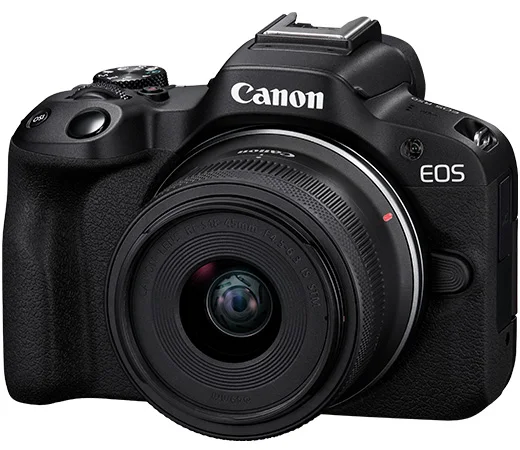
Canon
Canon EOS R50
The EOS R50 combines an electronic viewfinder with a screen that can face the photographer. It suits family outings and a first photo-and-video kit built around the small RF-S18-45mm zoom.
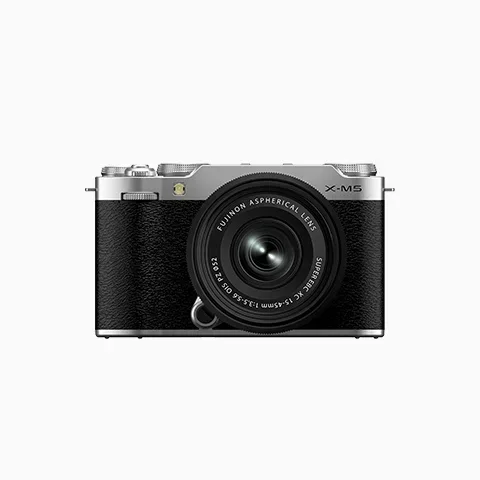
Fujifilm
Fujifilm X-M5
The Fujifilm X-M5 with XC15-45mm zoom is a small screen-operated system for travel photos and creator video. It is most appealing when minimum body bulk matters more than eye-level framing.
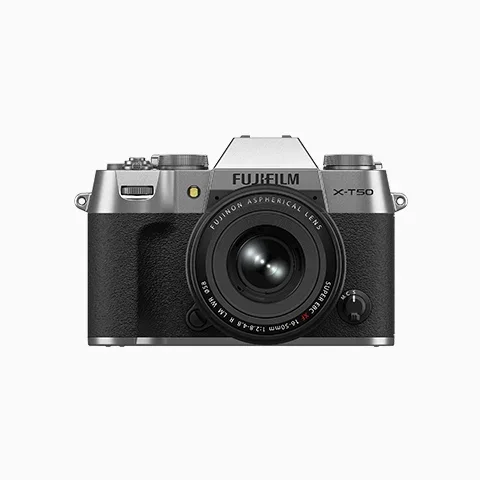
Fujifilm
Fujifilm X-T50
The Fujifilm X-T50 combines detailed still files, in-body stabilization and an electronic viewfinder in a compact X-mount body. The XC15-45mm kit keeps the everyday system small.
Fujifilm
Fujifilm X-T5
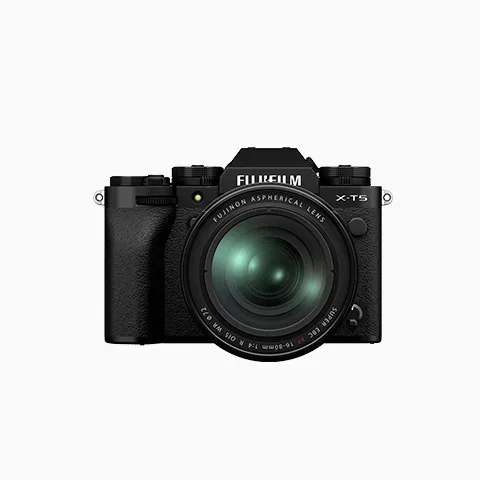
The Fujifilm X-T5 is a stills-oriented X-mount body for landscapes, deliberate travel photography and photographers who also record video. It combines in-body stabilization with weather-resistant construction.
Five key takeaways
- Trail usefulness depends on access and complete kit weight, not body weight alone.
- Weather resistance reduces risk but never makes a camera waterproof.
- A compact standard zoom is usually more useful than carrying several lenses.
- Spare batteries need safe carry-on handling when the hike begins with a flight.
- No camera in this guide was physically trail tested by Senkōra.
Frequently asked questions
Should I hike with a camera clip?
A clip can improve access, but the pack strap, clip rating, camera weight, and terrain must all be compatible. Use a secondary tether where a fall would be hazardous.
Is weather sealing necessary?
It is useful for frequent exposure to dust, spray, or light precipitation, but a rain cover remains the safer response to sustained rain.
What lens is best for hiking?
A compact standard zoom is the most flexible one-lens choice. Add a telephoto only when wildlife is a planned priority.
Can I leave the camera in my backpack?
Yes, but deep storage slows access. A top compartment, side opening, or small insert near the top of the pack is more practical.
Is this also the best camera guide for national parks?
Not necessarily. This guide optimizes equipment carried on foot. A national parks decision must also account for the exact park, dominant subject, local rules, wildlife distance, road access, and seasonal conditions.
Primary sources
- usa.canon.com · Verified 2026-08-26
- fujifilm-x.com · Verified 2026-08-26
- fujifilm-x.com · Verified 2026-08-26
- fujifilm-x.com · Verified 2026-08-26
- electronics.sony.com · Verified 2026-08-26
- usa.canon.com · Verified 2026-08-26
- fujifilm-x.com · Verified 2026-08-26
- dl.fujifilm-x.com · Verified 2026-08-26
- electronics.sony.com · Verified 2026-08-26