
The short answer
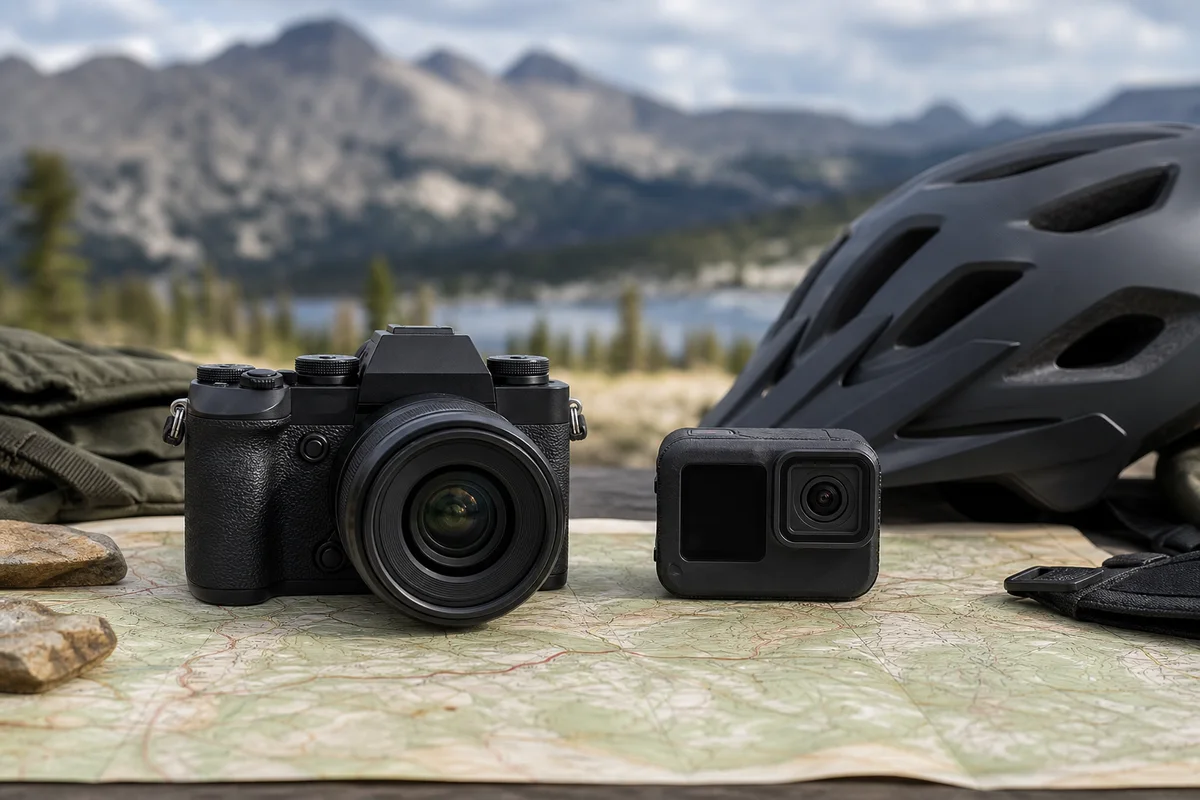
Choose a mirrorless camera for controlled image quality, interchangeable lenses, portraits, and low-light flexibility. Choose an action camera for mounting, water resistance where documented, extreme portability, and point-of-view footage. Many travelers need only one; some benefit from both.
Choose the shot that would be difficult with your phone
A mirrorless camera earns its place for lens choice, portraits, and deliberate image control. An action camera earns its place when it must be mounted, kept very small, or used in conditions covered by its documented protection. A wide point-of-view shot and a shallow-depth-of-field portrait ask for different tools.
Build the audio and mounting plan
The X-M5, EOS R50, and a6700 below are mirrorless examples, not a ranked action-camera shortlist. Consider the lens, microphone, wind protection, grip, and any stabilizer as part of their carried kit. For an action camera, verify the exact mount, waterproofing limits, and microphone connection rather than assuming those accessories are interchangeable.
The models and their tradeoffs
Fujifilm X-M5
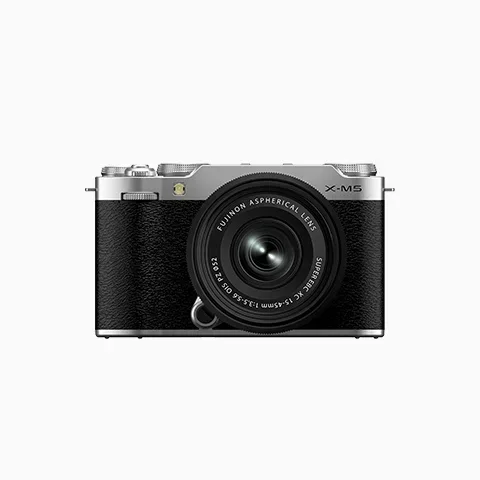
The Fujifilm X-M5 with XC15-45mm zoom is a small screen-operated system for travel photos and creator video. It is most appealing when minimum body bulk matters more than eye-level framing.
Main limitation: There is no viewfinder or in-body stabilization; bright sun and unsupported walking shots need consideration.
See the exact configuration and specifications.
Canon EOS R50
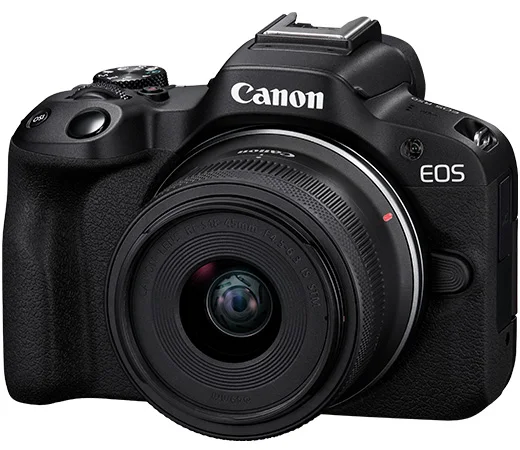
The EOS R50 combines an electronic viewfinder with a screen that can face the photographer. It suits family outings and a first photo-and-video kit built around the small RF-S18-45mm zoom.
Main limitation: There is no in-body stabilization, and the kit zoom is relatively slow in dim interiors.
See the exact configuration and specifications.
Sony Alpha 6700
The Sony a6700 brings in-body stabilization and a more advanced video workflow to a compact APS-C E-mount system. The 16-50mm comparison kit is an everyday starting lens, not a low-light specialist.
Main limitation: A brighter prime or long wildlife zoom changes both the cost and portability of this small-body setup.
See the exact configuration and specifications.
How we reached this recommendation
This is an editorial comparison of the documented products and their intended uses, not a hands-on test. The manufacturer references listed below support the specifications; the recommendations describe practical tradeoffs rather than measured performance. We do not reproduce retailer prices or guarantee availability.
Compare the exact configurations
| Product | Configuration | Before you choose |
|---|---|---|
| Canon EOS R50 | Black body with RF-S18-45mm F4.5-6.3 IS STM kit lens | Check the black 18-45mm kit rather than the white body, a body-only offer or a two-lens bundle. |
| Sony Alpha 6700 | Black body with E PZ 16-50mm F3.5-5.6 OSS kit lens | Distinguish the 16-50mm kit from the body-only offer and choose a bright lens separately for dim scenes. |
| Fujifilm X-M5 | Black body with XC15-45mmF3.5-5.6 OIS PZ kit lens | Try screen visibility outdoors and confirm the XC15-45mm power-zoom kit. |
Recommended gear
Explore the products in this guide
Review the key fit for each recommendation, then confirm the current offer and seller details directly on Amazon.
Fujifilm
Fujifilm X-M5
The Fujifilm X-M5 with XC15-45mm zoom is a small screen-operated system for travel photos and creator video. It is most appealing when minimum body bulk matters more than eye-level framing.
Canon
Canon EOS R50
The EOS R50 combines an electronic viewfinder with a screen that can face the photographer. It suits family outings and a first photo-and-video kit built around the small RF-S18-45mm zoom.
Five key takeaways
- Mirrorless cameras offer lens choice and deliberate image control.
- Action cameras favor mounting and compact point-of-view capture.
- The product selection below covers mirrorless examples only.
Frequently asked questions
Can one camera cover both portraits and mounted action?
Sometimes, but there are compromises. A mirrorless kit offers lens flexibility, while a compact action camera is easier to mount and protect for point-of-view footage.
Is a dedicated microphone required for travel video?
Not always. For speech outdoors, wind protection and keeping the microphone close to the speaker can matter more than a higher video resolution.
Primary sources
- fujifilm-x.com · Verified 2026-07-24
- usa.canon.com · Verified 2026-07-24
- electronics.sony.com · Verified 2026-07-24