
Quick picks
Here, a hybrid camera means an interchangeable-lens camera that supports a real still-photo and video workflow. These four choices are editorial directions based on documentation, not hands-on rankings.
Senkora may earn a commission when you buy through our links, at no additional cost to you. This does not influence our recommendations.
Best overall hybrid
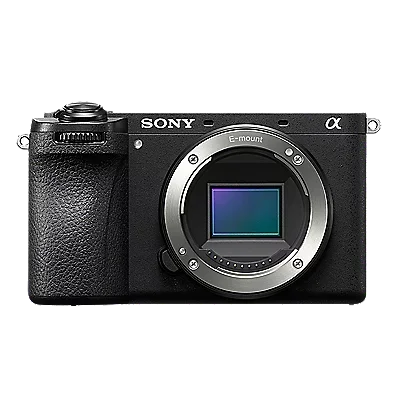
Sony Alpha 6700
Black body with E PZ 16-50mm F3.5-5.6 OSS kit lens
The Sony a6700 balances in-body stabilization and an advanced video workflow with everyday still photography. Choose it when both jobs matter and you are prepared to learn recording settings.
Main limit: The compact 16-50mm kit lens is slow in dim light; a brighter lens adds cost and weight.
Read the Alpha 6700 product profileAmazon offer omitted pending exact US variant verification.
Best stills-first hybrid
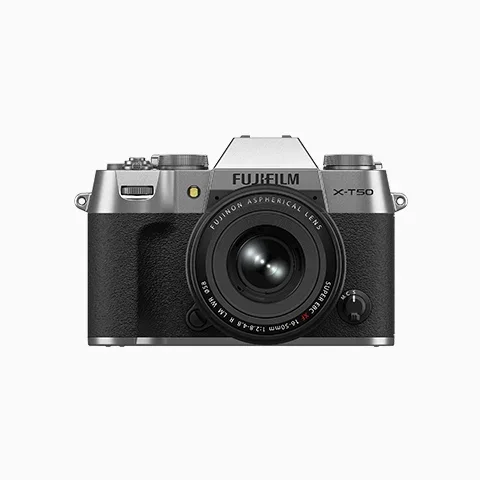
Fujifilm X-T50
Black body with XC15-45mmF3.5-5.6 OIS PZ kit lens
The Fujifilm X-T50 pairs detailed still files and in-body stabilization with video capability. It suits photographers who put stills ahead of self-recording.
Main limit: The tilting screen does not face forward; large files and a slow kit zoom add workflow constraints.
Read the X-T50 product profileAmazon offer omitted pending exact US variant verification.
Best accessible hybrid
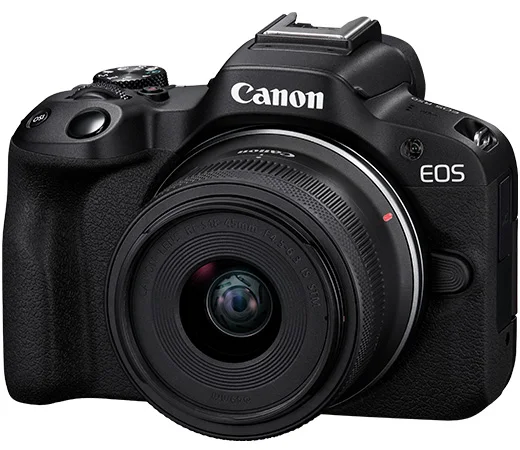
Canon EOS R50
Black body with RF-S18-45mm F4.5-6.3 IS STM kit lens
The Canon EOS R50 offers a small viewfinder-equipped starting point for learning photos and video. The 18-45mm kit is easy to carry before investing in specialist lenses.
Main limit: No in-body stabilization; the small grip and f/4.5-6.3 kit zoom constrain demanding handheld or dim-light work.
Read the EOS R50 product profileSee the exact US kit on AmazonBest handling and upgrade path
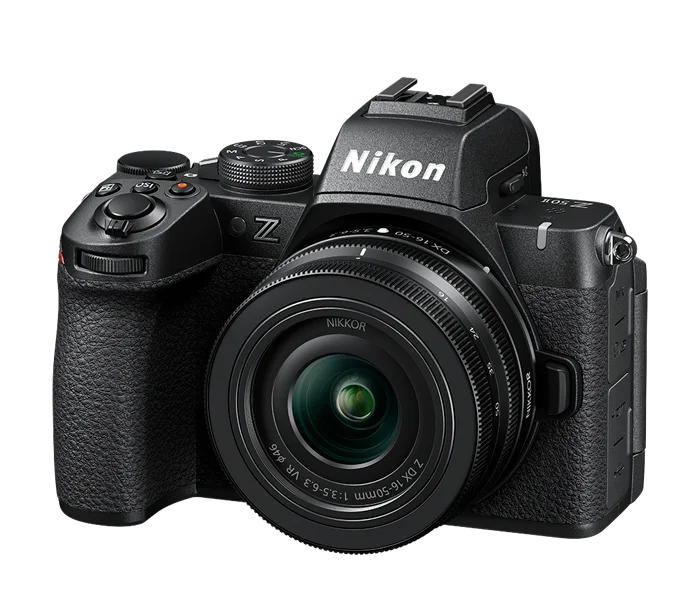
Nikon Z50II
Body with NIKKOR Z DX 16-50mm f/3.5-6.3 VR kit lens
The Nikon Z50II favors grip, physical controls and a Nikon Z lens path. Choose it when comfortable operation is more important than the smallest possible kit.
Main limit: No in-body stabilization; larger Z lenses can quickly increase the carrying burden.
Read the Z50II product profileAmazon offer omitted pending exact US variant verification.
Compare the recommended systems
| Decision factor | Sony Alpha 6700 | Fujifilm X-T50 | Canon EOS R50 | Nikon Z50II |
|---|---|---|---|---|
| Stabilization | In-body; kit lens OSS | In-body; kit lens OIS | Lens IS; no IBIS | Lens VR; no IBIS |
| Viewfinder | Electronic | Electronic | Electronic | Electronic |
| Screen | Side-articulating touchscreen | Tilting touchscreen | Side-articulating touchscreen | Side-articulating touchscreen |
| Microphone input | 3.5mm | 3.5mm | 3.5mm | 3.5mm |
| Main stills use | Travel and moving subjects | Detailed travel and everyday stills | Family, travel and learning exposure | Travel and subjects needing a firm grip |
| Main video use | Deliberate recording and grading | Tripod or operator-behind-camera video | Short everyday clips and beginner projects | Photo/video projects with external sound |
| Lens system | Sony E; APS-C kit lens | Fujifilm X | Canon RF / RF-S | Nikon Z; DX kit lens |
| Exact comparison kit weight | 609 g / 21.5 oz: 493 g body + 116 g E PZ 16-50mm OSS | 573 g / 20.2 oz: 438 g body + 135 g XC15-45mm | 505 g / 17.8 oz: 375 g body + 130 g RF-S18-45mm | 630 g / 22.2 oz: 495 g body + 135 g Z DX 16-50mm |
| Main limitation | The compact 16-50mm kit lens is slow in dim light; a brighter lens adds cost and weight. | The tilting screen does not face forward; large files and a slow kit zoom add workflow constraints. | No in-body stabilization; the small grip and f/4.5-6.3 kit zoom constrain demanding handheld or dim-light work. | No in-body stabilization; larger Z lenses can quickly increase the carrying burden. |
| Exact US offer | Black body with E PZ 16-50mm F3.5-5.6 OSS kit lens Amazon offer omitted pending exact US variant verification. | Black body with XC15-45mmF3.5-5.6 OIS PZ kit lens Amazon offer omitted pending exact US variant verification. | Black body with RF-S18-45mm F4.5-6.3 IS STM kit lens See the exact US kit on Amazon | Body with NIKKOR Z DX 16-50mm f/3.5-6.3 VR kit lens Amazon offer omitted pending exact US variant verification. |
Calculated kit totals include the manufacturer's body weight with battery and card plus the named lens. They exclude caps, straps, microphone, support and spare batteries. A different bundle has a different total; no kit price is implied.
The hybrid decision
The hybrid question is whether one body can switch between stills and video without forcing a major change of lenses, controls, sound, support, power, or file workflow. For a compact hybrid camera, compare the complete kit rather than the body dimensions alone.
Use Family Video for short everyday clips and simple sharing, Travel Vlogging for self-recording while moving, Hiking Video for an outdoor carried system, or Low-Light Video when available-light exposure is the dominant constraint.
Evaluate both workflows
| Decision factor | Stills question | Video question |
|---|---|---|
| Framing | Is a viewfinder important? | Can the screen support the operator’s position? |
| Lenses | Which still subjects need reach or aperture? | Is the field of view usable after any stabilization crop? |
| Stability | Does the lens or body help static subjects? | How will handheld motion and walking shots be controlled? |
| Sound | Is audio irrelevant to stills? | Are input, wind protection, distance, and monitoring adequate? |
| Power and files | How large are bursts and raw files? | What recording duration, heat, cards, and storage are required? |
Candidates in hybrid context
Sony a6700: deepest advanced path
The a6700 is the advanced choice when stabilization, video-oriented growth, subject recognition, and access to a broad APS-C lens system matter alongside still photography. Add the intended lens, microphone, support, and power before calling the completed rig compact.
Fujifilm X-T50: stills-first balance
The X-T50 suits a photographer who wants detailed still files and in-body stabilization while retaining capable video. Storage, lens choice, heat behavior, audio needs, and the absence of documented body weather sealing remain workflow checks.
Nikon Z50II: accessible handling
The Z50II is relevant when grip, viewfinder operation, physical controls, and a step-up lens path matter more than minimum size. Its lack of in-body stabilization makes the exact lens and shooting method part of the video decision.
Canon EOS R50: approachable first hybrid
The R50 is the accessible starting point for stills and occasional-to-regular video in a compact kit. Its smaller controls, lack of in-body stabilization, and available compact RF-S lens path should be weighed against its conventional viewfinder-equipped form.
Where should you buy a hybrid camera in the US?
Before ordering, verify the US variant, exact lens and accessories in the kit, the seller, manufacturer warranty coverage and return conditions. A body-only listing is not the same purchase as a lens kit, and third-party bundles may add accessories you do not need.
Amazon is one commercial destination offered by Senkōra. We do not claim it is always the best merchant. Compare the complete offer with your needs, and keep enough budget for lenses, sound and storage.
For a second wildlife lens, see our mount-by-mount lightweight telephoto guide. Canon beginners can compare the RF-S 55-210mm and RF 100-400mm.
Method and limits
Senkōra reviewed current US manufacturer documentation and retained catalog records on September 5, 2026. We did not perform a field test, measure recording duration, score image quality, or infer weather resistance beyond documented claims. The selection describes documented workflow fit rather than measured superiority.
Ready to choose?
Match the recommendation to your use, then verify the exact package, seller, US warranty and return policy. Amazon is a buying destination, not a guarantee of the best offer.
Sony Alpha 6700
Best overall hybrid
Black body with E PZ 16-50mm F3.5-5.6 OSS kit lens
Amazon offer omitted pending exact US variant verification.
Fujifilm X-T50
Best stills-first hybrid
Black body with XC15-45mmF3.5-5.6 OIS PZ kit lens
Amazon offer omitted pending exact US variant verification.
Canon EOS R50
Best accessible hybrid
Black body with RF-S18-45mm F4.5-6.3 IS STM kit lens
See the exact US kit on AmazonNikon Z50II
Best handling and upgrade path
Body with NIKKOR Z DX 16-50mm f/3.5-6.3 VR kit lens
Amazon offer omitted pending exact US variant verification.
Five key takeaways
- Choose for how often you switch between stills and video, including the controls, lens, and audio setup.
- Compare the stills lens path and the complete recording kit together.
- Audio, stabilization, screen movement, power, heat, and file workflow can expose different limitations.
- The best hybrid balance depends on which job is harder to replace with another device.
- This is a documentation-based evaluation, not a hands-on test.
Frequently asked questions
What is a hybrid camera?
In this guide, a hybrid camera is an interchangeable-lens camera that supports both deliberate still photography and a repeatable video workflow, including framing, lenses, sound and recording settings.
What is the best hybrid camera for beginners here?
The Canon EOS R50 is our accessible starting choice. The Nikon Z50II is an alternative when grip and physical controls matter more than the smallest kit. These are editorial recommendations, not measured test rankings.
Which compact hybrid kit is lightest here?
The Canon EOS R50 with RF-S18-45mm totals approximately 505 g including the camera battery and card, before caps, strap or video accessories. The exact lens package determines the comparison.
Can a kit lens handle low-light video?
A small variable-aperture kit zoom can work with sufficient light. Dim scenes often call for a brighter lens, support or added light; buying a more advanced body alone does not solve the exposure problem.
Primary sources
- usa.canon.com · Verified 2026-09-05
- nikonusa.com · Verified 2026-09-05
- electronics.sony.com · Verified 2026-09-05
- fujifilm-x.com · Verified 2026-09-05
- usa.canon.com · Verified 2026-09-05
- nikonusa.com · Verified 2026-09-05
- electronics.sony.com · Verified 2026-09-05
- fujifilm-x.com · Verified 2026-09-05