
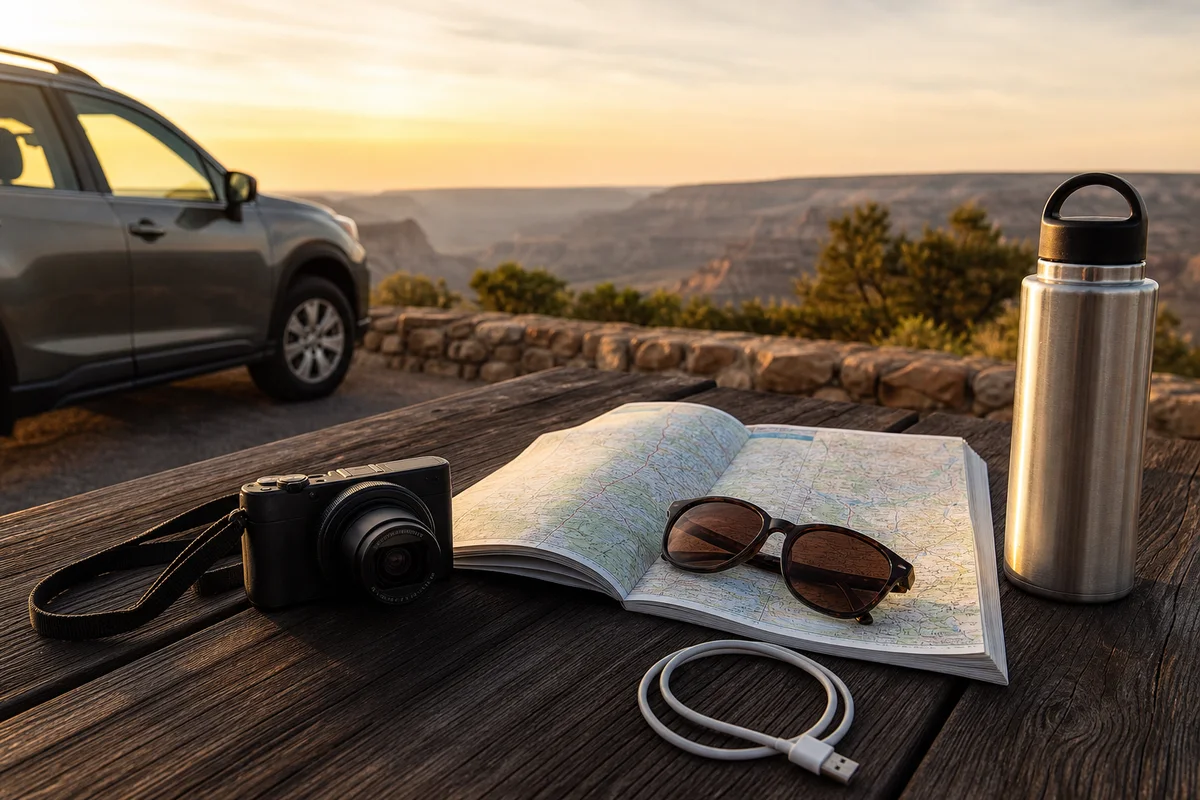
A road trip changes the camera problem
A vehicle increases carrying capacity, but it also introduces heat, cold, theft exposure, vibration, charging logistics, and equipment that becomes buried under luggage. The useful camera is the one that can be retrieved safely at a planned stop without unpacking the car. This guide owns that vehicle-based decision, not general travel portability.
Never operate or retrieve camera equipment while driving. Stop legally and secure the vehicle before handling the kit. For walking-first travel, use the lightweight travel camera guide. For trips dominated by National Park Service destinations, start with the national parks camera guide.
Road-trip criteria
| Constraint | Planning question |
|---|---|
| Stop-to-stop access | Can the camera be reached without exposing or unloading every bag? |
| Power | Where will batteries be charged, and does the exact camera support the intended method? |
| Environmental transitions | How will the kit handle dust, rain, heat, cold, and condensation risk? |
| Subject changes | Does one standard zoom cover the route, or is a second lens justified? |
| Security | Can equipment leave the vehicle with you rather than remain visible inside? |
The candidates in road-trip context
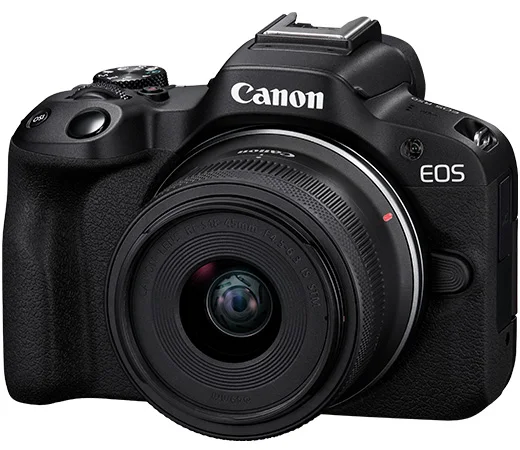
Canon EOS R50: straightforward one-lens travel
The EOS R50 is the simpler option when a compact standard zoom covers people, roadside landmarks, towns, and broad scenery. Its viewfinder helps at bright overlooks, while the small kit is easier to remove from the vehicle at every stop. The lack of in-body stabilization and the available compact RF-S lens path should be checked against any low-light or expansion plans.
Sony a6700: expandable stabilized system
The a6700 is the stronger fit when the route includes both general scenes and a planned second-lens use such as wildlife. In-body stabilization and the APS-C E-mount lens ecosystem expand the system, but the resulting two-lens kit requires more organization and can erase the compact-body advantage.
Nikon Z50II: handling for frequent lens changes
The Z50II’s larger grip and control layout are relevant when repeated stops involve more deliberate photography or a telephoto lens. It is heavier than the smallest travel combinations, so it earns its place through handling rather than minimum weight. The body lacks in-body stabilization; evaluate the exact lenses in the planned kit.
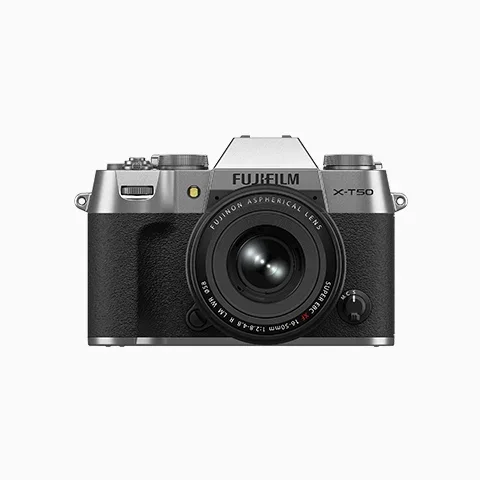
Fujifilm X-T50: compact detail-oriented option
The X-T50 combines a compact body with in-body stabilization and high-resolution files. It suits a route centered on scenery and deliberate still photography. Increased file size, the lack of documented weather sealing for the body, and the exact kit configuration should be part of the storage and protection plan.
Plan the vehicle workflow
Use a small secured insert or bag that can leave the vehicle with you. Keep batteries and electronics within their documented storage limits and avoid placing equipment in direct sun. When moving from a cold vehicle into warm humid air, allow the protected equipment to acclimate before exposing it abruptly.
Build the charging plan before departure: identify overnight outlets, compatible cables, battery chargers, and any power-bank limitations. A USB connector alone does not prove that every charger, cable, or in-use power scenario will work.
Method and limits
We reviewed official manufacturer documentation and retained Senkōra US catalog records on August 26, 2026. We assessed documented format, stabilization, viewing method, system expansion, and road-trip workflow constraints. We did not conduct a road trip, test charging combinations, measure thermal tolerance, or claim real-time availability.
Compare the exact configurations
| Product | Configuration | Before you choose |
|---|---|---|
| Canon EOS R50 | Black body with RF-S18-45mm F4.5-6.3 IS STM kit lens | Check the black 18-45mm kit rather than the white body, a body-only offer or a two-lens bundle. |
| Nikon Z50II | Body with NIKKOR Z DX 16-50mm f/3.5-6.3 VR kit lens | Verify the single 16-50mm lens kit. A two-lens package is a different offer and carrying calculation. |
| Sony Alpha 6700 | Black body with E PZ 16-50mm F3.5-5.6 OSS kit lens | Distinguish the 16-50mm kit from the body-only offer and choose a bright lens separately for dim scenes. |
| Fujifilm X-T50 | Black body with XC15-45mmF3.5-5.6 OIS PZ kit lens | Identify the XC15-45mm bundle: X-T50 offers with a different zoom have different weight and handling. |
Recommended gear
Explore the products in this guide
Review the key fit for each recommendation, then confirm the current offer and seller details directly on Amazon.
Canon
Canon EOS R50
The EOS R50 combines an electronic viewfinder with a screen that can face the photographer. It suits family outings and a first photo-and-video kit built around the small RF-S18-45mm zoom.
Fujifilm
Fujifilm X-T50
The Fujifilm X-T50 combines detailed still files, in-body stabilization and an electronic viewfinder in a compact X-mount body. The XC15-45mm kit keeps the everyday system small.
Five key takeaways
- Road-trip suitability depends on access at stops, not on using or handling a camera while driving.
- Plan charging around overnight stops and verify the exact camera, cable, adapter, and battery behavior.
- Repeated transitions between an air-conditioned vehicle and outdoor heat or humidity require care.
- A standard zoom covers most stops; add a telephoto only for a defined wildlife or distant-landscape need.
- This is a documentation-based editorial evaluation, not a road-trip field test.
Frequently asked questions
What camera setup is practical for a road trip?
A compact body with a standard zoom is the simplest starting point. Add a telephoto only when wildlife or distant details are planned strongly enough to justify more storage, weight, and lens changes.
Can I leave a camera in a parked car?
Heat, cold, theft, and rapid temperature changes can damage equipment or create condensation risk. Follow manufacturer storage guidance and do not treat a vehicle as secure climate-controlled storage.
Can I charge a camera in the vehicle?
Some cameras support in-camera USB charging or power, but behavior varies. Verify the exact model, cable, power source, and whether charging works while the camera is in use.
Were these cameras tested on a US road trip by Senkōra?
No. We evaluated manufacturer documentation and retained US catalog records; we did not conduct a road-trip field test.
Primary sources
- usa.canon.com · Verified 2026-08-26
- nikonusa.com · Verified 2026-08-26
- fujifilm-x.com · Verified 2026-08-26
- electronics.sony.com · Verified 2026-08-26