
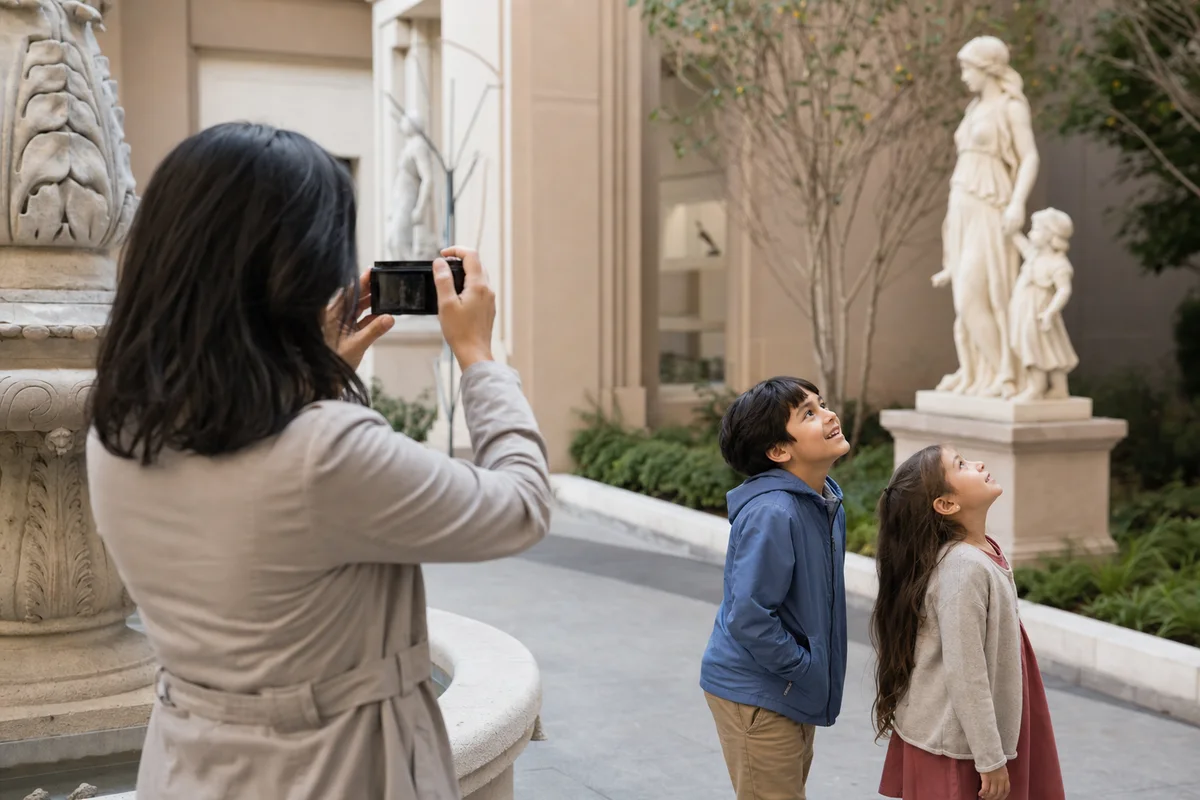
The family decision is about friction
A family travel camera competes with schedules, meals, luggage, supervision, and the phone already in a pocket. It succeeds when it can be reached, switched on, and handed to another adult without a long explanation. This page therefore evaluates family workflow rather than repeating a generic lightweight-camera ranking.
Use the lightweight travel camera guide when minimum system weight is the first constraint. For vehicle-based logistics and repeated stops, use the US road trip guide.
Family-specific criteria
| Decision | Why it matters on a family trip |
|---|---|
| Quick handoff | Another adult should be able to frame and shoot without changing the setup |
| People autofocus | Faces and moving family members are more common than controlled static subjects |
| Screen and viewfinder | Screens help group and low-angle framing; viewfinders help in bright sun |
| One-lens simplicity | Fewer lens changes reduce delay, exposed equipment, and items to track |
| Secure access | The camera must remain protected without disappearing at the bottom of a bag |
The candidates in family context
Canon EOS R50: balanced shared-use starting point
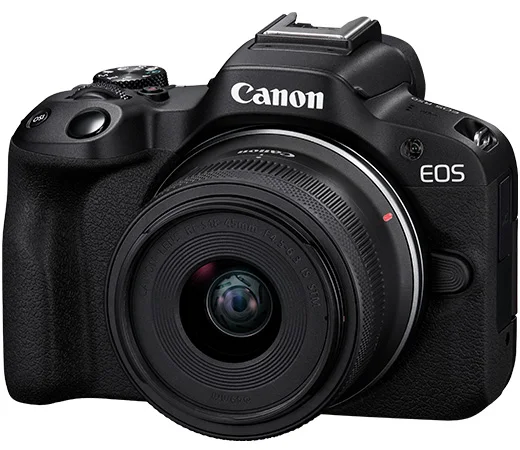
The EOS R50 combines a conventional grip and viewfinder with a compact kit configuration. That makes it the clearest starting point when different adults may use the camera and bright outdoor framing matters. Its limitation is not family usability but future system choice: confirm that Canon’s available compact RF-S lenses match any planned expansion.
Fujifilm X-M5: smallest screen-first option
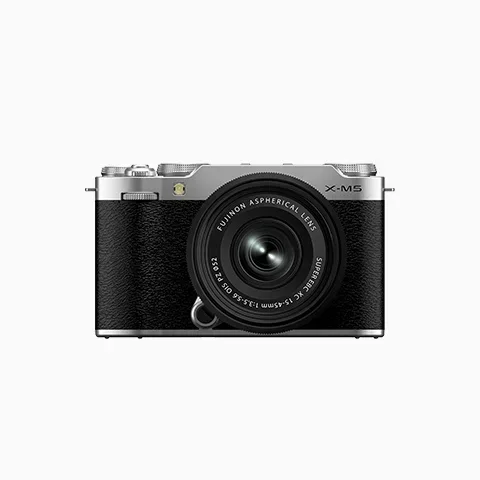
The X-M5 makes sense for a family accustomed to composing on a phone screen and prioritizing the smallest bag footprint. The absence of a viewfinder is the defining compromise, especially at beaches, snow, or other bright locations. Its video orientation also makes it relevant when short family clips matter alongside stills.
Sony a6400: established system path
The a6400 adds a viewfinder and access to a mature APS-C lens system. Its older interface and handling deserve attention when the camera will be passed between users. A broad lens catalog is not a family benefit unless the household actually plans to add lenses.
Canon EOS R100: stills-first simplicity with limitations
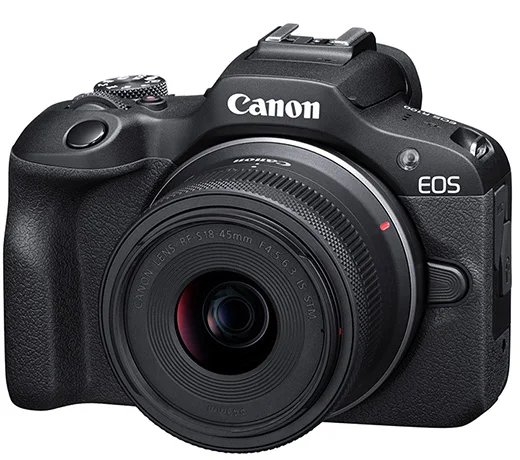
The R100 can serve a family focused on straightforward still photographs, but its fixed rear screen and older platform are meaningful constraints for group framing and flexible video. Treat its simpler feature set as a deliberate tradeoff, not as an automatic recommendation based on catalog position or launch price.
Build a low-friction family kit
Start with one general-purpose zoom, one compatible memory card, a secure strap, and a protective insert. Add a spare battery only after checking the exact camera’s charging behavior and the length of the family day. Avoid carrying accessories without a defined use; every extra item adds something to protect and remember.
Before leaving a location, use a repeatable check for camera, lens cap, phone, wallet, and family bags. This operational habit adds more practical value than a small specification advantage that makes the kit harder to manage.
Method and limits
We reviewed official manufacturer documentation and retained Senkōra US records on August 26, 2026. We evaluated format, controls, viewing method, kit simplicity, and documented system constraints. We did not conduct a family trip test, measure autofocus performance, or infer child safety or durability from product specifications.
Compare the exact configurations
| Product | Configuration | Before you choose |
|---|---|---|
| Canon EOS R100 | Black body with RF-S18-45mm F4.5-6.3 IS STM kit lens | Handle the fixed screen before buying and check that the RF-S18-45mm lens is included. |
| Canon EOS R50 | Black body with RF-S18-45mm F4.5-6.3 IS STM kit lens | Check the black 18-45mm kit rather than the white body, a body-only offer or a two-lens bundle. |
| Sony Alpha 6400 | Black body with E PZ 16-50mm F3.5-5.6 OSS kit lens | Confirm the E PZ 16-50mm lens and test how your microphone affects screen visibility. |
| Fujifilm X-M5 | Black body with XC15-45mmF3.5-5.6 OIS PZ kit lens | Try screen visibility outdoors and confirm the XC15-45mm power-zoom kit. |
Recommended gear
Explore the products in this guide
Review the key fit for each recommendation, then confirm the current offer and seller details directly on Amazon.
Canon
Canon EOS R100
The EOS R100 is a small, viewfinder-equipped starting point for learning still photography with Canon RF-S lenses. Its 18-45mm kit covers everyday scenes without a large bag.
Canon
Canon EOS R50
The EOS R50 combines an electronic viewfinder with a screen that can face the photographer. It suits family outings and a first photo-and-video kit built around the small RF-S18-45mm zoom.
Fujifilm
Fujifilm X-M5
The Fujifilm X-M5 with XC15-45mm zoom is a small screen-operated system for travel photos and creator video. It is most appealing when minimum body bulk matters more than eye-level framing.
Sony
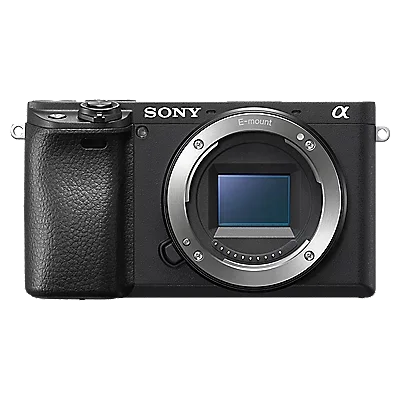
Sony Alpha 6400
The Sony a6400 with 16-50mm zoom is an E-mount travel option for photographers who want a viewfinder and a compact everyday lens, especially when they already own compatible Sony lenses.
Five key takeaways
- Family usability means quick handoffs and low setup friction, not simply the lowest body weight.
- A compact standard zoom covers people, meals, landmarks, and ordinary indoor or outdoor scenes.
- A viewfinder helps in bright sun, while a flexible rear screen can simplify group and low-angle framing.
- Choose a carry method that keeps the camera secure and accessible around children, bags, and crowds.
- This is a documentation-based editorial evaluation, not a family field test.
Frequently asked questions
What makes a camera suitable for family travel?
Fast access, understandable automatic operation, reliable people-focused autofocus, a manageable kit lens, and controls another adult can use without rebuilding the setup are more important than advanced specifications alone.
Is a viewfinder necessary for family trips?
No, but it can make framing easier in strong daylight. A screen-only camera can be smaller and familiar to phone users, so the better choice depends on who will operate it.
Should children carry the camera?
That depends on age, supervision, environment, and the equipment. Use a secure strap and make a deliberate family decision rather than assuming a small camera is automatically safe to hand over.
Were these cameras physically tested by Senkōra?
No. We evaluated official manufacturer documentation and retained US catalog records; we did not conduct a family travel field test.
Primary sources
- usa.canon.com · Verified 2026-08-26
- usa.canon.com · Verified 2026-08-26
- fujifilm-x.com · Verified 2026-08-26
- electronics.sony.com · Verified 2026-08-26