
Before the trip
Open the official page for the exact National Park Service unit, not just a general travel article. Check alerts, closures, weather, road status, trail conditions, wildlife guidance, fire restrictions, permits, and rules for the locations you plan to visit. Download maps for offline use and leave your route with someone when entering remote areas.
This checklist implements a park-specific plan; it does not decide which camera is best for hiking in general. Use the national parks camera guide to choose around a park profile, or the hiking camera guide when route duration, carried load, and trail access are the dominant constraints.
Make three lists: essential, conditional, and leave behind. This prevents a scenic-drive kit from becoming an unnecessarily heavy hiking kit.
Core kit
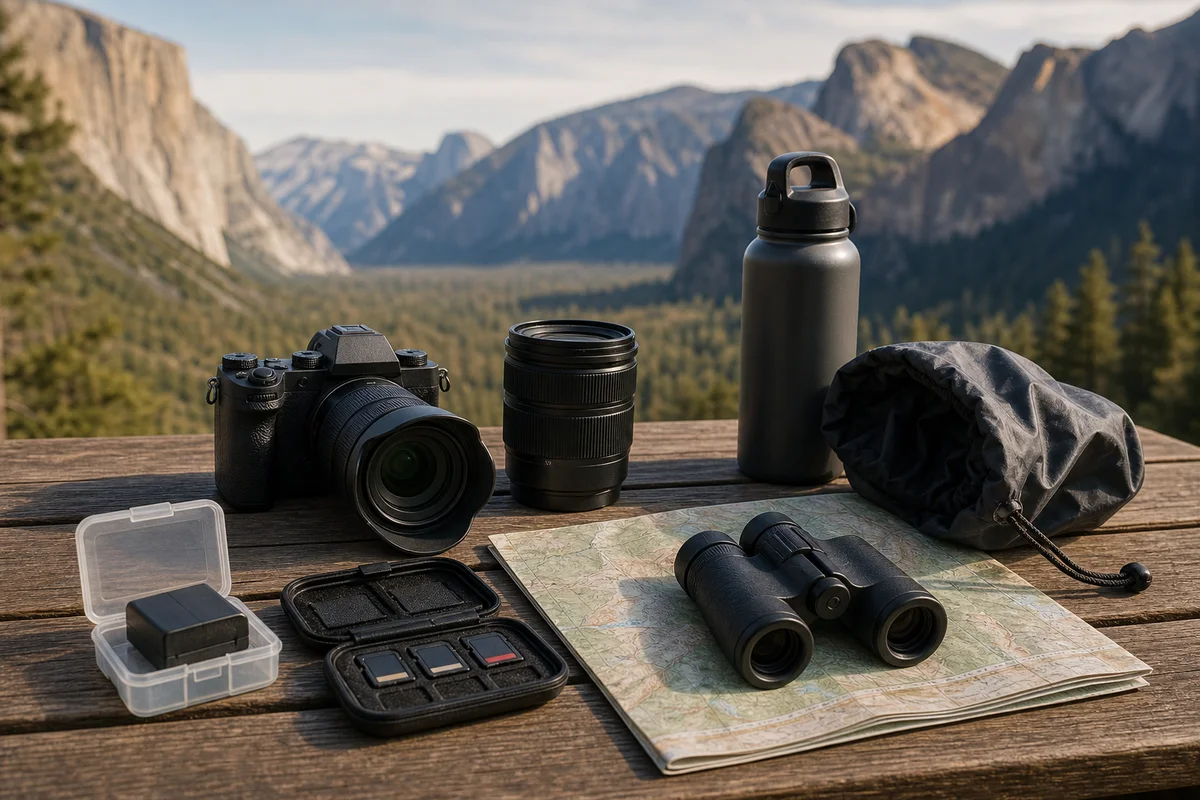
For most park days, start with:
- one camera you already know how to operate;
- one versatile lens suited to the main subject;
- one charged battery in the camera and a protected spare;
- enough formatted memory-card capacity for the day;
- lens cloth, blower, and simple rain or dust protection;
- comfortable strap or pack attachment;
- phone, offline map, water, layers, and safety essentials.
Test date, time zone, card status, image format, stabilization, and autofocus settings before leaving the trailhead. Do not rely on a first-time firmware update or unfamiliar accessory in the field.
Landscape module
Add a wider lens only if it creates a meaningful framing option beyond your standard zoom. A compact tripod can help at dawn, dusk, and night, but it should never block a trail or overlook. A polarizing filter can reduce glare in some scenes, yet it may create uneven skies on very wide lenses. Graduated filters are optional; exposure bracketing is often the lighter alternative.
Wildlife module
Add binoculars before automatically adding the heaviest telephoto. Binoculars make it easier to locate and observe animals without pointing a camera continuously. If photography is a main goal, choose a telephoto you can hold and control safely from the required distance.
The National Park Service says distances vary by park and that visitors should know the local rule before approaching an area. Never pursue, call, bait, or crowd wildlife for a photograph. If the animal changes behavior because of you, increase the distance.
Weather and terrain module
For rain, pack a fitted cover or a simple waterproof barrier that allows safe control of the camera. For dust and wind, minimize lens changes and keep caps accessible. In cold conditions, keep spare batteries protected and expect shorter runtime. In heat, never leave batteries or camera equipment exposed in a closed vehicle.
Add traction, lighting, or emergency equipment based on the route, but treat these as safety gear rather than camera accessories. Turn around before photography compromises daylight, hydration, or weather margins.
Flying with camera batteries
FAA PackSafe guidance requires spare lithium batteries and power banks to remain in carry-on baggage, with terminals protected against short circuit. Battery size and airline conditions can add requirements, so verify the current FAA and carrier pages for your exact battery before departure.
Keep batteries accessible for screening and do not pack damaged or recalled batteries. A USB charger can reduce cable bulk, but confirm that it can charge your exact battery or camera body.
What to leave behind
Leave equipment behind when it duplicates a focal range, has no planned use, cannot be protected from the forecast, or makes the pack unsafe for the route. A smaller kit used attentively is better than an exhaustive kit left in the car or carried to exhaustion.
Final five-minute check
- Exact park alerts and rules checked.
- Camera, lens, batteries, and cards tested.
- Wildlife distance and route plan understood.
- Weather and emergency gear packed.
- Total weight carried comfortably for ten minutes before departure.
Five key takeaways
- Build the kit around the day’s route and subject, not every possible photograph.
- Park-specific rules override generic packing advice.
- Binoculars and a telephoto lens help maintain safe wildlife distance.
- Spare lithium batteries belong in carry-on baggage and require protected terminals under FAA guidance.
Frequently asked questions
Are tripods allowed in national parks?
Often, but restrictions can apply at crowded overlooks, sensitive sites, trails, buildings, or during special conditions. Check the individual park’s current rules.
Can I fly a drone in a national park?
The National Park Service generally prohibits launching, landing, or operating unmanned aircraft from lands and waters it administers, subject to limited exceptions. Check the park and FAA rules before travel.
How close can I get to wildlife?
Distances vary by park and species. Check the park’s rule; use binoculars or a telephoto lens and move back if an animal reacts or approaches.