

More reach while the play is still unfolding
An athlete moves away from your position. At 300mm, the framing starts to loosen, but stopping to fit an external teleconverter means looking away from the action. Nikon’s new NIKKOR Z 120-300mm f/2.8 TC VR S addresses that specific interruption: a built-in 1.4x teleconverter extends the long end to 420mm, with maximum aperture changing from f/2.8 to f/4.
Announced on October 29, 2026, the full-frame Nikon Z lens carries a $13,999.95 US suggested retail price. Nikon expects availability in mid-November 2026. Its US product data marks the lens for preorder; that is not a promise that a new order will ship on a particular day.
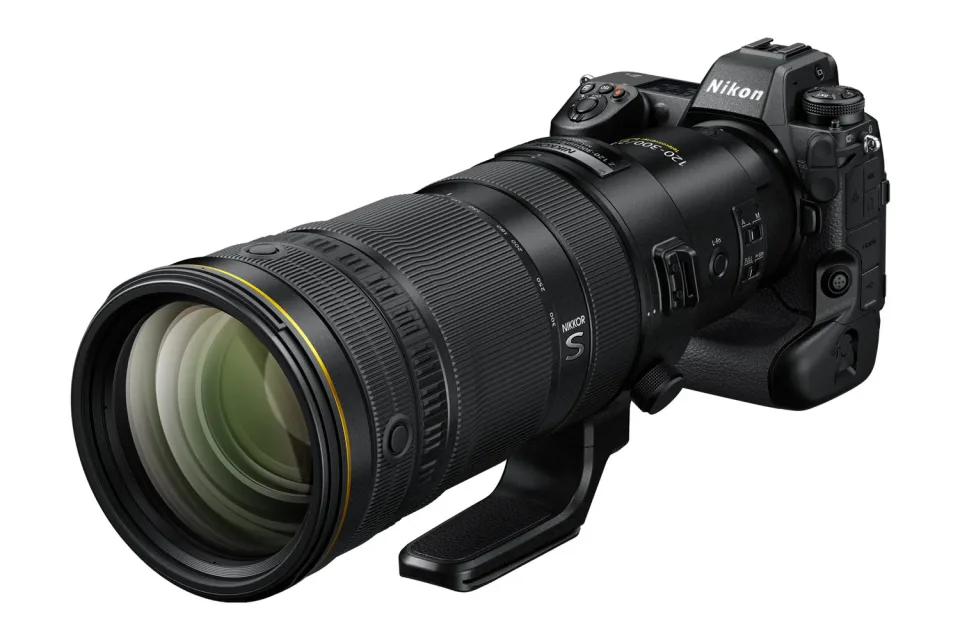
This is a source-based first look. Nikon’s optical and autofocus claims have not been independently measured by Senkōra. The cover is an official Nikon press photograph; the Z9 shown is not included with the lens.
Nikon Z 120-300mm TC specifications that matter
| Specification | Nikon announcement or product data | Practical consequence |
|---|---|---|
| Mount and image coverage | Nikon Z, full-frame/FX | Intended for Nikon Z users; it is not the older F-mount 120-300mm |
| Native focal range | 120-300mm, constant f/2.8 | Keeps a bright maximum aperture as subject distance changes |
| Built-in converter | 1.4x | Changes the range to 168-420mm at f/4 |
| Approximate weight | 2,735 g, about 6 lb | A substantial lens before adding a camera or support |
| Focus drive | Silky Swift VCM, or SSVCM | Nikon’s specified AF system; tracking reliability still needs independent evaluation |
| Stabilization | Up to 6.5 stops with compatible Synchro VR | A conditional camera-shake rating, not a subject-motion guarantee |
| Zoom and focusing | Internal mechanisms | Overall lens length remains constant while zooming and focusing |
| Filters | 112mm front screw-on; 46mm rear slip-in with supplied holder | Check the exact mounting arrangement rather than buying by diameter alone |
| US launch price and timing | $13,999.95 SRP; mid-November 2026 planned | Manufacturer announcement, not confirmed retailer stock |
The converter range of 168-420mm follows from multiplying both 120mm and 300mm by 1.4. Engaging it changes the entire zoom range, not just the maximum focal length.
What can it actually replace in a professional bag?
A fast long zoom plus repeated converter changes
The clearest replacement is a workflow: using a fast telephoto zoom, interrupting coverage to attach a 1.4x converter, then removing it when closer subjects return. Here, those transitions happen with the converter switch while the lens stays mounted.
That can matter for field sports and wildlife moving between distances. It also avoids opening the lens-to-camera connection for that particular change. It does not prove that the integrated design produces better images than an external converter; that requires controlled testing.
Some jobs normally covered with a 300mm f/2.8 prime
At its native long end, the zoom offers 300mm f/2.8. It also lets you widen to 120mm without changing position or camera. A photographer whose subjects repeatedly approach the shooting position may value that flexibility over a fixed 300mm field of view.
This is a functional comparison, not a claim of prime-equivalent sharpness, subject separation or autofocus consistency. Nor does it establish a weight saving against an unspecified prime and body combination.
It does not replace every shorter or longer telephoto
A 70-200mm zoom still covers 70-119mm, which this lens cannot. That matters near the sideline, under a basket or when a subject comes close. With a 1.4x converter, a 70-200mm design becomes 98-280mm f/4: a different framing tool, not a cheaper route to the same 420mm endpoint.
Likewise, a 400mm f/2.8 prime retains f/2.8 around 400mm, while this zoom reaches 420mm at f/4 with the converter engaged. That one-stop difference may matter when shutter speed is already constrained by dim lighting. Longer wildlife assignments can still demand more reach than 420mm.
| Setup concept | Native range | With a 1.4x converter | Main workflow distinction |
|---|---|---|---|
| New Nikon zoom | 120-300mm f/2.8 | 168-420mm f/4, built in | Change reach without fitting an external unit |
| 70-200mm f/2.8 plus compatible external converter | 70-200mm f/2.8 | 98-280mm f/4 | Wider close-action coverage; less long-end reach |
| 300mm f/2.8 prime plus compatible external converter | 300mm f/2.8 | 420mm f/4 | Same nominal long endpoints; no zoom flexibility |
The external-converter rows describe optical range arithmetic, not a compatibility list. Check the exact lens, converter and camera combination in manufacturer documentation before purchase.
One stop still matters at 420mm
The built-in converter changes maximum aperture to f/4. At the same shutter speed and scene brightness, that means roughly twice the ISO compared with f/2.8, all else equal. In bright outdoor sport, the reach may be the more useful trade-off. In a dim arena, retaining f/2.8 and accepting a looser frame may be preferable.
Nikon’s 6.5-stop VR claim does not remove that exposure decision. Its footnote specifies CIPA 2024 testing on a Z6III at the telephoto end, in Normal mode, without the teleconverter enabled, and requires a camera supporting Synchro VR. A moving athlete still needs a shutter speed suited to the movement you want to stop.
For a broader explanation of why reach, light and motion are separate constraints, see our guide to camera limits in zoom, low light and motion.
Handling: six pounds still deserves planning
Nikon lists approximately 2,735 g, about 515 g lighter than its older AF-S 120-300mm f/2.8E FL ED SR VR. That is a comparison with a specific predecessor, not evidence that this is a lightweight everyday wildlife lens.
Internal zoom and focusing keep overall length constant. This should simplify planning the space around the lens, but does not establish that balance never changes internally. For long assignments, assess your existing monopod, head, plate and carrying setup against the complete camera-and-lens load.
Nikon also specifies an Arca-Swiss-compatible tripod collar, with an important qualification: its release refers to screw-type clamps and warns against lever-type clamps that may not secure the lens firmly. Do not assume every head bearing the same compatibility label is suitable.
Filters and supports: buy for a demonstrated need
The official product data lists 112mm screw-on front filters and 46mm slip-in rear filters with the supplied holder. These are different mounting options. A diameter match alone does not establish that a particular filter or holder is appropriate.
We have not added speculative filter or monopod purchases to the product selection. Confirm the exact accessory, mounting interface and practical need first. An unnecessary filter is not part of the cost of entry merely because the lens accepts one.
For wildlife travel, work through your camera gear checklist for national parks before adding more equipment to carry.
Who should consider it, and who should keep their current lens?
Consider it if you already work in Nikon Z, regularly need f/2.8 at 300mm, and lose useful coverage while switching between native and converter-assisted reach. At this price and weight, the case rests on repeated assignments, not occasional curiosity about longer focal lengths.
Keep your current setup if a 70-200mm covers the distances you shoot, your existing longer lens already gives you the required framing, or your bigger limitation is position, technique or shutter speed. A built-in converter offers a handling advantage; it cannot improve a blocked sightline or fix motion blur caused by an unsuitable exposure.
Where possible, rent or arrange a practical evaluation before committing. We cannot yet tell you how the lens performs during a full game, how its AF behaves through obstructions or how its converter affects fine detail. Those questions deserve evidence beyond the launch specifications.
Official sources
- Nikon USA launch announcement, October 29, 2026: US suggested retail price, expected availability, handling features and VR test footnotes. Consulted October 29, 2026.
- Nikon USA product specifications and preorder page: exact US product identity, filter arrangements and preorder indication. Consulted October 29, 2026.
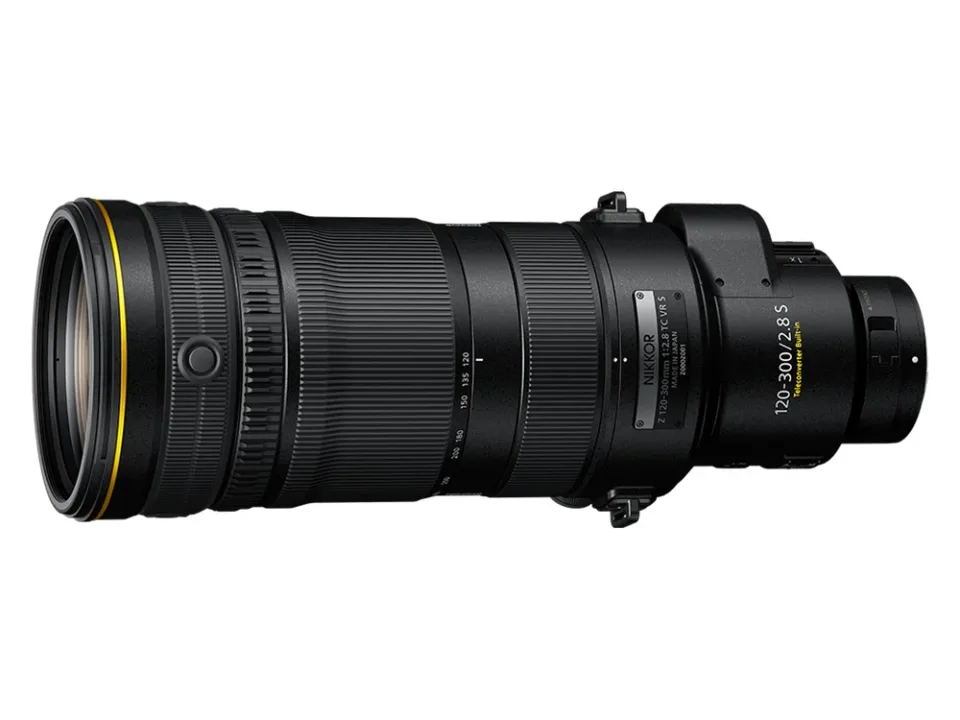
Photographs: Nikon, supplied through the linked manufacturer newsroom gallery for editorial coverage. No Senkōra field-test photographs are presented.
Transparent evidence
Method and limitations
Documentary analysis of Nikon USA's October 29, 2026 press release, its linked press gallery and official US product data. Converter range is calculated by multiplying both zoom endpoints by 1.4. Comparisons describe focal-length and handling trade-offs, not measured optical performance.
- Senkōra has not physically evaluated this lens, its autofocus, stabilization or image quality.
- Planned availability and preorder status do not confirm inventory or an order's delivery date.
- No exact Amazon US ASIN is verified. The merchant destination is a labeled search.
- Official Nikon press photographs identify the hardware and are not evidence of a Senkōra field test.
Five key takeaways
- Nikon USA announced a $13,999.95 suggested retail price and planned mid-November 2026 availability.
- The lens covers 120-300mm f/2.8 or 168-420mm f/4 with its built-in 1.4x converter.
- Nikon lists approximately 2,735 g, internal zoom and Silky Swift VCM autofocus.
- The 6.5-stop stabilization claim requires a compatible Synchro VR body and specific test conditions.
- Nikon specifies 112mm front screw-on filters and 46mm rear slip-in filters with the supplied holder.
Frequently asked questions
What is the Nikon 120-300mm f/2.8 TC US price?
Nikon USA announced a suggested retail price of $13,999.95. This is the manufacturer launch price, not an Amazon quote or a guarantee of the final checkout total.
When will the NIKKOR Z 120-300mm TC be released?
Nikon says mid-November 2026. Its US product data indicates preorder availability; an individual order's shipping date remains unconfirmed.
Does the built-in teleconverter keep f/2.8 at 420mm?
No. It changes 120-300mm f/2.8 into 168-420mm f/4, costing one stop of maximum aperture.
Can this lens replace a 70-200mm zoom?
Only if you do not need the wider 70-119mm range. It extends native f/2.8 reach to 300mm, but its 120mm starting point can be restrictive for nearby action.
Does 6.5-stop VR let me freeze athletes at slower shutter speeds?
VR reduces camera shake, not subject motion. Nikon's maximum rating requires a compatible Synchro VR camera and was measured at the telephoto end without the built-in converter engaged.
Which filters does the Nikon Z 120-300mm TC use?
Nikon specifies 112mm screw-on front filters and 46mm slip-in rear filters with the supplied holder. Confirm the exact filter and holder combination before buying an accessory.
Primary sources
- nikonusa.com · Verified 2026-10-29
- nikonusa.com · Verified 2026-10-29