

A simpler route to your first deep-sky pictures
Photographing a nebula can involve more than choosing a telescope: you also need to find the target, track it and combine exposures. The Seestar S30 Plus, announced November 10, puts those jobs into an app-guided package aimed at beginners. The question is whether that convenience solves your particular obstacle.
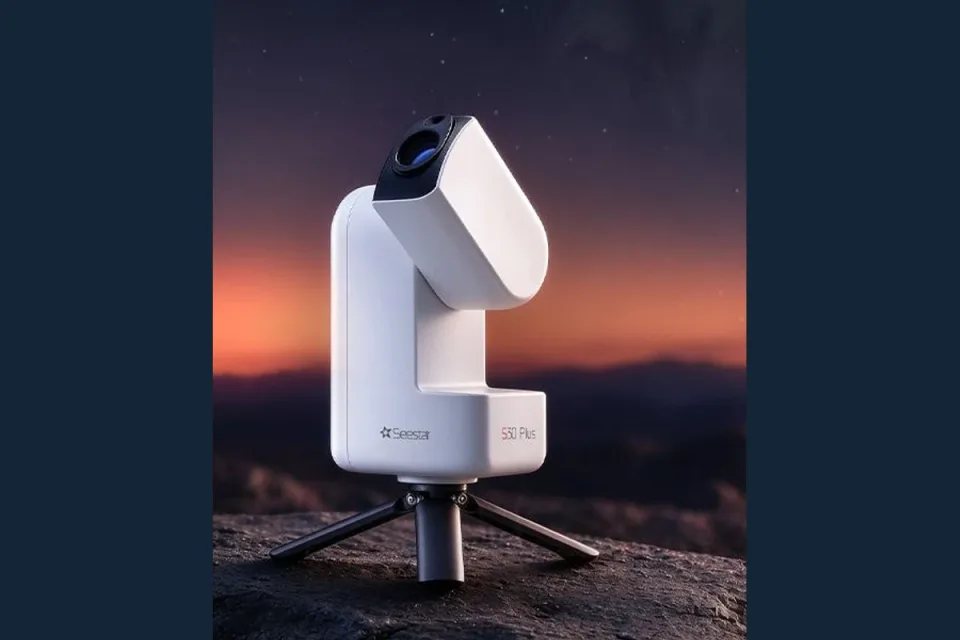
This is a documentary first look, not a physical review. The cover shows the actual S30 Plus in an official launch visual supplied by ZWO / Seestar. The product area has been cropped and resized; it is not a sample image captured with the telescope.
What Seestar announced
According to the official US product page, the kit has two 2K cameras, a 30mm-aperture, 160mm-focal-length main telescope, four-element apochromatic ED optics, a 43.5-degree wide view, JPEG/FITS output and 64GB storage. Weight is 1.65kg (3.64lb), excluding the tripod.
Seestar lists a regular US price of $499 and a temporary $474 introductory promotion, checked November 13. Its preorder notice says dispatch within seven days in order of receipt. That is the manufacturer’s stated schedule, not guaranteed delivery or verified retailer inventory. The kit includes a tabletop tripod, magnetic solar filter and carrying case.
Two views serve different pictures
The main camera is the relevant view for isolating a deep-sky target. The wide camera gives more context for larger sky scenes. Think of them as different framing tools rather than assuming that two cameras automatically produce twice the detail.
The 2K output specification tells you image dimensions; it does not establish noise, dynamic range or how much useful detail survives processing. Likewise, an ED optical design describes construction. A consistent comparison is still needed to determine the practical difference in star shapes, color correction and edge quality.
Where a 30mm aperture still matters
A compact instrument is easier to take outside regularly. That can be more valuable to a beginner than a larger system that stays in storage. However, processing cannot remove every limit imposed by aperture, sky brightness, atmospheric conditions and time on target.
Do not choose this type of device expecting the eyepiece experience of a traditional visual telescope or detailed planetary photography simply because the software can locate a planet. First decide whether your goal is screen-based imaging, visual observing or high-magnification planetary work.
S30, S30 Plus or S30 Pro?
These are separate models: check the full name rather than relying on an S30 search result. This launch report does not establish a tested ranking between them. For an existing S30 owner, a new camera specification alone is a weak reason to replace a working setup.
Identify the actual constraint first: framing, processing, time outdoors or tracking. If your images already meet your needs, practice and more suitable observing conditions may help more than an upgrade. Readers weighing aperture against portability can also read our earlier S30 versus S50 comparison, which concerns those original models, not the Plus or Pro.
Support and solar precautions
Seestar documents equatorial-mode support and recommends its TH10 head with a suitable tripod. The included tabletop tripod should not be treated as proof that every equatorial setup is ready to use. Check the manufacturer’s mounting instructions before buying extra support; an existing compatible tripod may be sufficient.
For solar imaging, follow the model-specific safety instructions and use only the correct, securely fitted, undamaged solar filter. Never point unfiltered optics at the Sun or look at it through optical equipment without appropriate protection. A software mode is not a substitute for a solar filter. If unsure, stop and obtain qualified guidance.
Buy, wait or keep what you have
Consider the S30 Plus if assembling and operating a separate tracking system is what prevents you from starting deep-sky imaging. Wait if your decision depends on independently measured tracking, optical performance or processing quality. Keep your present equipment if it already delivers the images you want.
The S30 Plus product guide records the exact model and ordering checks. No accessory is required merely to complete a shopping list. Verify phone support, seller identity, warranty terms and dispatch timing for your own order.
Sources
- Seestar US: S30 Plus specifications, kit and preorder notice, checked November 13, 2026.
- Seestar US: November 10 launch announcement.
Transparent evidence
Method and limitations
Manufacturer US product documentation checked November 13, 2026, with launch context from the official announcement. Documentary analysis only. The cover is an official Seestar launch visual of the S30 Plus, not a sample image captured with the telescope.
- No independent optical, tracking or battery measurements.
- Manufacturer preorder information is not retailer stock confirmation.
Five key takeaways
- Two 2K cameras serve different framing needs.
- The main telescope retains a 30mm aperture.
- Seestar lists a $499 regular US price; its introductory promotion is temporary.
- The supplied tabletop kit does not establish readiness for equatorial operation.
- This is an announcement analysis, with no physical evaluation by Senkōra.
Primary sources
- us.seestar.com · Verified 2026-11-13
- us.seestar.com · Verified 2026-11-13