
Start with the image, then choose a place
For a first Milky Way landscape, the objective is a broad sky over a foreground, not a magnified view of a distant galaxy. That is why a camera with a wide lens is usually a more appropriate starting point than a telescope. An interchangeable-lens camera is helpful, but some phones also offer a night or astrophotography mode when held completely still. Read your device instructions and practice before committing to a remote trip.
Use the Stargazing Finder to choose a place with documented access and room for a legal setup. Death Valley’s Mesquite Flat area has hosted NPS night-photography meetups; Bryce Canyon documents independent viewing locations. These are useful starting points, not a promise that the galaxy will align with a particular landmark.
The minimum working kit
| Component | Use what you own first | What to check |
|---|---|---|
| Camera or suitable phone | Learn its long-exposure or night controls | Focus control, battery life and file storage |
| Wide lens | Try the widest end of your kit zoom | Mount, sensor coverage and focus behavior |
| Tripod and head | A stable existing support is sufficient | Leg locks, head lock and ground stability |
| Camera plate or phone clamp | Use the correct attachment | Secure fit, clearance and battery-door access |
| Spare battery and card | Keep the session self-contained | Charge and test before departure |
| Red light and layers | Borrow from the evening packing kit | Dim controls and local conditions |
If your camera produces RAW files, they provide more editing flexibility, but shooting RAW does not rescue a badly focused image. Avoid buying a new body before learning how much your current camera can do from a tripod.
Support and compatibility come first
The Peak Design Travel Tripod is an optional compact-support candidate. The aluminum model is also identified in a US Best Buy listing. We use that listing to confirm the US product reference, not to report pricing or stock availability.
Check the manufacturer’s plate interface and supported load for your complete camera-and-lens combination. A general load rating does not measure performance in wind. Make sure the plate is firmly secured and the head cannot slip when you point upward. Keep the center column low where possible and avoid spreading tripod legs into a walkway.
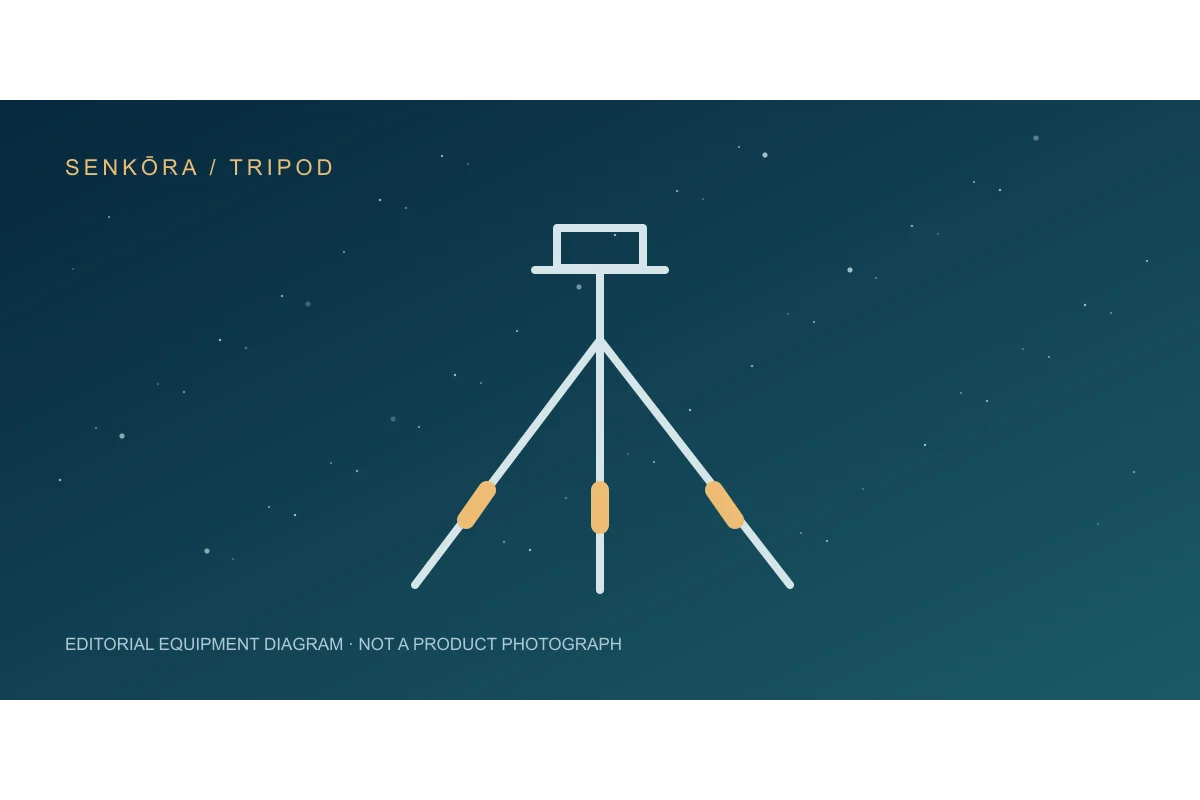
A tripod you already own is preferable to an unnecessary purchase. Carbon fiber is an optional carrying-weight choice, not a condition of photographing stars. The illustration below is a generic support diagram rather than a product photograph.
Practice focus and exposure before the trip
Set up in daylight and learn the controls by touch. At night, focus on a bright star using a magnified live view when your camera supports it. Do not assume the lens’s infinity mark gives perfect focus. Take a test frame, inspect stars at high magnification and adjust.
Begin with a short exposure and inspect whether stars remain points. Longer exposures collect more light but also record Earth’s rotation as trailing. The useful limit depends on focal length, sensor resolution, sky position and how large you will display the image; a single shutter-speed rule is not universal.
Use your camera’s self-timer or a compatible release to avoid shaking it at the start of the exposure. Change one setting at a time. Check the histogram and star shape, not just the apparent brightness of a screen that looks very bright in darkness.
Upgrade only when you know the limitation
A faster wide lens can help when your current lens needs exposures that trail. Before choosing one, check the camera mount, autofocus or manual-focus behavior, sensor coverage and filter compatibility. A lens designed for a smaller sensor may crop or vignette on another body.
A tracker introduces polar alignment, power and support requirements. It can also blur a stationary foreground, so a tracked sky and landscape may require separate exposures and a disclosed composite workflow. It is an unnecessary complication for a first attempt.
Do not buy light-painting equipment as a default part of the kit. Capitol Reef prohibits light painting, and bright lights disturb other observers even where a specific prohibition is not listed. Work with a legal position and natural light.
Plan the date and the return
The bright central region of the Milky Way is seasonal, and a bright Moon or cloud can hide it. NPS’s Bryce guidance identifies summer as useful for seeing the center earlier in the night, but your exact date, direction and horizon still require planning. This guide is not a live sky calculator.
Scout the return path and keep the first session short enough to finish safely. Carry the basics from our stargazing packing list. A well-focused photograph from an ordinary kit is a better first milestone than a bag of unfamiliar equipment.
Recommended gear
Explore the products in this guide
Review the key fit for each recommendation, then confirm the current offer and seller details directly on Amazon.
Peak Design
Peak Design Travel Tripod, Aluminum
Best for: A compact support option when an existing tripod is too awkward to carry
The manufacturer offers an aluminum travel model with a camera plate. This is an optional portability purchase, not an astronomy-specific requirement. Verify the plate interface and complete camera load.
Transparent evidence
Method and limitations
Equipment advice based on official product identification, a US merchant listing and official night-photography guidance. No camera, lens or tripod field test is claimed.
- No exact Amazon US ASIN is confirmed; the affiliate destination is a search.
- No live astronomical calculation, weather forecast or guaranteed Milky Way visibility is provided.
Five key takeaways
- A camera and wide lens are the starting point for landscape Milky Way images.
- Tripod stability and a secure plate matter more than a new camera body.
- Check lens mount, sensor coverage and the full supported load before buying.
- Use test exposures and inspect stars rather than trusting one universal setting.
- A tracker adds alignment and foreground complexity, so leave it for later.
Primary sources
- peakdesign.com · Verified 2026-09-13
- bestbuy.com · Verified 2026-09-13
- nps.gov · Verified 2026-09-13
- nps.gov · Verified 2026-09-13
- nps.gov · Verified 2026-09-13