
Quick answer
APS-C is often the efficient choice for birds, distant mammals, and hiking because a dense sensor can place many pixels on a subject while using a smaller system. Full frame is often stronger when wildlife is active in poor light and a fast shutter speed forces high ISO. Neither format creates a photograph by itself: the lens, autofocus, handling, and photographer’s ability to carry and stabilize the kit are decisive.
What crop factor actually changes
A crop sensor records a smaller portion of the image projected by a lens. The result looks tighter when compared at the same output size. The lens did not become longer, and the scene was not optically magnified.
For distant wildlife, ask how many useful pixels cover the animal. A high-density APS-C sensor can outperform a lower-density full-frame file that must be heavily cropped. But more pixels do not rescue soft optics, missed focus, heat shimmer, subject motion, or camera shake.
Matched wildlife scenarios
| Situation | APS-C advantage | Full-frame advantage |
|---|---|---|
| Small birds in good light | Dense framing with a manageable lens | More cropping flexibility on high-resolution bodies |
| Mammals at dawn or dusk | Smaller system may be easier to position | Better high-ISO latitude in comparable technology |
| Long trail day | Often lower body-and-lens weight | Compact options exist, but lens choice is critical |
| Subject isolation | Capable with longer or faster lenses | Shallower depth of field is easier |
Reach and detail
Compare a complete output workflow. If two cameras have similar pixel pitch, cropping the full-frame image to APS-C framing may produce similar subject resolution. If the APS-C body has substantially greater pixel density, it may record more samples across the animal. Test results must therefore state sensor resolution, distance, lens, framing, and output size.
Noise and shutter speed
Wildlife often needs a fast shutter speed, especially for birds in flight. That can push ISO upward at sunrise, sunset, or under forest cover. Full frame has a useful advantage here when comparing sensors of similar generation and exposure. A wider-aperture lens can change the equation, but usually adds cost and weight.
Autofocus and handling
Sensor format does not guarantee better subject detection or tracking. Evaluate the exact camera’s autofocus modes, control layout, buffer behavior, and compatibility with the lens. Senkōra does not infer real-world hit rates from a feature list; controlled testing is required for that claim.
Lens and carried weight
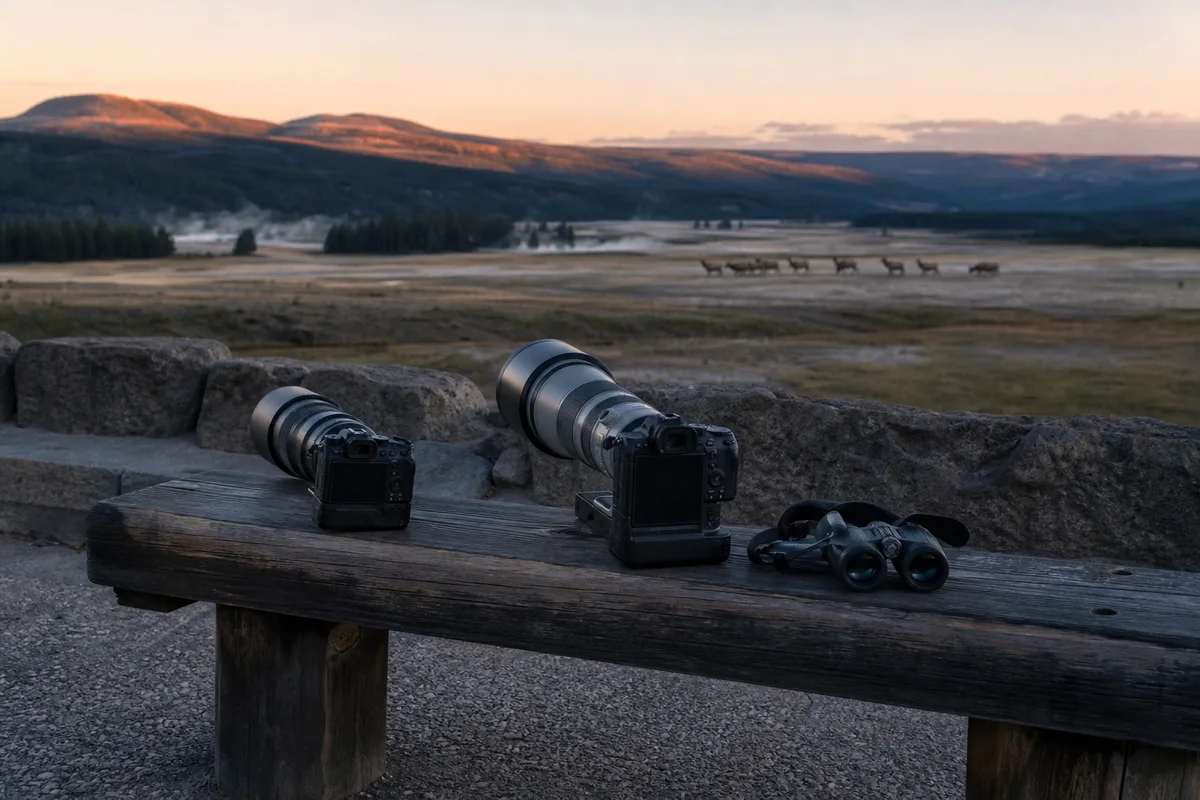
A lighter body can be overwhelmed by a heavy telephoto. Compare the body, lens, hood, support, spare battery, and rain protection. For national parks, the safer and more useful kit may include binoculars and a moderate telephoto rather than the largest lens you can afford.
Choose by wildlife type
- Birds in good light: prioritize pixel density, autofocus controls, buffer, and a lens you can hold steadily.
- Large mammals near dawn or dusk: prioritize low-light performance and a sufficiently fast lens.
- Backcountry wildlife: prioritize total weight, weather strategy, and battery endurance.
- Roadside observation: a heavier supported system may be practical, provided you use designated pullouts and maintain park-specific wildlife distances.
Safety comes before framing
The National Park Service advises visitors to check each park’s rules and use binoculars or a telephoto lens rather than approaching wildlife. If an animal reacts to you, you are too close. Sensor format never justifies reducing a required viewing distance.
Methodology and limits
This article evaluates documented camera specifications and established imaging principles. It is not a field test and does not assign universal autofocus or image-quality rankings. Compare exact current US bodies and lenses before purchase.
Five key takeaways
- Crop factor changes field of view, not focal length or optical magnification.
- Pixels on the subject, lens quality, focus accuracy, and atmospheric conditions determine usable detail.
- Full frame generally has more low-light latitude in a matched-generation comparison.
- The best wildlife system is the one whose lens, autofocus behavior, and total weight fit the subject and location.
Frequently asked questions
Does APS-C give a wildlife lens more reach?
It gives a narrower field of view. Whether it records more subject detail depends largely on pixel density, lens performance, focus, and shooting conditions.
Which format is better at dawn?
Full frame generally provides more high-ISO latitude when technology and framing are comparable, but lens aperture and stabilization strategy remain important.
Do megapixels matter more than sensor size?
They are one part of the result. Pixel density can put more pixels on a distant subject, but noise, lens resolution, motion, and focus can limit the benefit.
Primary sources
- usa.canon.com · Verified 2026-07-22
- nikonusa.com · Verified 2026-07-22
- electronics.sony.com · Verified 2026-07-22
- explore.omsystem.com · Verified 2026-07-22