

A close-up that still tells you where you are
A dish photographed with its table setting, a small product shown in its workspace, or an insect with a recognizable habitat calls for more than isolated detail. A wider macro lens can put the subject and its surroundings into the same visual story.
Venus Optics introduced the Laowa ACRIS 35mm f/2.8 1X Macro APO on September 30, 2026. It covers full frame and reaches life-size reproduction, with a $449 listing on Laowa’s international store checked October 1. The important buying detail is the focusing range: the autofocus versions do not autofocus all the way to life-size macro. Laowa product page, dated launch report.
This is a first look based on documentation. Senkōra has not handled the lens or measured its image quality.
The autofocus boundary you need to know
Autofocus lens does not mean autofocus at 1:1. On Sony E, Nikon Z and Canon EF, autofocus operates from 0.5 m to infinity. Below 0.5 m, through the maximum 1:1 magnification, Laowa specifies a manual focus ring with Macro Focus Assistance. Canon RF and L-Mount versions are manual focus only.
| Mount | From 0.5 m to infinity | Closer macro range through 1:1 |
|---|---|---|
| Sony E | Autofocus | Manual focus with macro assistance |
| Nikon Z | Autofocus | Manual focus with macro assistance |
| Canon EF | Autofocus | Manual focus with macro assistance |
| Canon RF | Manual focus | Manual focus |
| L-Mount | Manual focus | Manual focus |
Laowa describes the assisted close-range adjustments as useful for focus stacking. That is relevant when a stationary subject needs multiple focus planes combined into one image. It does not establish automatic in-camera focus-bracketing compatibility, automated stacking or reliable autofocus tracking of a moving insect at 1:1. Those workflows need verification with your exact body and mount. Laowa focusing explanation.
180mm focusing distance is not 180mm of space for a light
The two distance specifications describe different measurements:
- Minimum focusing distance: 180mm, about 7.1 inches. This is measured from the camera’s sensor plane to the subject.
- Minimum working distance: 48.6mm, about 1.9 inches. This is the clearance ahead of the lens at the closest setting.
That second number is the practical constraint. At maximum magnification, there is little room to position a diffuser or bring light in from the front. The camera and lens may shade the subject. A hood or protruding accessory can further reduce usable clearance.
For food or a still product, you can move lights and arrange the set around the lens. For a living subject, moving the lens that close may disturb it before you get the frame. Do not assume that a wider macro is automatically easier for insect photography.
At 1:1, an object is projected onto the sensor at its actual size: a 10mm feature occupies 10mm on the sensor. This describes reproduction scale, not a promise about resolution, sharpness or screen enlargement. Official specifications.
35mm versus 90mm or 100mm: choose the picture first
The following comparison describes typical focal-length tradeoffs, rather than measured results from specific competing lenses. At the same reproduction ratio on the same sensor, the subject occupies the same sensor area; the view and rendering of its surroundings can still differ substantially.
| Shooting goal | What a 35mm macro can offer | Why a 90mm or 100mm macro may fit better |
|---|---|---|
| Food with a table setting | More surrounding objects and a stronger sense of place | Tighter detail with fewer background distractions |
| Products in a workspace | Close detail while retaining context | Easier subject isolation and generally more lighting clearance |
| Insects in their habitat | An immersive environmental viewpoint | Generally more distance from wary subjects; check the exact lens |
| Small textures or specimens | Life-size detail with a wider perspective | A simpler route to an isolated detail study |
Including surroundings also means managing them. Move a distracting utensil, choose a cleaner background or change camera position before deciding that another lens will improve the photograph. A 35mm view does not make the background automatically sharp; aperture, distances and focus placement still matter.
If your existing 90mm or 100mm macro already produces the isolated images you want, keep it. The ACRIS is a possible complementary viewpoint, rather than an automatic replacement.
What Laowa specifies, and what remains a claim
| Specification | Manufacturer listing | Practical relevance |
|---|---|---|
| Coverage and focal length | Full frame, 35mm | Environmental close-ups and general photography |
| Maximum reproduction | 1:1 | Life-size detail on the sensor |
| Aperture range | f/2.8 to f/22 | Exposure and depth-of-field choices; stopping down does not guarantee more resolved detail |
| Optical construction | 13 elements in 10 groups, APO design | Color-fringing control is a design aim, not an independently verified result |
| Minimum distances | 180mm focus; 48.6mm working | Plan subject clearance and lighting carefully |
| Body | Metal, advertised dust and moisture resistance | No independent durability result or waterproof rating established here |
| Filter thread | Official table lists 72mm | Confirm exact mount version before ordering |
There is a filter-size ambiguity worth resolving before buying accessories. Laowa’s current specification table lists 72mm without separating mounts, while Newsshooter’s launch coverage gives 72mm for AF and 67mm for manual-focus versions. Senkōra therefore does not recommend a universal 72mm filter purchase for every ACRIS version. Ask Laowa or the seller to confirm the thread for your exact mount.
The APO label and manufacturer claims about edge sharpness do not substitute for independent samples. We cannot yet judge flare, chromatic aberration, corner consistency, focus breathing or autofocus confidence.
US ordering: $449 is a store listing, not a delivery guarantee
Laowa’s international store displays USD $449 and ordering controls for the mount variants. That establishes a manufacturer store offer, not confirmed US retailer stock, a firm US arrival date or the total delivered cost. Check shipping, taxes, return terms and warranty coverage for your destination before ordering.
No exact Amazon US ASIN has been verified. Any enabled Amazon link in the product selection below is an explicitly labeled Amazon.com search. A result for another Laowa 35mm lens, or a different mount, is not this exact product. The ACRIS product guide keeps the mount limitations alongside the lens record.
We have selected only the lens. A focusing rail, tripod or macro light may help a particular stationary-subject workflow, but the announcement alone does not justify buying a new kit. Start with the support and lighting you already own, then identify a specific clearance or stability problem. Filter compatibility must be settled first.
Consider, wait or keep your current lens
Consider the ACRIS if you want life-size close-ups with more context, can control a stationary subject and its lighting, and are comfortable focusing manually in the macro range. Choose the mount for your actual camera; Canon EF and Canon RF are different versions with different focusing capabilities.
Wait if you need proven optical performance, demonstrated camera focus-bracketing compatibility, dependable close-range action focusing or delivery by a fixed date. The specifications do not resolve those questions.
Keep your existing macro if you mainly photograph wary insects, need room for front lighting or prefer isolated details. Better light, more careful framing and a steadier setup may improve those images more than adding a wider lens.
The ACRIS’s most useful proposition is a different kind of close-up. Its buying case depends on wanting that wider visual story and accepting the very short working distance required to create it.
Recommended gear
Find your next piece of gear
Find the setup that fits your plans, then explore prices and buying options on Amazon.
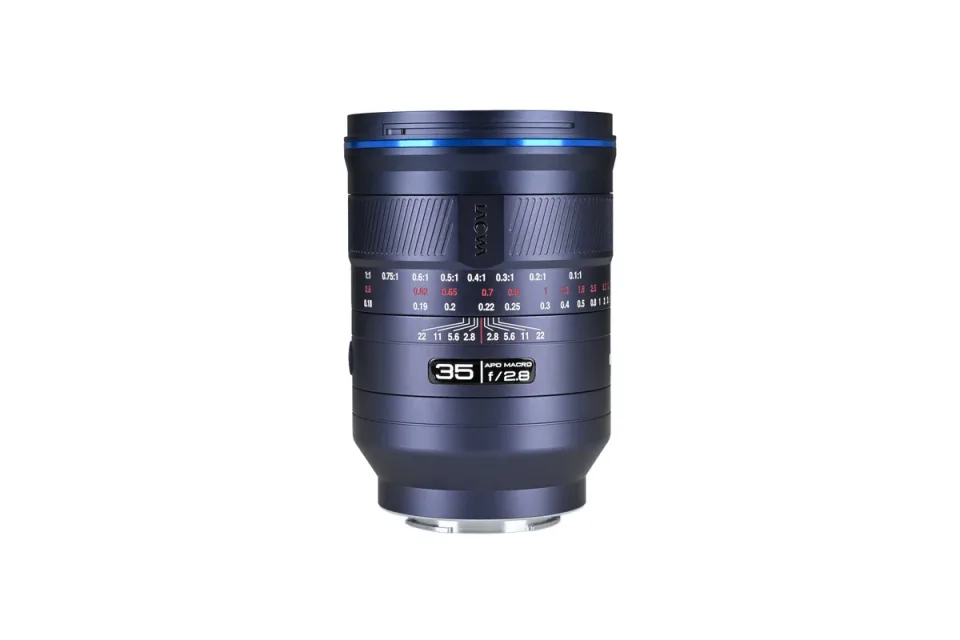
Laowa
Laowa ACRIS 35mm f/2.8 1X Macro APO
Best for: Close-ups with environmental context
Full-frame 1:1 reproduction with a wider view than a conventional 90mm or 100mm macro; manual focus is required in the close macro range.
Transparent evidence
Method and limitations
First-look documentary analysis. We checked Laowa's official product page, specification table, focusing explanation and $449 ordering interface on October 1, 2026. Amateur Photographer's September 30 report establishes launch chronology. Use-case comparisons are editorial interpretation of focal length and working distance, not measured performance. Official lens photography: Laowa / Venus Optics.
- No independent optical, autofocus, focus-stacking or weather-resistance tests.
- US stock, firm shipping date, delivered cost and exact Amazon US ASIN remain unconfirmed.
- Official filter-size copy does not distinguish mounts; confirm the exact variant before buying accessories.
- The official Sony E photograph does not establish the appearance or dimensions of every mount version.
Five key takeaways
- The international Laowa store lists $449; that is not a confirmed US delivered cost or shipping date.
- Sony E, Nikon Z and Canon EF autofocus stops at 0.5 m. It does not extend to 1:1.
- Canon RF and L-Mount versions are manual focus only.
- 180mm minimum focus distance is measured from the sensor plane; 48.6mm working distance is the much smaller clearance in front of the lens.
- Confirm filter size for your exact variant before buying; no exact Amazon US ASIN is verified.
Frequently asked questions
Does the Laowa ACRIS 35mm autofocus at 1:1?
No. Sony E, Nikon Z and Canon EF versions autofocus from 0.5 m to infinity. In the closer range, including 1:1, Laowa specifies manual focusing with Macro Focus Assistance. Canon RF and L-Mount are manual focus only.
What is the difference between focusing distance and working distance?
Focusing distance runs from the camera's sensor plane to the subject. Working distance is the clearance from the front of the lens to the subject. Laowa specifies 180mm minimum focusing distance and 48.6mm minimum working distance, so you do not have 180mm of lighting space ahead of the lens.
Is a 35mm macro better than a 100mm macro?
Choose by the image you want. A 35mm macro includes more surrounding context, while a longer macro generally makes it easier to isolate the subject and leave room for lighting. Exact working distance depends on the lens. Neither focal length alone establishes optical quality.
Does every ACRIS 35mm version take 72mm filters?
Laowa's official specification table lists 72mm without a mount distinction. Some launch reports distinguish 72mm AF and 67mm manual-focus versions. Confirm the exact variant's thread with Laowa or your seller before ordering a filter.
Is the Laowa ACRIS 35mm available on Amazon US?
No exact Amazon US ASIN has been verified. Any enabled Amazon link for this selection is a search, not a confirmed product listing or availability claim. Check the full ACRIS model name and camera mount.
Primary sources
- venuslens.net · Verified 2026-10-01
- amateurphotographer.com · Verified 2026-10-01
- newsshooter.com · Verified 2026-10-01