

For a weekend of street details, friends and paired visual stories, half-frame film offers room to experiment before the roll runs out. Lomography’s new Lomo72 adds a glass lens, two-zone focusing and creative exposure modes to that idea. The important question is whether those controls help you make pictures your current camera cannot.
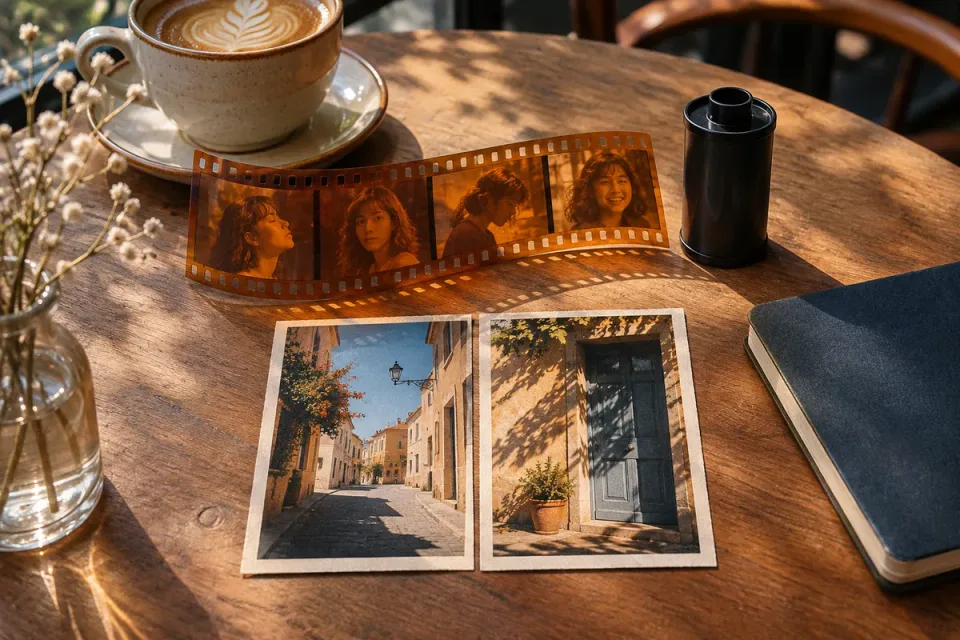
The cover is an original AI-generated conceptual illustration. It does not show the Lomo72 or photographs made with it.
What Lomography announced
The November 16 announcement describes a 35mm half-frame camera with a multi-coated, two-element glass lens. The US specifications list a 27mm focal length, a fixed f/10 aperture, a normal 1/100-second exposure and Bulb mode. Black and silver versions are offered.
The US black product page and official announcement now agree on f/10. Both were checked on November 20, 2026; we have not carried forward the earlier f/8 discrepancy.
What the half-frame format changes
Each image measures 17 × 24mm. A 36-exposure roll can yield up to 72 photographs, so you can try a second composition without consuming a full-size frame. With the camera held normally, the individual image is vertical. Two consecutive pictures can become a diptych: a person and their surroundings, or a wide scene followed by a detail.
The economy has a trade-off. Each negative has roughly half the area of a conventional 35mm frame. For the same output size, it needs more enlargement, making grain and imperfections more apparent. Large prints and heavy cropping leave less margin than full-frame 35mm. This is a format consequence, not a measurement of the Lomo72’s resolving power.
Film cost per picture can fall, but processing and scanning savings depend on the lab. Ask whether it scans individual half-frames, pairs them or charges extra. A roll with twice as many frames also takes longer to finish if you shoot only occasionally.
Why the glass lens and zone focus matter
Lomography describes the lens’s framing as approximately 40.5mm equivalent. Treat that as a manufacturer comparison for field of view, not a change in its physical focal length or light-gathering ability. In practice, this favors everyday subjects and details over expansive interiors.
The two manual zones cover 0.4–1m and 1m to infinity, approximately 1.3–3.3 feet and 3.3 feet onward. Selecting the near zone may be useful for a friend across a table or a small object. You still need to estimate distance and remember the switch; there is no autofocus confirmation.
Glass and coatings are design choices with potential optical benefits. They do not prove that this camera produces sharper, better-exposed pictures than another model. Focus accuracy, film, flare, scanning and manufacturing consistency all matter. We have no controlled comparisons to settle that question.
Where the Lomo72 remains limited
Normal shooting combines one shutter speed with a fixed aperture. There is no documented ISO adjustment or exposure meter in the material reviewed. Choose film and lighting deliberately; do not expect a change of film speed to make the camera automatically adapt. A fixed 1/100 second also leaves subject motion and camera shake to your technique.
Bulb mode lets you hold the shutter open, while the multiple-exposure control lets you layer images on one frame. These expand creative possibilities without becoming a full manual exposure system. The tripod socket and mechanical cable-release thread help with supported long exposures; they do not calculate the exposure for you.
The built-in flash uses one AAA battery. Plan to obtain film and a battery separately, and verify the package contents before ordering: the official pages reviewed do not establish that these consumables are supplied. We cannot judge flash recycling, battery life, real exposure accuracy, handling or long-term reliability from the specifications.
Lomo72 vs Kodak Ektar H35 and H35N
RETO’s current documentation distinguishes the H35 from the H35N. Do not treat them as one model or assume that an imported bundle has the same contents as a US offer. No exact US retailer kit or ASIN for either competitor was confirmed in this research, so this is a model-feature comparison, without purchase links.
| Feature | Lomo72 | Kodak Ektar H35 | Kodak Ektar H35N |
|---|---|---|---|
| Lens construction | Multi-coated glass, two elements | Two acrylic elements | Coated lens, one glass and one acrylic element |
| Focal length | 27mm | 22mm | 22mm |
| Focusing approach | Two selectable zones | Simple focus-free design | Simple focus-free design |
| Normal shutter | 1/100 second | 1/100 second | 1/100 second |
| Long exposures | Bulb | No Bulb mode listed | Bulb, with tripod and cable-release support |
| Distinctive creative option | Multiple exposures and colored flash gels | Minimal controls | Built-in star filter |
The Lomo72’s case against the H35 rests on deliberate focusing and additional creative controls. Against the H35N, the distinction is narrower: that camera already has a glass element and long-exposure support. A longer focal length also changes framing; it is not automatically an upgrade.
Both Kodak models are positioned below the Lomo72’s announced $79 on RETO’s dollar-denominated store pages checked November 20. That observation is not a verified US delivered-price comparison: shipping, taxes, seller, warranty and bundles can change the total. Compare equivalent offers before deciding that a premium is justified.
Who should consider it
Consider the Lomo72 if you specifically want to try close-zone subjects, layered exposures or supported night experiments while keeping the half-frame workflow. Those are useful reasons to pay for different controls.
Keep your current half-frame camera if you mostly shoot daylight snapshots and already like the results. Spend the next roll on a focused project: pair every establishing frame with a detail, or photograph one neighborhood at the same time each day. Changing equipment will not supply that visual idea.
Wait for independent testing if you need predictable exposure or want proof that the lens improves fine detail. A preorder is a poor substitute for evidence when image quality is the deciding factor. Readers seeking broader exposure control should assess a different class of camera rather than expecting this simple design to behave like a more advanced system.
Price and US availability
As checked November 20, 2026, Lomography’s US range page lists both colors for preorder at an announced US launch price of $79. This is manufacturer pricing, not an Amazon quote or a permanent price promise.
The black product page lists estimated shipping in December 2026. Its regional FAQ refers to North American delivery before mid-December, while promotional copy promises worldwide delivery before December 24. These are manufacturer estimates with different wording, not a delivery guarantee from Senkōra. Confirm the date for your US address at checkout.
The Lomo72 product guide keeps the documented black variant and ordering checks together. Amazon link unavailable: no exact US ASIN has been confirmed, and we do not substitute an Amazon search for a verified listing.
Method and limits
This is documentary analysis of official sources consulted on November 20, 2026, not a field review. The DPReview announcement report, dated November 16, provides independent context; it is not evidence of a controlled comparison by Senkōra. Manufacturer superlatives about sharpness are not our findings.
No sample photographs, exposure measurements, reliability trials or handling observations were produced for this article. The public product guide intentionally has no camera photograph until editorial image rights are confirmed. The generated cover belongs to the article and is not reused as a product image.
For another creative approach, see the Polaroid Mod announcement. It uses a different workflow; its discussion of creative modes does not establish Lomo72 compatibility or performance.
Transparent evidence
Method and limitations
Documentary analysis of official Lomography and RETO product information consulted November 20, 2026. DPReview's November 16 announcement coverage supplies independent context, not a comparative field test. No camera was used or measured by Senkōra.
- No hands-on image-quality, reliability or flash-endurance findings.
- No exact Amazon US listing or ASIN confirmed; no Amazon link is offered.
- Manufacturer shipping estimates can change; verify US delivery before ordering.
Five key takeaways
- Up to 72 pictures on a 36-exposure roll means more attempts, with a smaller negative for each image.
- Two focus zones add a deliberate near-subject option; this is not autofocus.
- The glass lens is a documented feature, not proof of superior image quality.
- Multiple exposures and Bulb mode favor experimentation over exposure precision.
- The $79 US launch price and December shipping estimate are manufacturer information, not Amazon inventory.
Frequently asked questions
Does the Lomo72 use ordinary 35mm film?
Yes. It exposes smaller 17 × 24mm images on 35mm film, allowing up to 72 pictures on a 36-exposure roll. Ask your lab how it scans and bills half-frame images.
Is the Lomo72 autofocus or automatically metered?
No autofocus is documented. You select one of two focus zones. The manufacturer lists no ISO adjustment and does not document automatic exposure metering.
Is its aperture f/8 or f/10?
The US black product page and official announcement both list a fixed f/10 aperture as checked November 20, 2026. Earlier conflicting information is not used here.
Can I buy the Lomo72 on Amazon US?
Senkōra has not confirmed an exact US listing or ASIN. This page provides no Amazon product or search link for the Lomo72.
Primary sources
- shop.lomography.com · Verified 2026-11-20
- shop.lomography.com · Verified 2026-11-20
- lomography.com · Verified 2026-11-20
- kodak.retopro.co · Verified 2026-11-20
- kodak.retopro.co · Verified 2026-11-20
- dpreview.com · Verified 2026-11-20