

The decision in one glance
The Insta360 X6 is not merely an X5 with a faster headline mode. It combines larger dual custom square 1/1.1-inch sensors, a revised triple-chip imaging system, 8K 360 video at up to 50 fps, 10-bit color options, native Dolby Vision, a 2.32-inch OLED screen, internal storage, and a second-generation replaceable-lens design.
Those changes make the X6 the better camera on paper. They do not make every X5 obsolete.
| Buyer | Best starting decision | Why |
|---|---|---|
| Buying a first premium 360 camera | X6 | Higher motion and color ceiling, larger sensors, newer screen and lens system |
| Owns an X5 and mainly shoots daylight at 8K30 | Keep the X5 | The practical image gain is unlikely to repay a full-price replacement |
| Owns an older X3 or X4 | X6 if the budget fits | The combined sensor, processing, usability, and workflow changes are more substantial |
| Wants 360 capture at the lowest sensible cost | Discounted X5 | Still offers 8K30, replaceable lenses, and a mature workflow |
| Always points the camera forward | Conventional action camera | Simpler files, less reframing, and fewer exposed lenses |
X6 versus X5: what actually changed
| Feature | Insta360 X6 | Insta360 X5 | Practical consequence |
|---|---|---|---|
| Sensors | Dual custom square 1/1.1-inch Sony sensors | Dual 1/1.28-inch sensors | More sensor area gives the X6 a stronger base for mixed and low light |
| Maximum 360 video | 8K50 | 8K30 | Smoother motion and more freedom to slow action modestly |
| Color workflow | 10-bit, I-Log, native Dolby Vision | More limited high-end delivery options | X6 better suits controlled grading and compatible HDR delivery |
| Display | 2.32-inch OLED | 2.5-inch touchscreen | X6 trades a little size for deeper contrast and a more compact body |
| Lens repair | Replaceable Lens 2.0 | User-replaceable lenses | Both address a major 360-camera vulnerability; X6 revises the system |
| Body | About 196 g | About 200 g | The X6 is slightly lighter despite the larger imaging hardware |
The sensor names require context. A 360 camera uses two ultra-wide views and stitches them into a sphere. Larger sensors can improve noise, tonal separation, and highlight handling, but lens design, processing, exposure strategy, motion, and stitching all remain part of the result.
Are the low-light gains worth an X5 upgrade
Usually not by themselves. The larger X6 sensors and upgraded processing are credible reasons to expect cleaner shadows and more usable detail. Insta360 also emphasizes its low-light processing pipeline. But a specification change is not the same as a controlled result.
An independent TechRadar hands-on review found the X6 strong in both daylight and low light, while describing the direct image-quality step from the X5 as incremental rather than dramatic. That distinction matters. The X5 was already a capable night-oriented 360 camera; the X6 improves an existing strength instead of repairing a fundamental weakness.
An upgrade becomes easier to justify when low light is combined with other needs:
- moving subjects that benefit from 50 fps;
- mixed bright and dark scenes that stress highlight handling;
- 10-bit or I-Log grading;
- a Dolby Vision delivery path;
- a need for the revised screen, storage, or lens-replacement workflow.
If low light is the only complaint, download original files from both cameras, view them at the same reframed field of view, and compare motion as well as paused frames. Noise reduction can make a still frame look clean while removing texture or creating artifacts during movement.
Who really needs 8K50
8K50 is useful when the camera or subject moves quickly: skiing, cycling, motorsports, walking tours, water sports, and third-person follow shots. Fifty frames per second can make motion smoother and allows a 50-to-25 fps slowdown without invented frames.
It is less important for locked-off virtual tours, real-estate walkthroughs, calm travel narration, or clips delivered at normal speed after light reframing. Those uses may gain more from careful camera placement, clean lenses, controlled exposure, and a good export than from the higher frame rate.
The 8K label also covers the whole stitched sphere. A conventional action camera points nearly all of its recorded pixels toward the scene in front. A 360 camera distributes resolution around the camera, then discards much of it when the editor chooses a flat view. X6 footage can look detailed, but a reframed crop should not be evaluated as though it were a forward-facing 8K image.
What native Dolby Vision changes
Dolby Vision uses dynamic metadata to describe how brightness and contrast should be presented through a compatible HDR chain. Native in-camera support can reduce friction for creators who want a recognizable HDR delivery format without building every grade from scratch.
The feature matters when all of these are true:
- The scene benefits from extended highlight and shadow range.
- The editing application preserves the intended metadata and color space.
- The export platform supports the result.
- The audience watches on compatible HDR displays.
If the final clip is converted to SDR, compressed for a platform with inconsistent HDR handling, or viewed primarily on ordinary screens, Dolby Vision may not justify the purchase. It is a workflow capability, not an automatic guarantee of better-looking footage everywhere.
The $699.99 question
The X6 starts at $699.99 in the United States for the Standard Bundle. That is a significant entry price for a compact camera, especially when the X5 can be discounted during a generational transition.
Do not compare model names alone. The verified Amazon US ASIN B0H5CJRJV7 is the X6 Essentials Bundle, which adds a second Xtreme battery, a Utility Fast Charge Case, a 114 cm Invisible Selfie Stick, a lens cap, and extended-warranty coverage described by Insta360. It is not the $699.99 Standard Bundle.
The X6 premium is rational when the new capture modes will be used repeatedly or when buying into the system for the first time. An X5 discount is more compelling for daylight travel, casual social clips, property capture, and users who value the established editing workflow over maximum frame rate.
For an X5 owner, compare the net cost after resale with the number of shoots that genuinely require an X6-only capability. A feature used twice a year is a weak reason to replace a camera that already delivers the required footage.
X6, discounted X5, or a conventional action camera
Choose the X6 when
- you are buying your first high-end 360 camera;
- action at 8K50 is central to the work;
- you regularly shoot mixed or low light;
- 10-bit, I-Log, or Dolby Vision fits a real post-production workflow;
- reframing after capture is the reason you want the camera.
Choose the X5 when
- its discount creates meaningful room for batteries, mounts, storage, and lens protection;
- 8K30 and 5.7K higher-frame-rate modes already cover the deliverables;
- you want replaceable lenses without paying for the newest capture ceiling;
- the X6 improvements are attractive but not tied to a recurring limitation.
Choose a conventional action camera when
- the important action always stays in front of the camera;
- fast turnaround matters more than choosing angles later;
- you want simpler storage and editing requirements;
- exposed dual fisheye lenses create unnecessary risk;
- a natural forward-facing perspective is preferable to an invisible-stick effect.
Senkōra’s verdict
The X6 is the stronger new purchase, but it is not an automatic X5 replacement. Its best upgrades work together: larger sensors, faster 8K, a more serious color pipeline, and improved usability. Remove 8K50 and the advanced delivery workflow from the equation, and the case for paying full launch price becomes much weaker.
For most X5 owners, wait for matched footage from the situations you actually shoot. For first-time premium 360 buyers, the X6 offers more room to grow. For creators who never exploit capture-everything reframing, a conventional action camera remains the more direct tool.
Recommended gear
Find your next piece of gear
Find the setup that fits your plans, then explore prices and buying options on Amazon.
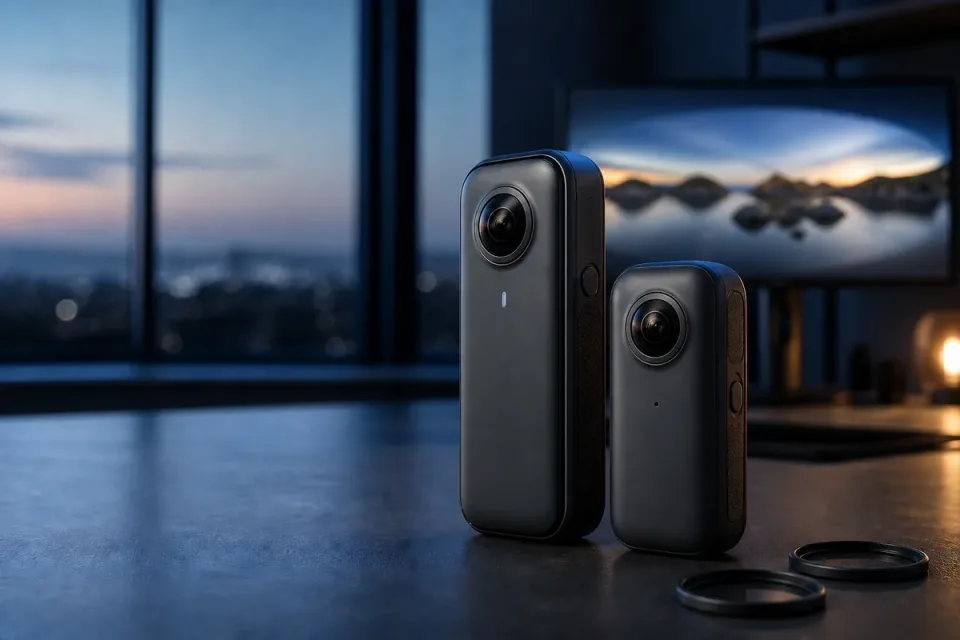
Insta360
Insta360 X6 Essentials Bundle
The Insta360 X6 Essentials Bundle is the 360-camera package discussed in our X6 versus X5 buying analysis. Its appeal is the ability to capture the scene first and choose the final framing later.
Transparent evidence
Method and limitations
We compared official X6 launch and store information with Insta360's published X5 specifications, then used an attributed independent hands-on review only for image-quality context. Senkōra has not physically tested either camera. The Amazon US page was checked directly to match the ASIN to the exact Essentials Bundle.
- Senkōra has not performed a controlled X6-versus-X5 low-light test.
- Manufacturer sensor, processing, battery, and AI claims are not treated as independent performance measurements.
- The usefulness of Dolby Vision depends on capture settings, editing software, export choices, platform support, and the viewer's display.
- Retail pricing and X5 discounts can change; no merchant price is reproduced in the affiliate card.
Five key takeaways
- The X6 moves from the X5's dual 1/1.28-inch sensors to dual custom square 1/1.1-inch sensors and adds a newer triple-chip processing system.
- 8K50 is most valuable for action, smoother motion, and modest slow-down after reframing; it does not create an 8K flat-camera crop in every direction.
- Native Dolby Vision matters most to creators with compatible displays and a delivery workflow that preserves its dynamic metadata.
- The Standard Bundle launches at $699.99. ASIN B0H5CJRJV7 identifies the accessory-rich Essentials Bundle on the retailer listing.
- X5 owners who mainly publish daylight clips at normal speed gain less than new buyers, night shooters, and demanding post-production users.
Frequently asked questions
Is the Insta360 X6 much better than the X5 in low light?
The X6 has larger sensors and newer processing, so its technical foundation is stronger. Independent hands-on comparison reports an improvement but not a dramatic generational leap. X5 owners should examine matched footage from their own shooting conditions before upgrading for low light alone.
Does 8K50 mean reframed video is 8K?
No. The 8K frame covers the entire 360-degree sphere. Reframing selects only part of that sphere, so the exported flat view contains fewer pixels. The 50 fps mode mainly adds smoother action and more timing flexibility than the X5's 8K30 mode.
Who benefits from Dolby Vision on the X6?
Creators delivering to compatible HDR displays and platforms benefit most. If footage is exported to SDR, heavily compressed, or viewed on an incompatible screen, the practical advantage can shrink. Dolby Vision also does not replace deliberate exposure and color management.
Should an Insta360 X5 owner upgrade to the X6?
Upgrade if 8K50, the larger sensors, 10-bit and I-Log workflows, native Dolby Vision, the OLED screen, or the revised replaceable-lens system solves a recurring limitation. Keep the X5 if daylight 8K30 already meets the brief and the editing workflow matters more than the capture ceiling.
Does ASIN B0H5CJRJV7 identify the $699.99 X6 bundle?
It is an Insta360 X6, but the verified listing is the Essentials Bundle with additional accessories and two batteries total. The $699.99 launch figure refers to the Standard Bundle. Buyers should compare the exact included items rather than assuming every X6 listing is the base configuration.
Primary sources
- store.insta360.com · Verified 2026-08-15
- onlinemanual.insta360.com · Verified 2026-08-15
- onlinemanual.insta360.com · Verified 2026-08-15
- techradar.com · Verified 2026-08-15