

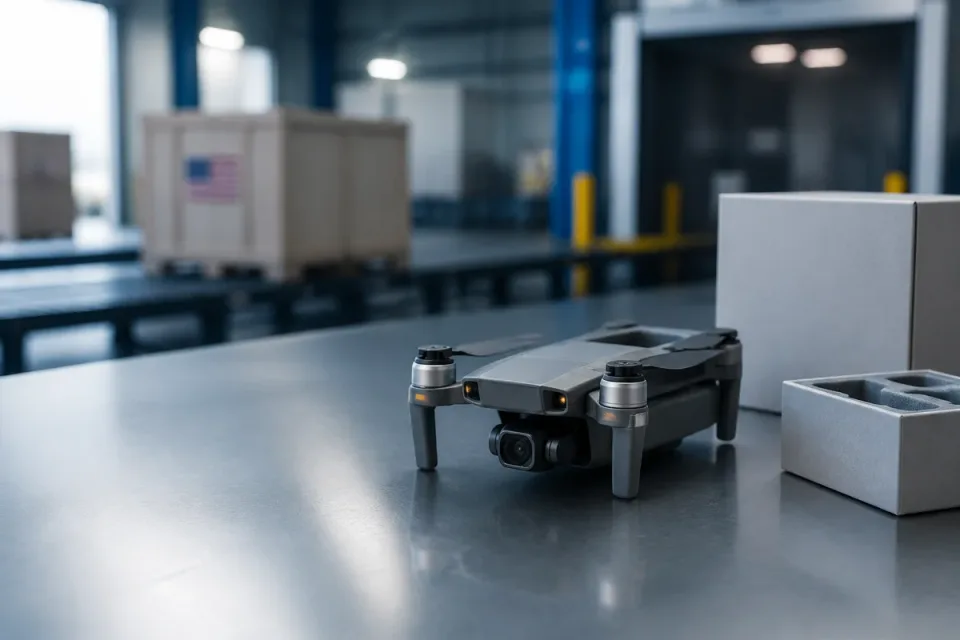
What changed on August 13
The White House announced a new Section 232 tariff structure for imported unmanned aircraft systems and components on August 13, 2026. The first measures are scheduled to take effect 21 days after the proclamation was signed, placing the initial effective date on September 3, 2026.
The headline number is 100%, but that is not the rate assigned to every imported drone. The official fact sheet separates the policy into distinct categories:
| Import category described by the White House | New ad valorem tariff | What that means for buyers |
|---|---|---|
| Drones over 25 kg maximum takeoff weight, drones with thermal imaging, docking stations for covered sensitive drones, and certain critical components | 100% | Primarily a concern for heavy commercial, industrial, public-safety, and specialized systems rather than a typical folding camera drone |
| Certain smaller drones without the listed sensitive capabilities, plus other drone components | 25% | The category most relevant to many consumer camera drones, FPV equipment, and future replacement inventory |
| Qualifying drones and components from the EU, Japan, Liechtenstein, South Korea, Switzerland, and Taiwan | 15% | Reduced treatment applies only when the policy’s hardware, software, and technology origin conditions are satisfied |
| Qualifying drones from the United Kingdom | 10% | A lower partner rate, again subject to origin conditions |
An ad valorem tariff is calculated as a percentage of the customs value of an imported product. It is paid at importation by the importer of record. That importer may pass the cost to a distributor or retailer, absorb it, negotiate with the manufacturer, change suppliers, or use a combination of those responses.
A 25% import duty does not mechanically equal a 25% increase on the retail sticker price.
Which consumer drones are most likely to be affected
Most folding camera drones bought by recreational pilots and creators weigh far less than 25 kg and do not include a thermal camera. On the face of the White House summary, those products are therefore more likely to sit in the 25% category than the 100% sensitive category.
That is a category-level reading, not a model-by-model customs ruling. A product’s treatment can depend on its HTSUS classification, country of origin, components, capabilities, and the final implementing language. A lightweight aircraft sold with a thermal payload, for example, should not be analyzed as an ordinary visible-light consumer drone merely because it weighs less than 25 kg.
Components matter too. Motors, flight controllers, radio systems, cameras, batteries, frames, and other parts can influence the cost of complete drones assembled in the United States. A drone marketed as American-assembled is not necessarily protected from every new cost if covered hardware comes from abroad.
Could DJI, Autel, and other prices rise
Yes, future U.S. prices could rise, but a rise has not been confirmed by this announcement. The White House fact sheet does not name DJI, Autel, a particular model, or a new manufacturer suggested retail price.
DJI and Autel deserve attention because their U.S. product pipelines depend on imported hardware and because both companies are already part of the separate FCC policy discussion. That makes replenishment cost and the ability to introduce new radio-equipped models more consequential. It still does not tell us how either company or any retailer will price a specific drone.
Several outcomes are possible:
- An importer passes most of the duty through to wholesale and retail prices.
- A manufacturer and importer share the cost to protect demand.
- Retailers hold current prices on existing inventory, then reprice replenishment.
- Promotions become less frequent even if the list price does not change.
- A brand changes sourcing, configuration, or launch timing.
The retail effect can therefore appear as a higher price, a smaller discount, fewer bundles, delayed restocking, or reduced model choice. Until a manufacturer or retailer acts, those remain scenarios rather than facts.
Why current U.S. inventory may become strategic
Tariffs generally attach when covered goods enter the United States for consumption or are withdrawn from a bonded warehouse. A unit that cleared customs before the new measure takes effect may have a different landed cost from an otherwise identical unit imported afterward.
That gives existing domestic stock potential value. Retailers may be able to sell it at the previous economics, preserve it for later demand, or reprice it based on the expected cost of replacement inventory. The presence of stock does not guarantee a bargain.
For buyers, “in stock” should mean more than a marketplace listing. Before making a time-sensitive purchase, verify:
- the seller is an authorized U.S. retailer or otherwise offers clear warranty support;
- the unit is physically located in the United States, not merely listed by a U.S.-facing storefront;
- the exact model, controller, battery bundle, and Remote ID support match the listing;
- the return window and service path remain acceptable;
- the purchase still makes sense without assuming a future shortage.
Avoid panic buying. A tariff changes import economics, but it does not prove that a particular model will disappear or that today’s price will never return.
Tariff, FCC restriction, and flight ban are three different things
These policies are often collapsed into one alarming headline. They operate at different points in a drone’s life:
| Policy | Agency or authority | What it controls | What it does not automatically do |
|---|---|---|---|
| Import tariff | President, Commerce, U.S. trade and customs authorities | The duty charged when covered goods enter the country | Revoke ownership or prohibit flight |
| FCC Covered List and equipment authorization | Federal Communications Commission | Whether covered radio-frequency equipment can receive authorization for U.S. marketing and import | Set airspace rules or ground every previously authorized drone |
| Flight rules and restrictions | Federal Aviation Administration and other authorized airspace authorities | Registration, Remote ID, pilot requirements, airspace authorization, operating limits, and temporary or site-specific restrictions | Set the customs duty or retail price |
The FCC said its December 2025 action applied on a going-forward basis to new device models and did not prevent consumers from continuing to use drones they had already purchased. It also said retailers could continue selling, importing, or marketing models that had already received FCC equipment authorization. Subsequent exemptions and proceedings can change the scope, so buyers evaluating a newly announced model should check its current U.S. authorization status.
The FAA remains the authority buyers should consult for flight operations. Under Part 107, small UAS rules generally cover drones under 55 lb, while recreational flyers follow a separate statutory exception. Registration, Remote ID, controlled-airspace authorization, and location-specific restrictions can apply regardless of what tariff was paid.
What buyers should do now
Use the next few weeks to improve the quality of a decision, not to manufacture urgency.
If you already own a suitable drone
Keep flying it within current FAA rules, maintain the batteries, and confirm that your firmware, app access, Remote ID setup, and spare parts are in order. The tariff announcement does not impose a new ownership tax or flight prohibition on your existing aircraft.
If you planned to buy soon
Compare confirmed U.S. stock from reputable sellers and save a dated copy of the listing, warranty terms, and return policy. Decide based on capability and support first. Treat tariff timing as one risk factor, not the entire buying case.
If you are waiting for an unreleased model
The uncertainty is higher. A future model may face both new import economics and FCC equipment-authorization constraints. Wait for a confirmed U.S. announcement, authorization status, price, and delivery date before considering it available.
If you need thermal or heavy industrial equipment
Do not apply consumer-drone assumptions. The 100% category may be directly relevant, and procurement should include customs, compliance, service, and supply-chain review for the exact configuration.
What remains unknown
As of August 15, 2026, Senkōra has not seen official brand-level announcements establishing new U.S. prices for DJI, Autel, or other consumer drone lines in response to this measure. We also do not yet know how much cost individual importers will absorb, which configurations may be reclassified, or how quickly replacement inventory will reach retailers.
The signals worth monitoring are concrete: updated U.S. list prices, changes to authorized-dealer promotions, confirmed domestic stock, customs implementation guidance, FCC authorization records for new models, and statements from manufacturers or importers.
This article will be updated when those facts change.
Transparent evidence
Method and limitations
We compared the White House fact sheet published August 13, 2026 with official FCC guidance on foreign UAS equipment authorization and current FAA Part 107 operating rules. Brand-level price and availability implications are explicitly identified as scenarios, not confirmed outcomes.
- The public fact sheet summarizes the policy; customs treatment ultimately depends on the applicable proclamation, annexes, origin rules, and HTSUS classification.
- The White House announcement does not provide brand-by-brand or model-by-model retail guidance.
- Prices, promotions, inventory positions, and importer decisions can change without notice.
- This is a policy and buying-impact explainer, not legal, customs, or financial advice.
Five key takeaways
- A 100% tariff applies to specified sensitive imports, including drones over 25 kilograms and drones with thermal imaging capabilities; it is not the default rate for ordinary camera drones.
- Certain smaller drones without the listed sensitive capabilities and other components face a 25% tariff.
- Qualifying products from named partner countries may receive 15% or 10% treatment under strict origin conditions.
- The White House did not announce DJI, Autel, or retailer price increases, so any near-term pricing claim remains an inference.
- Tariffs affect import cost, FCC rules affect authorization of radio equipment, and FAA rules govern where and how a drone may fly.
Frequently asked questions
Will DJI drone prices increase in the United States?
They could, because a new duty can increase the cost of future imports, but no automatic retail increase or percentage has been announced. DJI, distributors, and retailers can absorb, share, delay, or pass through costs, and inventory already in the United States may have a different cost basis.
Do the new tariffs apply to drones already owned by consumers?
A tariff is collected when covered goods enter the United States; it is not a retroactive tax charged to an owner who already bought a drone. The announcement does not make an existing drone illegal to own or fly.
Are all imported drones subject to a 100% tariff?
No. The 100% category covers specified sensitive drones and associated items, including drones over 25 kilograms and drones with thermal imaging. The White House describes a 25% category for certain smaller, non-sensitive drones and other components, with reduced rates for qualifying partner-country products.
Is an FCC restriction the same as a flight ban?
No. The FCC equipment-authorization system controls whether covered radio-frequency devices can receive authorization for U.S. marketing and import. FAA rules and airspace restrictions govern flight operations. The FCC said its December 2025 action did not stop consumers from using previously purchased drones.
Should buyers purchase a drone before September 3, 2026?
A deadline alone is not a reason to rush. Buyers should first confirm that a model fits their needs, has reliable U.S. support, and is actually in domestic stock. The tariff creates uncertainty around future landed cost and replenishment, but it does not guarantee that today's price is the lowest price a retailer will offer.
Primary sources
- whitehouse.gov · Verified 2026-08-15
- docs.fcc.gov · Verified 2026-08-15
- faa.gov · Verified 2026-08-15