

The decision in one glance
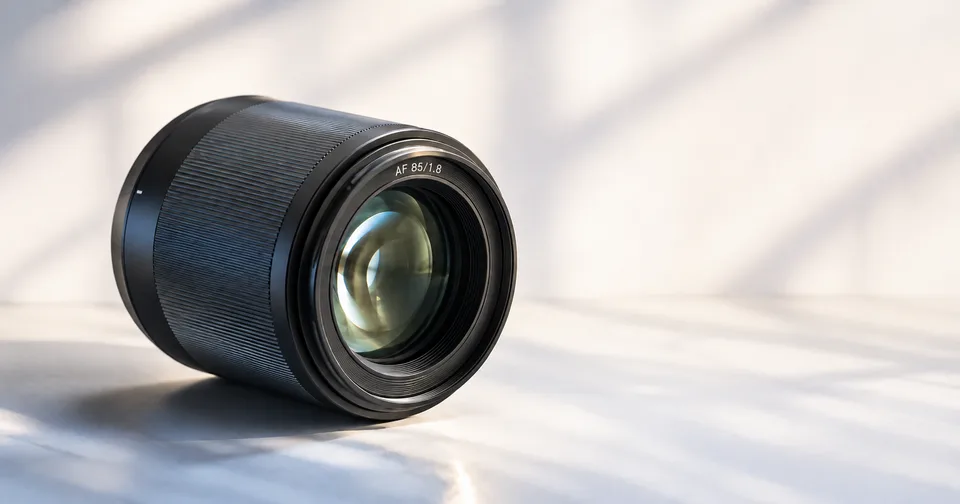
TTArtisan’s AF 85mm F1.8 Neo is a genuine full-frame autofocus portrait prime for $99. It is available in Sony E and Nikon Z mounts, uses an STM focusing motor, and weighs only 332 g (11.7 oz.). Those are unusually strong headline specifications for the price.
The catch is not hidden in a small technical footnote. It is the entire control philosophy. The Neo has no focus ring, no aperture ring, no optical stabilization, no AF/MF switch, and no customizable lens button. Aperture and focus settings are handled from the camera body.
That makes the buying decision unusually simple:
| Buyer | Starting decision | Why |
|---|---|---|
| First full-frame portrait lens on a strict budget | Consider the TTArtisan | It preserves 85mm, f/1.8, electronic aperture control, and autofocus at $99 |
| Photographer who stays in AF and uses camera dials | The minimalist design may work | The missing rings may have little effect on the normal workflow |
| Photographer who frequently focuses manually | Choose a conventional lens | There is no physical focus ring |
| Hybrid photo and video creator | Compare controls carefully | Direct focus, aperture, and AF/MF controls can matter more during video work |
| Buyer who needs a lens immediately | Wait for confirmed stock | B&H still marks both mounts Coming Soon and gives no exact shipping date |
This is a first look, not a review. A low price and a specification sheet cannot establish sharpness, bokeh quality, flare resistance, autofocus confidence, or sample variation.
What the $99 price keeps
The Neo does not reduce the basic portrait-lens formula to a manual-focus novelty. It retains the features that define a modern entry-level autofocus 85mm:
- Full-frame coverage for Sony E and Nikon Z mirrorless cameras;
- an 85mm focal length, which provides a comfortable working distance for many head-and-shoulders portraits;
- a maximum aperture of f/1.8 and minimum aperture of f/16;
- an STM autofocus motor with electronic communication to the camera;
- an optical design of 12 elements in 8 groups;
- an 11-blade diaphragm;
- a minimum focusing distance of 0.8 m (2.6 ft.);
- a 62mm filter thread;
- a reinforced-fiberglass body weighing 332 g (11.7 oz.).
TTArtisan also specifies two extra-low-dispersion and two high-index elements. Those ingredients describe the optical formula, but they do not prove the result. Claims about detail, background rendering, color fringing, or contrast must wait for controlled independent samples.
The weight is noteworthy even before testing. Sony’s FE 85mm F1.8 is listed at 371 g, while Nikon’s NIKKOR Z 85mm f/1.8 S is substantially heavier. The TTArtisan is not a pancake lens, but it avoids turning a compact full-frame body into a front-heavy portrait setup.
What the minimalist barrel removes
The biggest omission is the focus ring. Most autofocus lenses still let the photographer turn a ring for manual correction, magnified focusing, video pulls, or work through foreground objects. The Neo removes that familiar interface entirely.
It also lacks an aperture ring. This is less unusual because many first-party mirrorless lenses already use a camera dial for aperture. What makes the TTArtisan different is that it removes all other on-lens controls at the same time.
There is no dedicated AF/MF switch, so changing focus mode means using a body control, quick menu, or camera menu, depending on the model and customization. There is no focus-hold or function button to trigger eye AF, subject tracking, exposure lock, or another assigned action. There is no distance scale and no lens-based stabilization.
None of these omissions prevents autofocus portrait photography. Together, however, they make the lens highly dependent on the ergonomics of the attached camera.
Before preordering, Sony and Nikon owners should test a simple scenario with their current lens: keep both hands away from the lens barrel, change aperture and focus mode from the body, activate subject detection, and attempt a manual-focus correction without touching a lens ring. If that workflow feels acceptable, the Neo’s minimalism may be a rational saving. If it feels slow or obstructive, the $99 price is solving the wrong problem.
TTArtisan versus Sony, Nikon, Viltrox, and Meike
The useful comparison is about features and handling, not untested image quality.
| Lens family | Mount context | Maximum aperture | Physical control approach | Stabilization | Main functional difference from TTArtisan |
|---|---|---|---|---|---|
| TTArtisan AF 85mm F1.8 Neo | Sony E, Nikon Z | f/1.8 | No focus ring, aperture ring, AF/MF switch, or function button | No | Lowest-control design and $99 launch price |
| Sony FE 85mm F1.8 | Sony E | f/1.8 | Focus ring, focus-hold button, AF/MF switch | No lens OSS | More direct focus and autofocus control |
| NIKKOR Z 85mm f/1.8 S | Nikon Z | f/1.8 | Customizable control ring and focus-mode switch | No lens VR | Ring can handle focus, aperture, or exposure compensation |
| Viltrox AF 85mm F2 EVO | Sony E, Nikon Z variants | f/2 | Focus ring, aperture ring, function button, AF/MF switch, click switch | No | Much richer external controls, but one-third stop slower on paper |
| Meike AF 85mm F1.8 SE II | Sony E, Nikon Z variants | f/1.8 | Conventional focus ring and AF/MF control | No | Retains familiar manual-focus access |
The Sony comparison shows that a lens can remain relatively compact without deleting every control. Sony includes a focus-hold button and AF/MF switch, which can shorten the path to a changed shooting mode.
The Nikon S-Line lens uses a customizable control ring. Its owner can assign manual focus, aperture, or exposure compensation depending on the camera setup. It represents almost the opposite philosophy: the lens becomes another programmable camera interface.
Viltrox’s current 85mm F2 EVO makes the contrast even clearer. Its documented controls include a focus ring, aperture ring, function button, AF/MF switch, and a click/de-click control. Its f/2 maximum aperture is one-third stop slower than f/1.8, but its barrel offers far more direct interaction.
Meike’s AF 85mm F1.8 SE II occupies another budget-oriented position while retaining conventional manual-focus access. Again, that does not establish which lens produces the better file. It establishes what the photographer can control without diving into the camera interface.
Is f/1.8 enough to make it a real portrait lens?
Yes in category, not yet in verdict. An 85mm full-frame prime with an f/1.8 maximum aperture is a conventional portrait lens. It can frame faces from a practical distance and can produce shallow depth of field when subject distance, background distance, framing, and aperture align.
But f/1.8 alone does not guarantee attractive portraits. Rendering depends on more than the number printed on the barrel. Eye sharpness, longitudinal chromatic aberration, bokeh transitions, onion-ring texture, flare, autofocus placement, focus shift, and field curvature can all affect the result.
The 11-blade diaphragm may help maintain a rounded aperture shape when stopped down, but blade count does not independently prove smooth bokeh. Likewise, STM identifies the motor type but does not tell us how quickly or reliably the lens will detect and hold an eye on every Sony or Nikon body.
Until matched testing exists, the responsible conclusion is limited: the Neo has the format, focal length, and aperture expected of a portrait prime. Its performance remains an open question.
US price, preorders, and availability
The announced US price is $99. B&H, an authorized US dealer, has separate Sony E and Nikon Z listings and accepts preorders. Both were labeled New Item - Coming Soon when Senkōra checked on August 25, 2026.
That is not the same as in-stock availability. B&H does not provide a precise shipping date on the listings, and preorder timing can change. Buyers who need an 85mm for a scheduled portrait session should not plan around an unconfirmed delivery window.
No exact Amazon US product page or ASIN has been verified for the AF 85mm F1.8 Neo. Senkōra is therefore providing no Amazon link, including no generic search link. Similar TTArtisan names and older 85mm products should not be assumed to identify this model.
Who should preorder and who should wait
Consider preordering when
- $99 makes the difference between adding an 85mm now and having no portrait prime;
- you use autofocus almost exclusively;
- aperture, focus mode, and subject detection are already assigned to accessible camera controls;
- low weight matters for a two-lens travel or family kit;
- you understand that delivery timing and performance are still unconfirmed.
Wait for testing or choose another lens when
- manual focus is part of your portrait, product, macro-adjacent, or video workflow;
- you depend on a physical AF/MF switch or focus-hold button;
- quiet, smooth, repeatable focus transitions matter for video;
- you need demonstrated eye-AF consistency rather than a motor specification;
- you need the lens by a fixed date;
- sample variation, flare, bokeh, or wide-open sharpness would materially affect paid work.
Senkōra’s first-look verdict
The TTArtisan AF 85mm F1.8 Neo is not a fake portrait lens or merely a $99 toy. It preserves the essential electronic core: full-frame coverage, f/1.8, camera-controlled aperture, and STM autofocus. For a Sony or Nikon owner who treats the lens as an optical attachment and the camera as the complete control surface, that can be enough.
The price is achieved by making minimalism a system requirement. The missing focus ring is the most consequential sacrifice, followed by the lack of direct AF/MF and customizable controls. Buyers are not simply choosing a less expensive version of the familiar 85mm experience. They are choosing a different operating model.
At $99, that experiment is unusually accessible. It is not yet a proven bargain. The next evidence that matters will come from independent tests of autofocus behavior, wide-open consistency, flare, color fringing, and background rendering, followed by confirmed US stock. Until then, the Neo is a compelling first-look value proposition, not a tested recommendation.
Transparent evidence
Method and limitations
We checked the dated DPReview launch report and specification record against the US B&H listings for both mounts. We then compared only documented physical controls and core specifications with official Sony, Nikon, and Viltrox material and an independently documented Meike model. Senkōra has not handled or tested the TTArtisan lens, and this first-look analysis does not rank image quality or autofocus performance.
- Senkōra has not independently tested sharpness, bokeh, chromatic aberration, flare, autofocus speed, autofocus accuracy, tracking, or video focus behavior.
- B&H product copy includes qualitative performance language that is not treated here as independent test evidence.
- The two B&H listings remain preorder pages with no precise shipping date, and retail status can change after verification.
- The feature comparison is not an overall ranking and deliberately excludes untested image quality.
Five key takeaways
- The $99 lens covers full frame in Sony E and Nikon Z mounts and uses STM autofocus.
- Its 12-element, 8-group design, 11-blade diaphragm, 0.8 m minimum focus distance, and 332 g weight are confirmed specifications, not performance results.
- There is no focus ring, aperture ring, optical stabilization, AF/MF switch, or customizable lens button.
- B&H lists both US versions as Coming Soon and accepts preorders, with no precise shipping date.
- No exact Amazon US listing or ASIN has been confirmed, so Senkōra is not linking to Amazon.
Frequently asked questions
Does the TTArtisan AF 85mm F1.8 Neo have a manual focus ring?
No. The minimalist barrel has no focus ring. Focus mode and supported focus adjustments must be handled through the camera, which is a materially different experience from Sony, Nikon, Viltrox, and Meike alternatives with physical focusing controls.
Does the TTArtisan 85mm F1.8 Neo have image stabilization?
No. The lens has no optical stabilization. Owners of compatible stabilized camera bodies may still use in-body stabilization, but lens-based stabilization is not part of the $99 design.
Is the TTArtisan 85mm F1.8 Neo available in the United States?
It is available to preorder for Sony E and Nikon Z at B&H, where both listings were marked Coming Soon when checked on August 25, 2026. A precise US shipping date was not posted.
Is the TTArtisan 85mm F1.8 Neo good for portraits?
Its 85mm focal length, full-frame coverage, and f/1.8 maximum aperture fit the conventional portrait-lens brief. Senkōra has not tested its sharpness, bokeh, flare, eye-AF behavior, or tracking, so those aspects cannot yet support a recommendation.
Can I buy the TTArtisan 85mm F1.8 Neo on Amazon US?
Senkōra has not confirmed an exact Amazon US product page or ASIN. No Amazon link is included. Buyers should not treat a search result or a listing for another TTArtisan 85mm as this specific Neo model.
Primary sources
- dpreview.com · Verified 2026-08-25
- dpreview.com · Verified 2026-08-25
- bhphotovideo.com · Verified 2026-08-25
- bhphotovideo.com · Verified 2026-08-25
- sony.co.uk · Verified 2026-08-25
- nikonusa.com · Verified 2026-08-25
- viltrox.com · Verified 2026-08-25
- digitalcameraworld.com · Verified 2026-08-25