

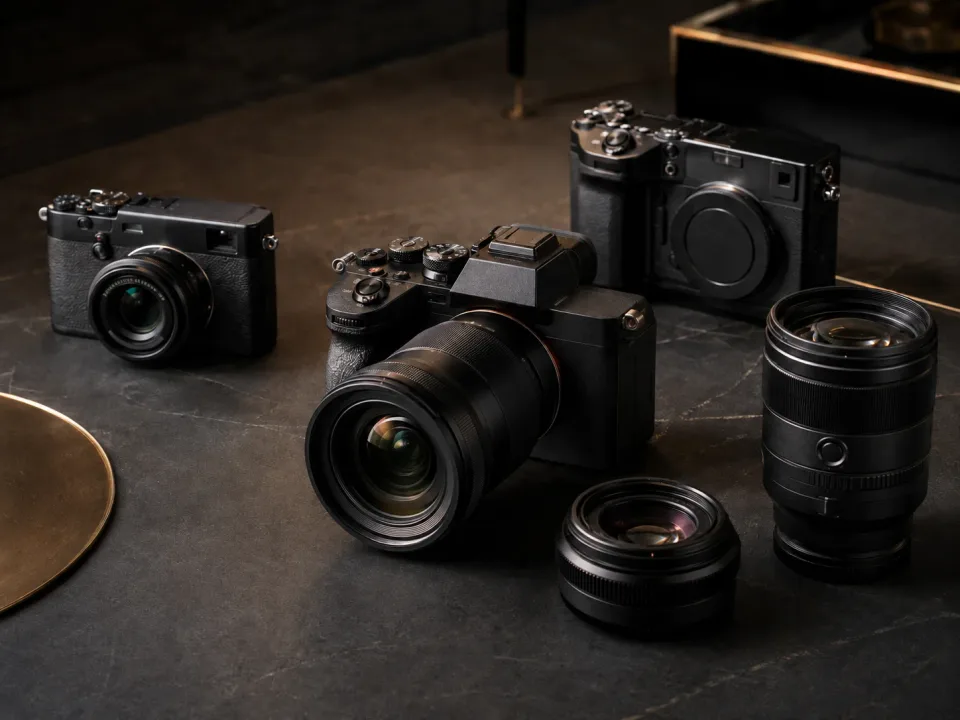
The EISA Photography Awards 2026–2027 were published on August 24, 2026, with 23 awards spanning cameras, lenses, software, smartphone imaging, and analog products. That is a broad industry snapshot. It is not a 23-item shopping list.
For U.S. buyers, the more useful question is narrower: which winners solve a recognizable need well enough to earn a place on a shortlist? Senkōra selected five that represent distinct decisions, from an all-around full-frame body to an APS-C travel option, a video-first camera, and a professional standard zoom.
What an EISA award tells you, and what it does not
EISA is an association of specialist technology publications. Its awards are collective editorial distinctions, so a win can be a helpful sign that experienced editors see a product as important within a defined category.
The badge does not prove that a product fits your hands, your existing lenses, your editing workflow, or your budget. It also does not mean Senkōra has tested the winner. This article is an editorial selection based on the official results and manufacturer information, not an independent field test.
Use the awards to reduce a long list. Use evidence tied to your own photography to make the final decision.
The five winners U.S. buyers should shortlist
Sony Alpha 7 V: the all-around full-frame choice
EISA named the Sony Alpha 7 V its Camera of the Year. Among the winners, it is the most straightforward starting point for a buyer seeking one full-frame body across still photography and video rather than a highly specialized tool.
Its U.S. relevance also rests on system maturity. Sony’s official Alpha 7 V page confirms a current U.S. product presence, while the broader E-mount ecosystem gives buyers multiple paths for building a kit. That does not make every lens combination affordable or appropriate, but it makes system planning easier to investigate.
Shortlist it if you want an adaptable full-frame foundation and have not already committed heavily to another mount. Existing Canon, Nikon, or Fujifilm users should first calculate the real cost and disruption of changing systems. Our guide to the best hybrid cameras for photo and video provides a use-based framework for that comparison.
Fujifilm X-T30 III: the more accessible APS-C route
The Fujifilm X-T30 III received EISA’s Best Buy Camera award. The category points toward a lower-commitment entry into an interchangeable-lens system; it does not guarantee the lowest current checkout price.
For buyers who prioritize a compact kit, APS-C lens options, and a camera they are likely to carry, the X-T30 III deserves attention before automatically moving to full frame. Fujifilm lists it in its current U.S. camera lineup, but buyers should still verify the exact body or kit, live U.S. pricing, and stock at purchase time.
It is the practical candidate here for learners, travelers, and enthusiasts who want room to grow without making sensor size the only measure of quality. If that tradeoff is unclear, start with our APS-C versus full-frame comparison for travel.
Fujifilm X-E5: the enthusiast-friendly travel alternative
EISA placed the Fujifilm X-E5 in its APS-C Camera category. Its role here differs from the X-T30 III’s: it is the option to examine when portability and an enthusiast-oriented shooting experience matter more than securing the simplest value proposition.
Two cameras can share a sensor format and still serve different buyers because body design, controls, viewfinder experience, lens pairing, and total kit size shape everyday use. The award identifies the X-E5 as notable; only hands-on handling can establish whether its approach suits you.
Travel and street photographers should compare it with the X-T30 III using the same lens, bag, and spare-battery assumptions. A small body paired with an oversized lens may erase the portability advantage. Our lightweight travel-camera guide explains why the complete kit matters more than body weight alone.
Nikon ZR: the video-first hybrid decision
The Nikon ZR won EISA’s Photo/Video Camera category. It is the strongest selection here for creators whose buying decision begins with video production rather than still-photo versatility.
Nikon positions the ZR in its Z Cinema line on the official Nikon USA product page. The real decision is therefore whether its recording formats, media, audio, monitoring, stabilization, lenses, post-production requirements, and rigging fit the buyer’s workflow.
Shortlist the ZR for documentary work, small productions, and creators building around a video-led Z-mount setup. A photographer who only occasionally records clips may be better served by a conventional hybrid body with simpler files and handling. The award category is a clue to intended use, not permission to skip a workflow audit.
NIKKOR Z 24-70mm f/2.8 S II: the pro-grade standard zoom
EISA named the NIKKOR Z 24-70mm f/2.8 S II its Lens of the Year. A professional standard zoom can cover a large share of event, editorial, portrait, documentary, and commercial assignments, making this winner especially relevant to working Nikon Z photographers.
It is also the least universal recommendation here. A lens purchase is inseparable from mount commitment, the focal lengths already owned, the need for a constant f/2.8 aperture, carrying tolerance, and the assignments that might justify professional glass. Buyers outside the Nikon Z system should not treat a cross-brand award as a reason to rebuild an effective kit.
For established Z-mount users, this is the winner to investigate first when a standard zoom is a daily tool. Judge the upgrade on measurable workflow gains, not the trophy alone.
Two Tamron wins broaden the lens conversation
Tamron separately confirmed two EISA awards on August 24: the 16-30mm F/2.8 Di III VXD G2 won Wide Angle Zoom Lens, and the 35-100mm F/2.8 Di III VXD won Standard Zoom Lens.
They do not displace the NIKKOR from this five-product shortlist because the buying decisions are not identical. They reinforce a useful rule: compare the exact focal range, mount, size, and role you need rather than assuming one award-winning zoom answers every assignment.
Why an award is helpful but not sufficient
Before buying any winner, verify five things:
- Real-world handling. Rent the camera or try it in a store with the lens you expect to use.
- Lens ecosystem. Price the complete system, including the focal lengths you need now and the likely upgrade path.
- Current pricing. Compare the exact body, kit, warranty, and included accessories.
- U.S. availability. Confirm authorized distribution, stock, warranty coverage, and the precise model or mount.
- Actual use case. Match the purchase to the work you do most often, not the most impressive scenario in a product description.
Independent reviews remain essential when autofocus, image quality, rolling shutter, stabilization, heat management, battery life, or optical performance could decide the purchase. Look for matched tests that resemble your subjects and working conditions.
Senkōra’s take
The EISA Photography Awards 2026–2027 are most useful as a filter. The Sony Alpha 7 V is the broadest all-around candidate; the Fujifilm X-T30 III and X-E5 offer two distinct APS-C paths; the Nikon ZR is the video-led choice; and the NIKKOR Z 24-70mm f/2.8 S II is the professional Z-mount lens to examine.
Each deserves a shortlist, not an automatic purchase. The right winner is the one that survives a comparison of handling, system cost, U.S. availability, and actual assignments after the award badge is removed from the decision.
Transparent evidence
Method and limitations
We reviewed EISA's official 2026–2027 photography awards list, then narrowed the 23 awards to products that map to distinct, common U.S. buyer decisions. Official U.S. manufacturer pages were used to confirm market relevance. We did not rank untested image quality, autofocus, handling, or value, and no Amazon or merchant data was used.
- Senkōra has not physically tested or directly compared the selected cameras and lens.
- EISA categories reflect a collective editorial award process, not a Senkōra test protocol.
- Current U.S. prices, bundles, promotions, inventory, and delivery dates can change after publication.
- The shortlist does not cover every valid system, specialist need, or one of EISA's 23 winners.
Five key takeaways
- EISA selected 23 photography winners for 2026–2027, but most U.S. buyers need a shortlist organized around use, not a complete awards roll call.
- The Sony Alpha 7 V is the clearest all-around full-frame candidate, while the Fujifilm X-T30 III and X-E5 address two different APS-C priorities.
- The Nikon ZR deserves attention from video-first creators, but its workflow fit matters more than the award label.
- The NIKKOR Z 24-70mm f/2.8 S II is relevant primarily to buyers already committed to a professional Z-mount kit.
- Handling, lens ecosystem, live U.S. pricing, availability, and the buyer's actual assignments should decide the purchase.
Frequently asked questions
What won EISA Camera of the Year for 2026–2027?
EISA named the Sony Alpha 7 V its Camera of the Year for 2026–2027. That makes it a credible shortlist candidate, but it does not establish that it is the best camera for every buyer or that Senkōra independently tested it.
How many EISA Photography Awards were announced for 2026–2027?
EISA lists 23 awards in its 2026–2027 photography group, covering cameras, lenses, software, smartphone imaging, and analog products.
Should I buy a camera because it won an EISA award?
No. Treat the award as a useful screening signal. Before buying, compare real-world handling, the lenses you need, current U.S. pricing and availability, and performance evidence that matches your use case.
Did Senkōra test these EISA winners?
No. This article is an editorial selection based on the official EISA results and official manufacturer information. It is not a hands-on test or a comparative laboratory review.
Primary sources
- eisa-awards.org · Verified 2026-08-24
- tamron.com · Verified 2026-08-24
- electronics.sony.com · Verified 2026-08-24
- fujifilm-x.com · Verified 2026-08-24
- nikonusa.com · Verified 2026-08-24