

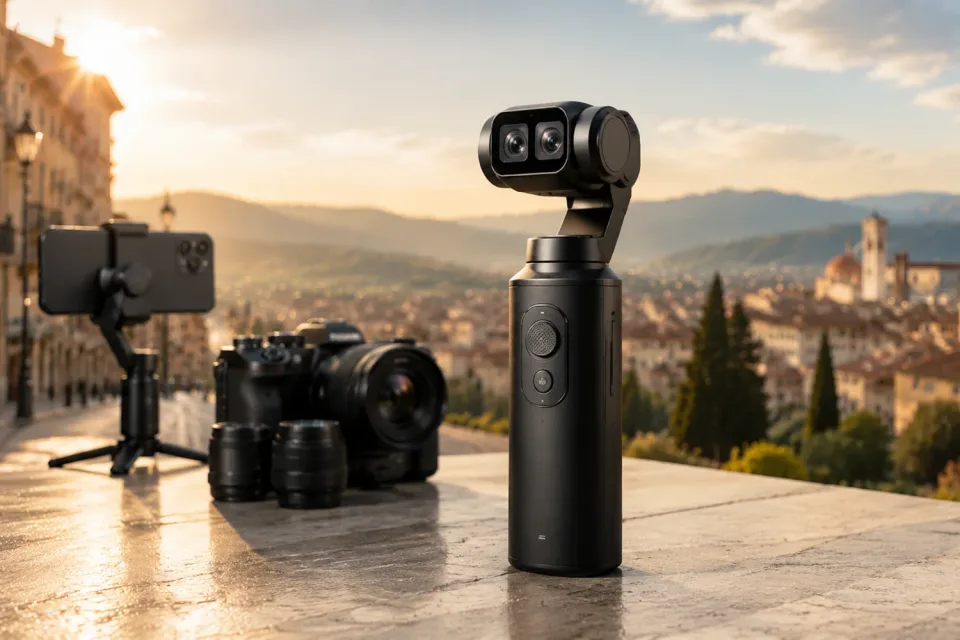
DJI’s Osmo Pocket 4P is more than a routine resolution update. Its central idea is a compact, mechanically stabilized camera with two genuinely different perspectives: a 20mm-equivalent wide-angle camera and a 60mm-equivalent short telephoto. That pairing addresses a familiar travel-video problem. Wide framing is excellent for showing place and movement, but it can make every portrait, architectural detail, and distant moment feel visually small.
The question is therefore not whether the second camera adds another specification. It is whether a real short-telephoto view makes this 230 g dual-lens gimbal camera credible as the core of a smaller travel kit.
First look based on manufacturer information and independent source verification. Senkōra has not tested the Osmo Pocket 4P.
What DJI announced
DJI formally launched the Osmo Pocket 4P on July 30, 2026. The company specifies a 1-inch CMOS sensor behind the main 20mm-equivalent f/2 lens and a second 60mm-equivalent f/1.8 lens. Both perspectives sit within a three-axis mechanical stabilization system, with ActiveTrack 8.0 intended to keep a selected subject framed as the operator or subject moves.
DJI also advertises recording up to 4K/240 fps in certain modes, a 10-bit D-Log 2 profile, up to 17 stops of dynamic range under its stated conditions, and operation up to 210 minutes under its stated battery test. These are manufacturer claims, not Senkōra measurements. Mode restrictions, crop, heat, subject motion, stabilization behavior, and practical battery life require independent testing before they can support a performance verdict.
The camera weighs 230 g, or about 8.1 oz. That figure is meaningful because it is less than half the weight of even the lightest interchangeable-lens camera-and-zoom combination in our study of complete travel camera kit weight. It does not include the microphone, filters, support, cable, charger, or protective case a real trip may require.
Why two focal lengths matter for travel video
A single very wide lens solves the framing problem of holding a camera close to the face. It also shows the environment, reduces the visibility of small camera movements, and makes narrow streets or interiors easier to capture. The cost is visual sameness. People near the edge can look stretched, background elements appear smaller, and distant details rarely become strong subjects.
The 60mm camera changes the available visual grammar. It can isolate a face without placing the camera uncomfortably close, frame food or craft details, compress layers in a street, and capture a more discreet view from across a room. Switching focal lengths is faster and cleaner than mounting an optical accessory, rebalancing a phone gimbal, or changing a mirrorless lens in dust or rain.
That convenience matters most when a trip is being experienced rather than staged. A creator can establish a location at 20mm, then move to a detail or portrait at 60mm without opening a bag. The system is not a continuous zoom, however. The two optical viewpoints remain distinct, and any intermediate digital framing should be judged separately for image quality.
20mm versus 60mm: what each lens is actually for
| Perspective | Strong uses | Watch for |
|---|---|---|
| 20mm equivalent, f/2 | Arm’s-length vlogging, landscapes, architecture, interiors, walking shots, environmental portraits | Edge distortion, very small distant subjects, exaggerated foreground-to-background scale |
| 60mm equivalent, f/1.8 | Portraits, signs, food, architectural details, street layers, less intrusive framing | Tighter composition while walking, more visible framing errors, less room in cramped spaces |
The 20mm view is the default storytelling lens. It answers “Where am I, and what is happening around me?” The 60mm view answers “What should the viewer notice?” Used together, they can create a more deliberate sequence than repeated wide clips.
Neither specification proves that both cameras match perfectly in color, dynamic range, autofocus, noise, or stabilization. Those transitions are central to a real dual-camera workflow and remain on Senkōra’s test list.
Pocket 4P versus a smartphone and gimbal
A modern phone already offers multiple focal lengths, strong computational processing, direct editing, and instant publishing. Mounted on a gimbal, it can produce controlled walking footage while keeping the creator’s entire social workflow on one device. The weakness is the assembled system: phone, clamp, gimbal, and sometimes a microphone receiver form a bulkier object that must be balanced, powered, and repeatedly mounted.
The Pocket 4P offers a more focused capture tool. Its mechanical gimbal is integrated, the 20mm and 60mm views are chosen for video, and using it does not occupy the phone that handles maps, messages, tickets, and uploads. For a creator who already carries a phone, however, the dedicated camera is an additional battery, storage medium, charger, file-transfer step, and device to protect.
The replacement case is strongest for people who regularly bring a phone gimbal specifically for shooting. It is weaker for social-first creators who value app effects, computational zoom transitions, direct livestreaming, or an immediate edit-and-post workflow more than a dedicated camera body.
Pocket 4P versus a mirrorless travel kit
A mirrorless camera remains the more adaptable system. It can accept lenses wider than 20mm, longer than 60mm, brighter primes, macro lenses, and specialized optics. Depending on the exact body, it can also provide physical controls, viewfinders, external audio, headphone monitoring, larger batteries, replaceable batteries, larger recording media, and a clearer upgrade path.
The Pocket 4P competes by removing choices and weight. A travel creator who mostly uses one wide view and one portrait/detail view may discover that the other lenses, gimbal, and camera bag are contingency equipment rather than daily tools. Before making that trade, compare the full packed system, not bodies alone. Our guides to choosing a lightweight camera for travel, travel-vlogging cameras, and compact hybrid cameras for photo and video show what the larger system still provides.
| Setup | Main strengths | Main limitations | Best suited to |
|---|---|---|---|
| DJI Osmo Pocket 4P | Two optical focal lengths, mechanical stabilization, very compact | US availability, fixed system, limited expandability | Travel creators and vloggers |
| Smartphone with gimbal | Familiar workflow, direct sharing, broad app support | Bulkier combined setup, battery management, variable stabilization | Social-first creators |
| Mirrorless camera with two lenses | Image control, interchangeable lenses, stronger system flexibility | More weight, more equipment, higher complexity | Advanced travel filmmakers |
What the Pocket 4P still cannot replace
Two focal lengths do not make a complete production kit. Sound remains the first gap to plan around. A creator may need a wireless microphone, wind protection, a way to monitor recording, and a backup strategy. DJI compatibility claims for its own audio ecosystem should be checked for the exact region, firmware, and bundle; third-party claims require separate verification.
Bright outdoor video also needs exposure control. ND filters can help maintain the intended shutter speed, but the filter must match the exact camera and must not obstruct the gimbal through its full movement. A support plan matters too: a mini tripod, grip, or clamp should hold the camera securely without compromising access or balance. Our hiking-video camera guide explains why rain protection, retrieval time, microphones, and spare power belong in the weight calculation.
A mirrorless camera also retains advantages for long focal lengths, shallow-depth portraits, low-light specialization, still photography, controlled manual operation, and productions that depend on external monitoring or redundant recording. The Pocket 4P is a reduction tool, not a universal replacement.
US availability: the biggest limitation
As of August 18, 2026, DJI had not announced standard US retail distribution or US pricing for the Osmo Pocket 4P. Digital Camera World reported on July 31 that no authorized US retailer had official stock and that DJI had not announced a formal US launch. DJI’s international product, support, and specification pages demonstrate that the product exists; they do not establish an authorized US sales channel.
That distinction matters. A marketplace listing can represent an imported regional model rather than official DJI US inventory. Before buying, a US reader would need to confirm the exact model, seller identity, return address, warranty and repair coverage, DJI Care eligibility, charger contents, taxes or import fees, app and firmware support, and the availability of replacement accessories. Seller language is not a substitute for a written DJI policy.
Accessories already appearing on Amazon
The affiliate collection below includes a SmallRig ND16/ND64/ND256/CPL filter set, a SmallRig 5,000 mAh battery handle, and a generic mini tripod. Their respective sellers claim Pocket 4P compatibility. DJI does not guarantee their fit, gimbal clearance, charging behavior, stability, or safe operation.
Treat the links as a route to verify the current product page, not as proof of compatibility or availability. Confirm the ASIN, variant, seller, return terms, and stated Pocket 4P support at Amazon before ordering. No price, promotion, stock statement, rating, review count, or Amazon image is reproduced on Senkōra.
Who should consider it, and who should wait
Consider the Pocket 4P if your travel work repeatedly alternates between wide establishing or vlog shots and short-telephoto portraits or details; if you currently carry a phone gimbal mainly for video; and if reducing setup time is worth giving up lens choice.
Wait if official US warranty and service are essential, if you depend on a long lens or specialized audio connections, or if the camera must serve equally well for high-resolution still photography. US buyers should also wait when an import listing leaves the regional model, return path, or repair coverage unclear.
Senkōra’s first-look verdict
The 60mm camera is the feature that makes the Osmo Pocket 4P a credible travel-kit reduction rather than merely another compact gimbal camera. It provides the missing counterpoint to the 20mm view: portraits, details, and visual compression without carrying and changing a second lens.
For many vloggers, that could replace a smartphone gimbal or a minimal two-lens video setup. It does not replace a mirrorless system for creators who use interchangeable optics, robust audio and monitoring, extensive manual control, or a broader photo workflow. Until DJI confirms US sales and support, the Pocket 4P is also difficult to recommend as a low-risk purchase for American readers, however strong its concept appears on paper.
Methodology and sources
This first look separates DJI’s announced specifications from Senkōra’s editorial assessment. We reviewed DJI’s July 30 launch announcement, the official Osmo Pocket 4P product page, DJI’s handheld-camera specification index, and Digital Camera World’s US availability report. Facts and availability were last verified on August 18, 2026.
The cover is a Senkōra concept illustration, not an official product photograph. The Osmo Pocket 4P combines wide-angle and short-telephoto perspectives in a pocket-size three-axis gimbal camera. Illustration: Senkōra.
Recommended gear
Find your next piece of gear
Find the setup that fits your plans, then explore prices and buying options on Amazon.
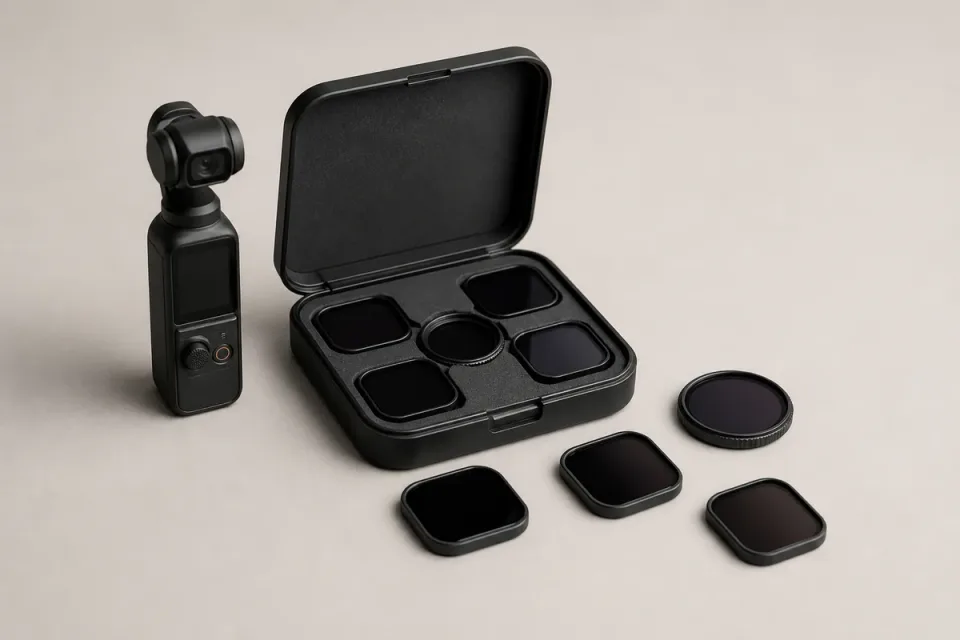
SmallRig
SmallRig ND16 / ND64 / ND256 / CPL Filter Set for DJI Osmo Pocket 4P
This SmallRig ND16, ND64, ND256 and CPL set is a third-party filter option for the Pocket 4P. Neutral-density filters address bright-light exposure; a polarizer has a different role in controlling some reflections.
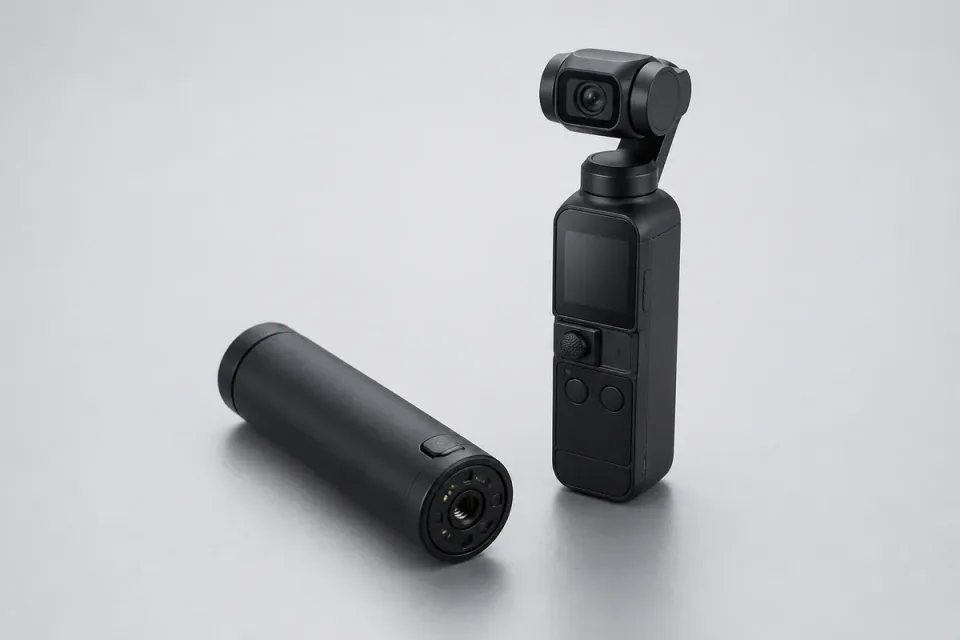
SmallRig
SmallRig 5,000 mAh Battery Handle for Pocket 4P/4/3/Xtra Muse
This SmallRig 5,000 mAh handle is a third-party power accessory for extended pocket-camera sessions. It can reduce the need to stop for charging when the added handle fits the intended setup.
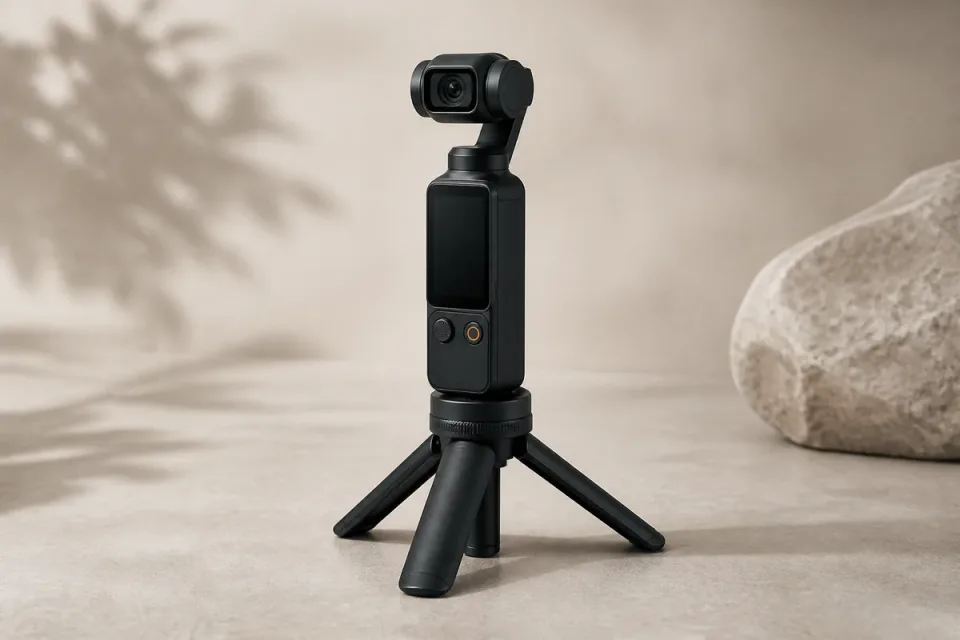
BOXOB
BOXOB Mini Tripod for Pocket 4P/4/3/2
The BOXOB mini tripod is a compact support candidate for a pocket gimbal camera on a table or other firm surface. It addresses static framing rather than walking stabilization.
Transparent evidence
Method and limitations
First look based on manufacturer information and independent source verification. Senkōra has not tested the Osmo Pocket 4P or the listed accessories. We checked DJI’s launch material, product and specification references, then used a recent independent report to assess US distribution. The three accessory ASINs and their stated variants were explicitly approved for publication by Philippe Contal on August 18, 2026; compatibility remains a claim by each third-party seller, not a DJI guarantee.
- Image quality, tracking, stabilization, heat, audio, runtime, durability, workflow, and accessory compatibility have not been independently tested by Senkōra.
- DJI’s performance and battery-life figures were measured under controlled conditions and should not be interpreted as independent test results.
- US distribution, import availability, warranty treatment, and third-party listings can change after the August 18, 2026 verification date.
Five key takeaways
- The 20mm camera suits vlogging, landscapes, architecture, and immersive movement; the 60mm camera adds portraits, details, and more discreet framing.
- At 230 g, the Pocket 4P can reduce the number of devices or lenses carried, but it does not duplicate a complete interchangeable-lens system.
- DJI claims up to 4K/240 fps in specified modes, 10-bit D-Log 2, up to 17 stops of dynamic range, and up to 210 minutes of operation under its test conditions.
- No official US price or standard authorized US distribution was confirmed as of August 18, 2026.
- Senkōra has not tested the camera or accessories; third-party Pocket 4P compatibility is claimed by the respective sellers and is not guaranteed by DJI.
Frequently asked questions
Is the DJI Osmo Pocket 4P officially available in the US?
Not through a standard official US launch confirmed by DJI as of August 18, 2026. DJI has not announced US pricing, and independent reporting found no authorized US retailer with official stock. Imported marketplace listings are not equivalent to official US distribution.
What is the difference between the 20mm and 60mm lenses?
The 20mm-equivalent lens captures a broad view suited to arm’s-length vlogging, landscapes, architecture, and immersive movement. The 60mm-equivalent lens gives tighter framing for portraits, details, and subjects that should not be approached as closely.
Can the Pocket 4P replace a smartphone and gimbal?
For creators who mainly need stabilized capture at two useful focal lengths, it could replace that combination. A phone still provides direct editing, apps, communication, and publishing, so the Pocket 4P does not replace the phone itself.
Can it replace a mirrorless travel camera?
It can replace a lightweight two-view video setup for some trips, but not a mirrorless system’s interchangeable lenses, larger control surface, broader audio and monitoring options, or upgrade path.
Does Senkōra recommend importing the Pocket 4P?
Not as a general recommendation. Before importing, verify the seller, exact regional model, warranty and repair coverage, return terms, taxes, charger details, app support, and accessory compatibility.
Primary sources
- prnewswire.com · Verified 2026-08-18
- dji.com · Verified 2026-08-18
- repair.dji.com · Verified 2026-08-18
- digitalcameraworld.com · Verified 2026-08-18