


Start with the photograph you missed
A child moves through a dim living room. You raise ISO, see grain, and assume that you need a larger camera. But a new body will not correct a shutter speed that was too slow, an autofocus point on the background, or a face outside the depth of field. This Lab is for travelers and family photographers deciding where an upgrade would actually help.
Inspect a missed frame at full size before comparing equipment. Look for directional smearing on a moving hand, doubled edges throughout the image, a sharp background behind a soft face, or fine detail hidden by noise. These clues do not replace a controlled check, but they narrow the next useful action.
The decision matrix
| What went wrong? | What to try with your current kit | When a purchase can help | What it cannot guarantee |
|---|---|---|---|
| Moving person is blurred | Raise shutter speed; accept higher ISO; seek brighter light | A compatible wider-aperture lens or suitable lighting | That every subject movement will be frozen |
| Whole frame shows hand shake | Improve grip, use support and check stabilization | Support equipment or stabilization when static scenes are the priority | Sharp moving subjects at a slow shutter |
| Background is sharp, face is soft | Check AF area, subject detection and focus distance | A body with a documented focus capability you repeatedly need | Correct focus without suitable settings |
| Focus and motion are acceptable, noise is not | Judge the intended print or screen output; check exposure | More light, a brighter lens, or a verified body improvement | A measured noise advantage from specifications alone |
| Only one face in a group is sharp | Align faces more closely; stop down and add light | Lighting that supports the needed aperture | Group sharpness by opening to f/1.8 |
These are editorial diagnoses, not automatic purchase prescriptions. Recreate the problem with a cooperative subject if possible. Change one setting at a time and compare the results at the size at which people will actually see them.
What a wider aperture changes in numbers
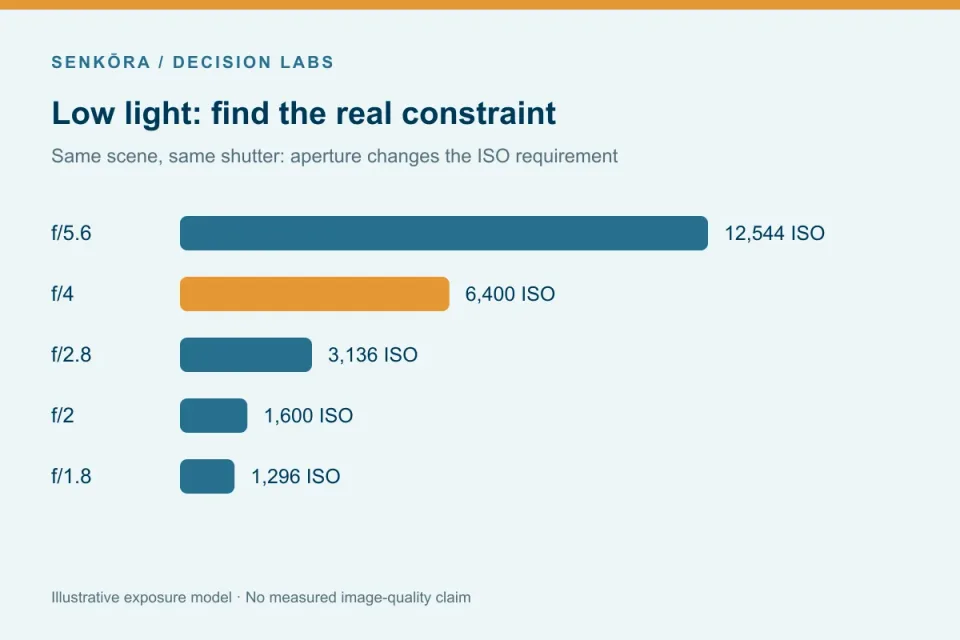
Assume a scene needs ISO 6400 at f/4 and 1/250 second. Keep the scene, shutter and composition fixed. The ideal exposure calculation is:
New ISO = baseline ISO × (new f-number ÷ baseline f-number)².
| Aperture | Relative light versus f/4 | Calculated ISO for the same shutter | Practical implication |
|---|---|---|---|
| f/5.6 | 0.51× | 12,544 | Less light; higher ISO requirement |
| f/4 | 1× | 6,400 | Our assumed baseline |
| f/2.8 | 2.04× | 3,136 | Roughly one stop more light |
| f/2 | 4× | 1,600 | Two stops more light |
| f/1.8 | 4.94× | 1,296 | About 2.30 stops more light |
These are mathematical targets, not selectable ISO settings or promised camera output. Your camera will use its supported steps, and actual lens transmission changes the result. Nothing here predicts how clean one body looks compared with another.
Three scenes, three different decisions
A still building at night: a stable surface or tripod can permit a longer exposure. Keep the existing camera if its files meet your output needs. A fast prime is optional rather than the first required purchase.
A child walking indoors: 1/250 second is a reasonable starting experiment, not a guarantee. Running or fast gestures can need a faster shutter. A bright lens can help maintain that shutter without pushing ISO as high, but the thinner depth of field requires accurate focus.
Several people around a table: opening fully may make the nearest face sharp and the others soft. Try more light or arrange people closer to the same focus plane before buying a lens specifically to use at its widest aperture.
Choose the change that fits your system
The Canon RF35mm F1.8 Macro IS STM is a documented RF-mount example of a bright prime. On Canon APS-C it gives a 56mm-equivalent angle of view, so it may be too tight for a whole room. Try 35mm on your current zoom to assess framing before purchasing. It is not a universal recommendation for Sony, Nikon, Fujifilm or an EF/EF-M camera.
The amaran Ace 25x is a portable-light option for a cooperative nearby subject. Its value is changing the scene rather than replacing the sensor. Output at your working distance, placement, diffusion and the subject’s willingness to be lit matter; this Lab assigns it no measured stop gain. A window or existing lamp may already be enough.
Keep your current camera if adjusting shutter, focus, position or light produces the intended result. Choose a compatible brighter lens if maintaining your shutter is the repeatable obstacle and the focal length fits. Consider a new body if controlled attempts reveal a specific focus, handling or output limitation that the proposed body demonstrably addresses.
Reproduce the model and check its limits
The downloadable table records every input and calculated result. For another baseline, substitute your f-number and ISO in the formula. For exposure gain in stops use 2 × log₂(old f-number ÷ new f-number). This compares aperture geometry, not complete systems at equivalent depth of field.
Canon’s lens-feature reference provides the underlying exposure and stabilization context. Product references were checked on October 4, 2026. No field-test result, retailer stock, price or cross-camera noise ranking is claimed.
Recommended gear
Find your next piece of gear
Find the setup that fits your plans, then explore prices and buying options on Amazon.
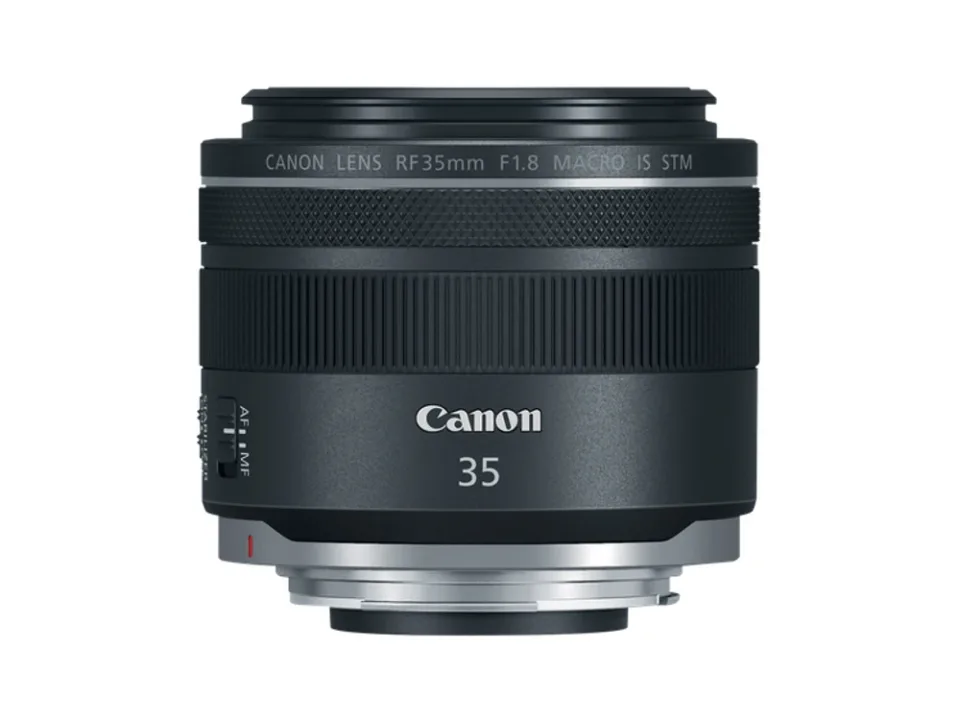
Photo: Canon. Resized for display.
Canon
Canon RF35mm F1.8 Macro IS STM
Best for: Canon RF users whose framing suits a bright 35mm prime
A bright RF prime for available-light people and travel details when its fixed framing fits your scene. 35mm gives a tighter 56mm-equivalent view on Canon APS-C; wider aperture reduces depth of field.
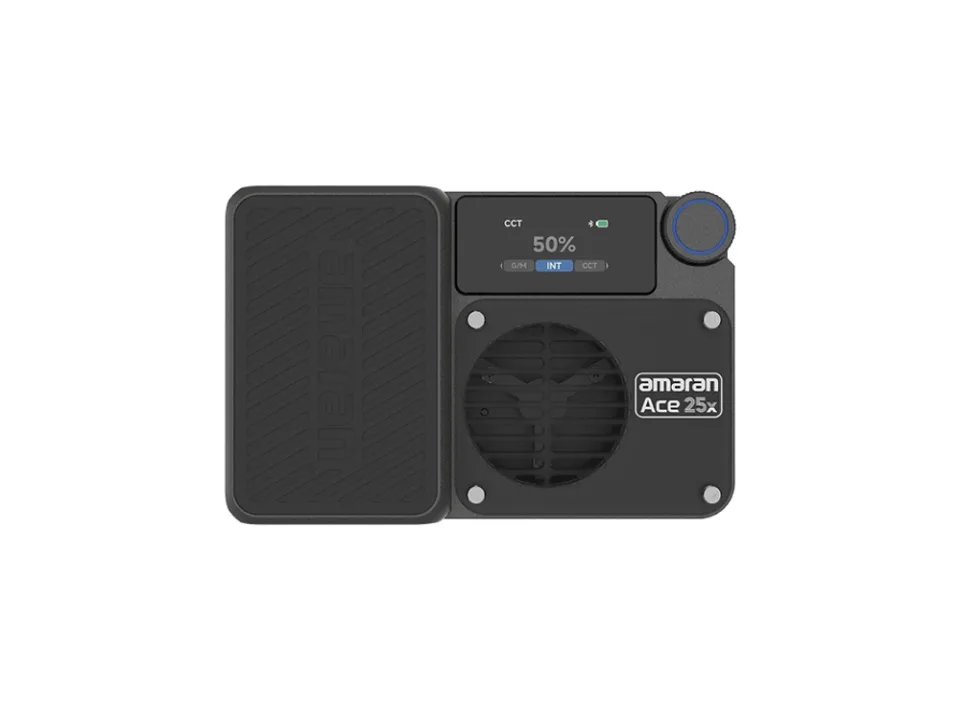
Photo: amaran. Resized for display.
amaran
amaran Ace 25x
Best for: Nearby cooperative subjects needing additional light
A small bi-color light for repeatable indoor spoken video when a window is not practical. This selection assumes a separate secure support, not a phone-mounted light. A secure separate support is required; no attachment to the phone or gimbal is assumed.
Transparent evidence
Method and limitations
We model relative exposure with the squared f-number ratio while holding scene luminance, shutter time and framing constant. The scenario baseline is ISO 6400 at f/4 and 1/250 second. It is an illustrative assumption, not a measured camera result.
- No camera, lens or light was physically evaluated for this article.
- The model omits lens transmission, vignetting, sensor response and processing differences.
- Starting shutter speeds are examples, not universal sharpness guarantees.
Five key takeaways
- Subject movement and camera shake need different solutions.
- At equal shutter speed, changing f/4 to f/2 provides two stops in the ideal aperture model.
- A wide aperture reduces depth of field and does not guarantee sharp faces.
- A fixed lens must fit both your camera mount and your working distance.
- A camera upgrade needs a documented capability gap, not just a high ISO number.
Frequently asked questions
Does stabilization freeze moving people?
No. Stabilization addresses camera movement. Subject motion requires a suitable shutter speed, flash or a change in the scene.
Will an f/1.8 lens make ISO 6400 look clean?
It can reduce the required ISO for the same scene and shutter speed, but it does not establish a noise score or guarantee sharp focus. Lens transmission and depth of field also matter.
Should I buy a new camera first?
Only after controlled attempts show that the body lacks a capability you need. Start by identifying the failure, checking settings and considering light or a compatible lens.
Primary sources
- usa.canon.com · Verified 2026-10-04
- usa.canon.com · Verified 2026-10-04
- amarancreators.com · Verified 2026-10-04