

Long reach with less weight to carry
Sony announced two full-frame E-mount primes on September 15, 2026: the FE 400mm F4.5 GM OSS and FE 600mm F6.3 GM OSS. Their headline is weight: approximately 994 g and 995 g, respectively, excluding the tripod mount. Sony plans October availability at US MSRPs of $2,699.99 and $3,699.99.
For wildlife walks and sports sidelines, that makes the purchase decision interesting. A lighter lens can reduce the burden of carrying and holding a camera for extended periods. But a prime commits you to one field of view. The established FE 200-600mm F5.6-6.3 G OSS can adjust framing as the distance changes.
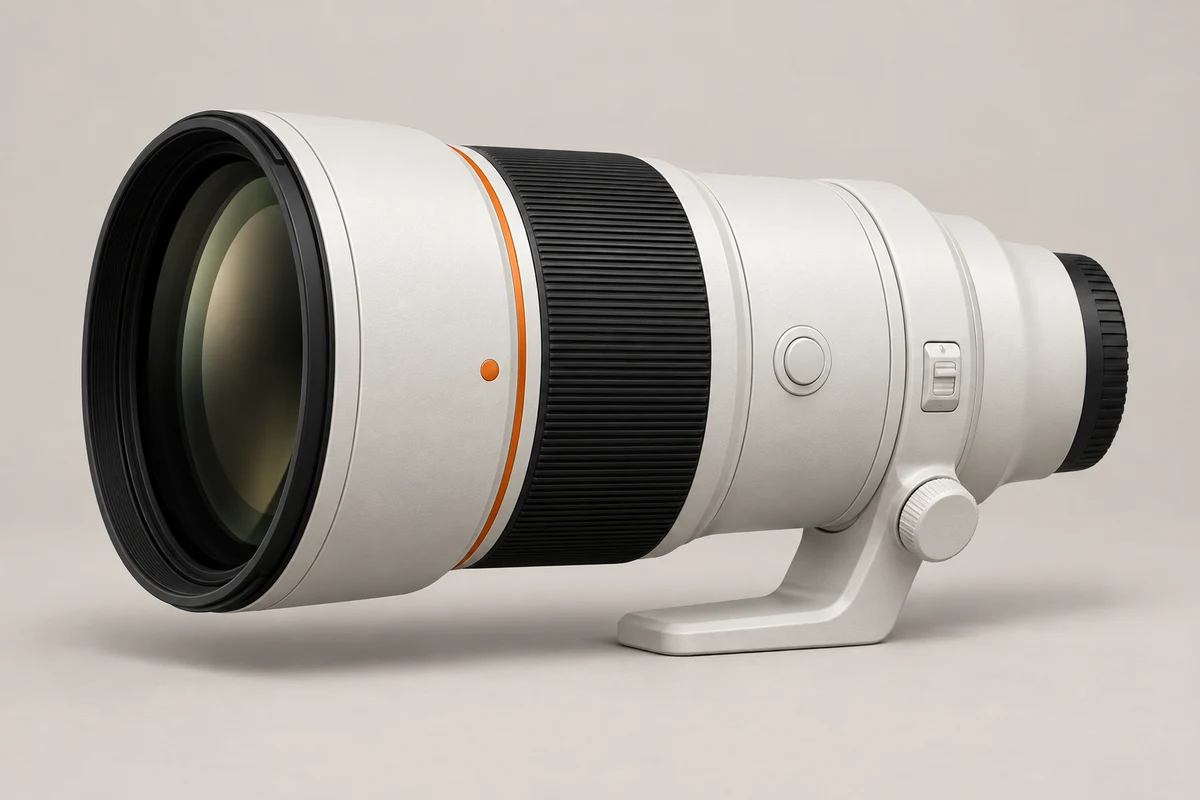
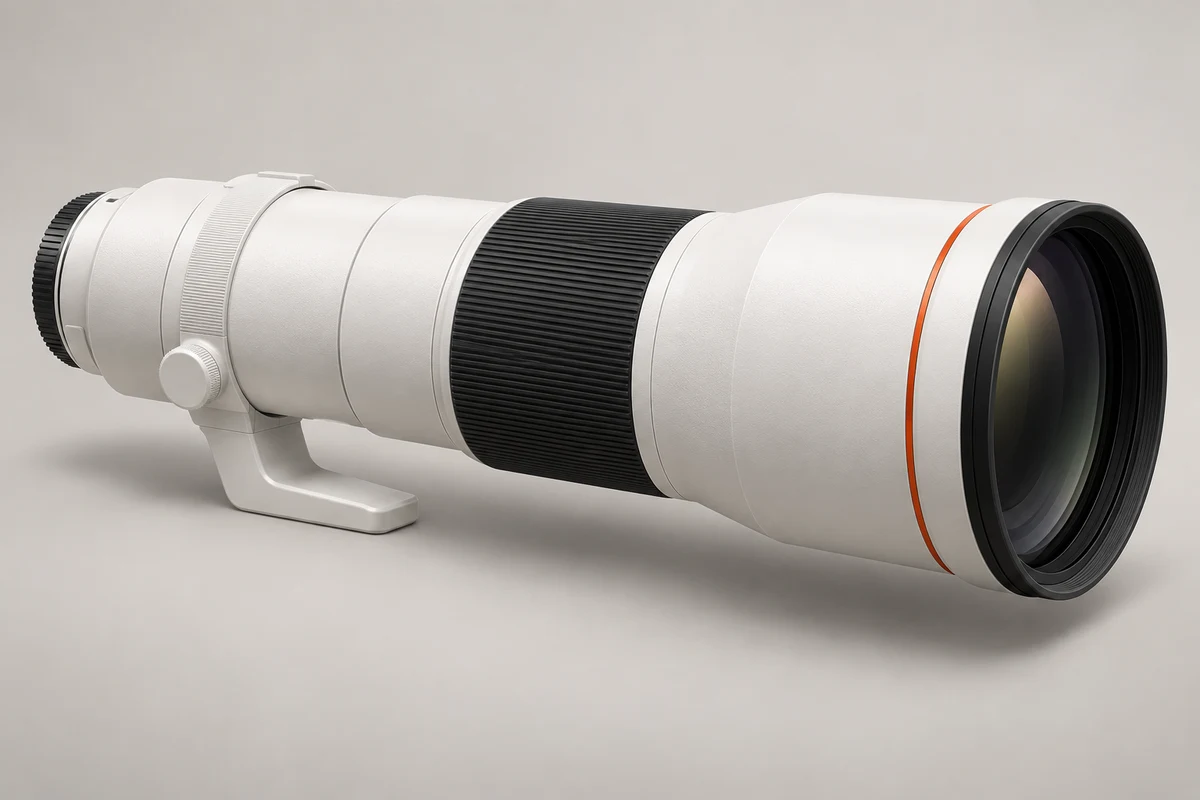
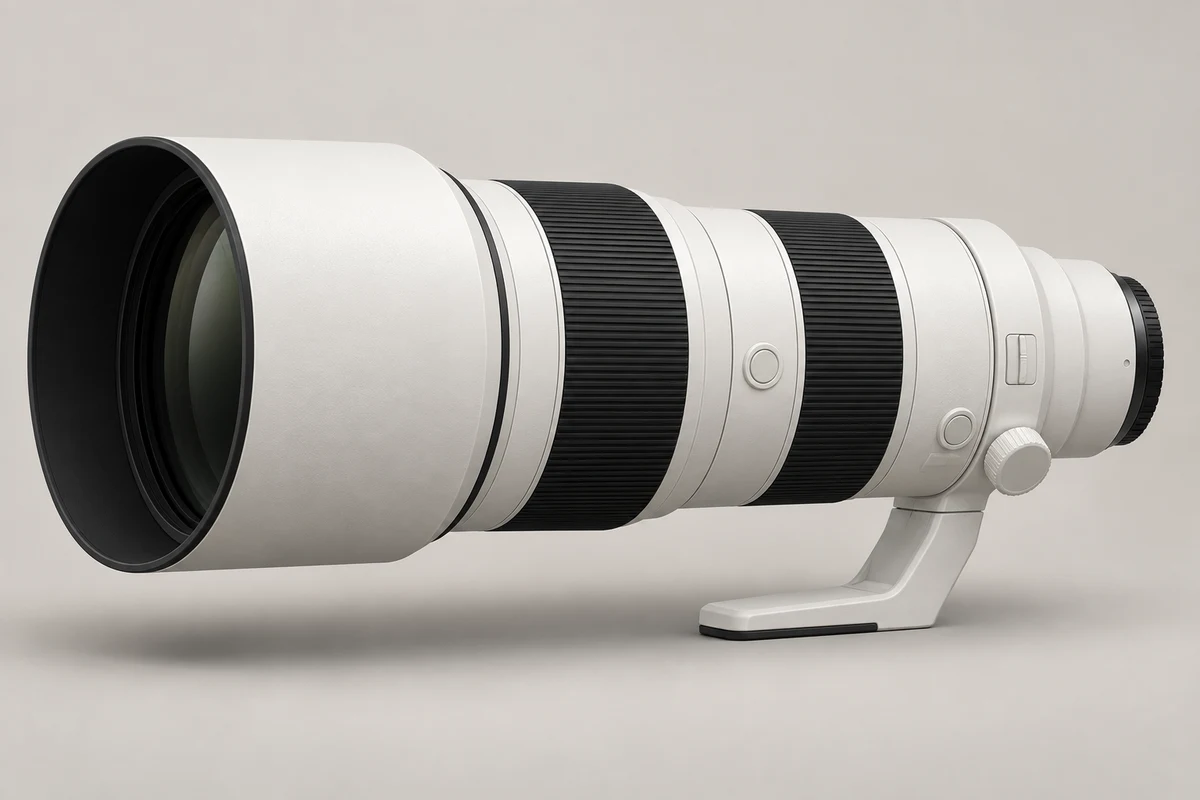
This is a specification-based first look, not a field test. The illustrations are AI-generated concepts with approximate hardware and proportions, not Sony product photographs or a scale comparison.
Sony 400mm vs. 600mm vs. 200-600mm
| Lens | Focal length | Maximum aperture | Stated weight, without tripod mount | US price reference |
|---|---|---|---|---|
| FE 400mm F4.5 GM OSS | 400mm fixed | f/4.5 | 994 g / 35.1 oz. | $2,699.99 announced MSRP |
| FE 600mm F6.3 GM OSS | 600mm fixed | f/6.3 | 995 g / 35.1 oz. | $3,699.99 announced MSRP |
| FE 200-600mm F5.6-6.3 G OSS | 200-600mm zoom | f/5.6-6.3 | 2,115 g / 74.6 oz., converted | $2,099.99 listed by Sony US on September 16 |
The zoom’s price is a dated Sony US store reference, not an Amazon offer or a guaranteed checkout amount. That page showed the zoom out of stock when checked. Retailer availability is unconfirmed for all three lenses here.
Each new prime removes roughly 1.12 kg, or 2.47 lb., compared with the zoom’s stated lens weight. That is a meaningful carrying difference, but a body, hood, support and accessories still add to the complete kit. The prime prices are $600 and $1,600 above that dated zoom reference.
Choose 400mm for aperture and a less restrictive view
The 400mm is the starting point for photographers whose subjects are large enough or close enough to fill the frame at that focal length. It offers more room around a moving bird or athlete than 600mm from the same position, making it easier to accommodate unpredictable movement without cutting off the subject.
An f/4.5 aperture admits approximately one stop more light than f/6.3, based on the f-number ratio. That can support a faster shutter speed or lower ISO in the same light. This compares the two primes at different focal lengths, however; it is not a measured advantage over the zoom at 400mm. We have not established the zoom’s exact maximum aperture at that intermediate setting.
Against an f/2.8 professional prime, f/4.5 is about 1.4 stops slower. Weight savings do not erase the exposure tradeoff under dim stadium lighting or at dawn. Optical stabilization helps with camera movement, but cannot freeze a running player or flapping wings.
Choose 600mm for distant wildlife
At the same shooting position, 600mm gives 1.5 times the focal length of 400mm. It suits small or distant subjects when approaching would be impractical or disturb the animal. Its almost identical stated weight makes it attractive for photographers who routinely need that tighter view.
The cost is a narrower view and an f/6.3 maximum aperture. Finding a bird in flight can be harder, and an approaching subject may quickly outgrow the frame. Compared with a 600mm f/4 lens, f/6.3 is approximately 1.3 stops slower.
Crucially, the new 600mm prime is not brighter than the 200-600mm zoom at 600mm: both are f/6.3. The documented benefit is lower weight. Any claims about better detail, bokeh or autofocus need comparable testing.
Keep the zoom in the comparison
The 200-600mm’s official specifications describe a substantially heavier lens, but one that covers a much wider range of situations. You can zoom out to find a moving subject, include its surroundings, or follow action toward the sideline without changing lenses or position.
For a photographer confined to one location, that flexibility may matter more than the weight saving. For a long hike with predictable distant subjects, the prime may be easier to justify. Neither decision requires assuming that a G Master badge guarantees better results in your particular use.
| Your main situation | Starting choice | Tradeoff to accept |
|---|---|---|
| Outdoor sports at a fairly predictable distance | 400mm F4.5 | Fixed framing; less reach than 600mm |
| Distant birds and long walks | 600mm F6.3 | Tight view and greater low-light demands |
| Animals or athletes moving toward you | 200-600mm zoom | Heavier carrying and handheld load |
| Existing 200-600mm owner happy with the weight | Keep evaluating before replacing it | A prime gives up rapid reframing |
Shared features and the limits of Sony’s claims
According to Sony’s launch announcement, both new lenses have three Super ED elements and one ED element, two XD linear motors, optical stabilization, an 11-blade diaphragm and four focus-hold buttons. Dust and moisture resistance does not mean waterproof construction.
Sony also states compatibility with Alpha 9 III bursts up to 120 fps under its test conditions. That is not a promise that every camera setting, subject or shooting situation will maintain that rate, or that every frame will be in focus.
The company’s lightest-in-class claim is specifically dated to its September 2026 survey. For the 400mm, it concerns full-frame interchangeable super-telephoto lenses that include 400mm and have a maximum aperture of f/4.5 or faster. For the 600mm, the corresponding category includes 600mm and f/6.3 or faster. These are Sony-defined categories, not an independently established claim about every telephoto lens.
Teleconverters: more reach, less light
Sony lists compatibility with the SEL14TC 1.4x and SEL20TC 2x converters. The following combinations follow from multiplying focal length and f-number; effective apertures are rounded to common photographic values.
| Base lens | With 1.4x | With 2x |
|---|---|---|
| 400mm f/4.5 | 560mm f/6.3 | 800mm f/9 |
| 600mm f/6.3 | 840mm f/9 | 1,200mm f/13 |
A converter adds cost and weight, and makes light, shutter speed, atmospheric conditions and focus accuracy more consequential. Compatibility is not proof of unchanged autofocus or image quality. Check support for your exact body and firmware before buying.
What to check before ordering
The new primes make the clearest case for photographers who already know which focal length they use most and want to reduce carrying weight. The 400mm favors aperture and a wider view; the 600mm favors native reach; the zoom favors adaptability.
Before spending, compare the full kit, your normal shooting distances and the light you work in. Wait for independent performance comparisons if sharpness, tracking accuracy or stabilization is the deciding factor. Our bird-photography lens guide and lightweight wildlife lens guide provide broader selection criteria.
The three product cards use clearly labeled Amazon.com search links because exact US ASINs have not been confirmed. Check the model name, aperture, seller, bundle, warranty and shipping estimate. An October launch announcement or a search result is not confirmation that the exact lens is in stock.
Recommended gear
Explore the products in this guide
Review the key fit for each recommendation, then confirm the current offer and seller details directly on Amazon.
Sony
Sony FE 400mm F4.5 GM OSS
Best for: Outdoor sports and wildlife at predictable distances
A lighter fixed 400mm option with an f/4.5 aperture. October availability is announced; no exact Amazon US listing or inventory is confirmed.
Sony
Sony FE 600mm F6.3 GM OSS
Best for: Distant birds and wildlife when carrying weight matters
Long native reach at a stated 995 g without the tripod mount. Check the F6.3 model carefully; search results may include Sony's different 600mm F4.
Sony
Sony FE 200-600mm F5.6-6.3 G OSS
Best for: Changing subject distances and flexible framing
The zoom covers both focal lengths and can widen to 200mm. It weighs more, and retailer stock must be checked. No exact Amazon US ASIN is confirmed here.
Transparent evidence
Method and limitations
Documentary comparison of Sony's September 15 announcement, official US product pages and Sony's 200-600mm specifications, checked September 16, 2026. Aperture and focal-length comparisons are calculations, not optical measurements.
- Senkōra has not measured optical quality, autofocus, stabilization or handling of the new lenses.
- Launch timing and Sony-listed prices are manufacturer information, not Amazon offers or stock guarantees.
- Images are AI-generated conceptual illustrations, not exact product photographs or scale drawings.
Five key takeaways
- Both new primes weigh less than 1kg without the tripod mount, not as complete camera setups.
- The 400mm favors a brighter aperture; the 600mm delivers 1.5x the focal length at almost the same lens weight.
- The 200-600mm zoom can reframe quickly, but its stated 2,115 g weight is more than double either prime's.
- Sony's 120 fps compatibility and lightest-in-class language are qualified manufacturer claims.
- Three Amazon.com search links use the approved US tag; none represents a verified exact listing.
Frequently asked questions
When do Sony's 400mm F4.5 and 600mm F6.3 GM lenses ship in the US?
Sony announces October 2026 availability, without a specific day in the launch release. US MSRPs are $2,699.99 and $3,699.99 respectively. This does not confirm retailer stock or delivery.
Is the 600mm F6.3 brighter than the Sony 200-600mm at 600mm?
No. Both reach f/6.3 at 600mm. The prime's documented advantage is substantially lower weight, not a wider maximum aperture at that focal length.
Are the new Sony GM primes waterproof?
No. Sony describes dust and moisture resistance but says they are not completely sealed against dust or water droplets.
Can both primes use Sony teleconverters?
Yes. Sony lists SEL14TC and SEL20TC compatibility. A 1.4x converter costs one stop of light, and a 2x costs two stops; check camera compatibility and practical autofocus performance.
Primary sources
- alphauniverse.com · Verified 2026-09-16
- electronics.sony.com · Verified 2026-09-16
- electronics.sony.com · Verified 2026-09-16
- electronics.sony.com · Verified 2026-09-16
- sony.com.au · Verified 2026-09-16